From Al-tieob to Artificial Intelligence: A Continuing Libyan Cultural Experiment
Souad Khalil | Libya
From Text to Image: When Artificial Intelligence Expands Its Role in the Newsroom
If the first part of this experience stopped at the use of artificial intelligence in news reporting, articles, interviews, biographies, and book and magazine reviews, the experiment does not stop at the boundaries of text. Contemporary cultural content is no longer built through words alone; images, visual elements, and multimedia presentation have become essential parts of the way an idea reaches the reader.
From here, Al-tieob experience moved into another area of artificial intelligence, one concerned with image production, visual treatment, and transforming an editorial idea into content that can combine text, image, and information. This transition was not simply a search for a means of giving published material an aesthetic dimension. Rather, it formed part of a broader question: How can a cultural institution re-present its content within a digital space where the ways of reading, viewing, and receiving information are constantly changing?
In this second part, we look more closely at the visual dimension of Al-tieob experience, before moving on to the impact of artificial intelligence on the creation of multimedia content and the reorganization of editorial work, ultimately reaching a more important question: What can artificial intelligence offer a cultural institution, and what should remain the responsibility of human beings?
Here, the issue is no longer simply connected to the machine’s ability to produce an image or a text, but rather to how this ability can be employed within an editorial and cultural identity that has its own history, memory, and vision.
If the first part of this experience stopped at the use of artificial intelligence in news reporting, articles, interviews, biographies, and book and magazine reviews, the experiment does not stop at the boundaries of text. Contemporary cultural content is no longer built through words alone; images, visual elements, and multimedia presentation have become essential parts of the way an idea reaches the reader.
From here, Al-tieob experience moved into another area of artificial intelligence, one concerned with image production, visual treatment, and transforming an editorial not simply a search for a means of giving published material an aesthetic dimension. Rather, it formed part of a broader question: How can a cultural institution re-present its content within a digital space where the ways of reading, viewing, and receiving information are constantly changing?
In this second part, we look more closely at the visual dimension of Al-tieob experience, before moving on to the impact of artificial intelligence on the creation of multimedia content and the reorganization of editorial work, ultimately reaching a more important question: What can artificial intelligence offer a cultural institution, and what should remain the responsibility of human beings?
Here, the issue is no longer simply connected to the machine’s ability to produce an image or a text, but rather to how this ability can be employed within an editorial and cultural identity that has its own history, memory, and vision..
The Image Enters the Experiment
If the use of artificial intelligence in texts represents a fundamental aspect of Al-tieob experience, the generation of images and illustrated posts represents another dimension of that experience.
Digital cultural work today no longer depends on text alone. The image has become part of the way material is presented, particularly on social media platforms. Al-Tayeb has benefited from image-generation tools to produce visual materials accompanying articles, features, and news stories, as well as to design illustrated posts and create artistic concepts related to the content.
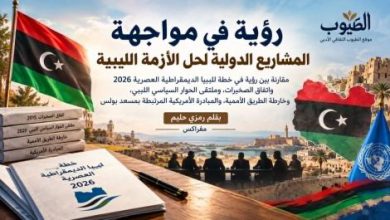
The two images accompanying this article provide a clear example of this approach.
The first is an infographic addressing a political and historical subject concerning Libya’s constitutional process, while the second offers a visual treatment of a topic concerning international projects related to the Libyan crisis, combining maps and symbolic elements with books, the Libyan city, and international institutions.
The importance here does not lie merely in the image being an “AI-generated image,” but in the ability to transform an abstract editorial idea into a visual treatment suitable for publication.
From the Traditional Image to Multimedia Content
This transition leads to a broader concept:
Multimedia Content.
A journalistic piece no longer ends with the writing of an article or news story.
The same material can be transformed into:
News → Headline → Introduction → Summary → Social Media Post → Image → Infographic → Visual Content.
This allows the website to present the same idea in different forms, according to the nature of the platform and its audience.
For a cultural website, this transition is important, because writers, poets, critics, and researchers no longer reach readers in the same way they did twenty years ago when they addressed an Internet audience.
What Has Artificial Intelligence Changed at Al-tieob?
After this experience, it can be said that artificial intelligence has changed the way Al-Tieob works more than it has changed the identity of the website.
The identity has remained the same: Libyan and Arab literature and culture, with an interest in writers, books, art, and thought. But the way material is accessed and processed has become faster and more diverse. The editor can now approach a text from more than one perspective and move quickly from writing to summarization, from analysis to design, and from news reporting to illustrated posts.
This saves time that can be directed toward what matters more: selection, verification, editing, and decision-making.
Artificial Intelligence Does Not Know Al-tieob
Perhaps this is one of the most important conclusions of the experiment.
Artificial intelligence may possess an enormous capacity to process language, but it does not necessarily possess detailed knowledge of the history of a Libyan cultural website or its editorial context. It does not know by itself what it means for a news story to be appropriate for Al-tieob. Nor does it necessarily know the difference between one Libyan cultural institution and another, between one writer and another, or the significance of a local cultural event that receives little visibility online.
This knowledge has accumulated within the website over more than a quarter of a century. Therefore, local editorial expertise is what gives the technology its value, rather than the other way around.
Prompt Engineering: A New Skill for the Editor
The experiment has also generated a new skill that has become part of working with artificial intelligence: Prompt Engineering—the ability to formulate precise instructions in order to obtain an appropriate result.
The difference between a general instruction such as “write a news story” and instructions specifying the nature of the website, the audience, the inverted-pyramid structure, the length of the introduction, the headline, and the information that must be preserved can be very significant.
Over time, prompts themselves become part of the editor’s professional expertise.
In this sense, editors no longer need only to know journalistic writing. They also need to know how to communicate with intelligent tools, direct them, and review their results.
What Should Artificial Intelligence Not Do?
Perhaps defining the limits is more important than listing the uses.
Artificial intelligence can write, summarize, analyze, suggest, and design. But this does not mean that it should take over everything. There are tasks that remain fundamentally human:
Selecting what deserves publication.
Verifying information.
Assessing the significance of an event.
Understanding the Libyan context.
Judging the literary and intellectual value of a text.
Taking responsibility for publication.
These boundaries are what make the use of artificial intelligence a professional tool rather than a substitute for the profession.
The Al-tieob Experiment Is Not an Experiment with “the Machine That Writes”
After 2025 and 2026, the issue for Al-tieob is no longer to prove that artificial intelligence can write.
That has become clear.
The more important question is how a cultural institution can use this capability without losing its editorial identity. For this reason, the experiment can be described as a transition from the concept of “artificial intelligence that writes” to a more mature concept: “artificial intelligence that helps the editorial team work.”
This is a significant difference.
A machine may produce ten versions of a headline, but the editor chooses the headline that suits Al-tieob. It may produce a summary of a long article, but the editor decides whether the summary faithfully represents the writer’s idea. It may suggest an analysis of an opinion piece, but the final decision regarding publication remains an editorial decision. It may generate dozens of visual concepts, but it is the human being who determines which image serves the material rather than distracts from it.
From 2000 to 2026: Technology Changes, the Mission Continues
When Al-tieob experience is viewed from a longer historical perspective, it appears to be another chapter in a story that began more than a quarter of a century ago.
In 2000, the question was:
How can Libyan culture reach the Internet?
Then it became:
How can the website reach the reader?
Later:
How can we produce content quickly and present it on new platforms?
Today, the question has become:
How can we benefit from artificial intelligence in producing cultural content without allowing technology to become a substitute for the human being?
This is a question whose answer will not remain fixed, because artificial intelligence itself changes every day.
An Ongoing Experiment, Not a Completed Project
After nearly two years of intensive use, Al-tieob does not claim that its experiment has reached its conclusion.
On the contrary, the experiment may have only just begun.
The tools are evolving, models are becoming more capable, and the ways of working with them are changing. What once required a great deal of time can now be accomplished within minutes.
But the real challenge does not lie in the speed of the tools. It lies in building a professional culture for using them. This means that Al-tieob experience with artificial intelligence is not merely a technological experiment, but an editorial and cultural one as well.
Al-tieob Faces a New Chapter
Since 2000, Al-Tieob has sought to remain present in the transformations affecting the relationship between culture and technology.
Today, more than 25 years later, the website finds itself facing one of the greatest transformations that the content industry has experienced since the emergence of the Internet itself.
Artificial intelligence has entered the details of Al-Tieob’s daily work: drafting and editing news stories, condensing articles and features, preparing and editing interviews, writing biographies, reviewing books and magazines, analyzing opinion pieces, screening materials before publication, and generating images and illustrated posts.
Throughout 2025 and up to the present, the presence of artificial intelligence in the drafting and editing of news has become an established part of the website’s experience, while its applications have expanded into other areas of editorial work and visual production.
But ultimately, artificial intelligence has not become “the writer of Al-Tieob.” It has become one of the tools in its newsroom.
And perhaps this is the most important conclusion of the experience.
Technology does not give an institution its identity; the institution determines how it uses technology.
Al-Tieob, which was among the early cultural websites to emerge from within Libya into cyberspace in 2000, is now undertaking a new experiment in the age of artificial intelligence, while preserving the same idea that has accompanied it since the beginning: to keep Libyan culture present in every new space opened by technology.
Click here for Part-1
___________
 Souad Khalil, hailing from Benghazi Libya, is a writer, poet, and translator. She has been writing on culture, literature and other general topics.