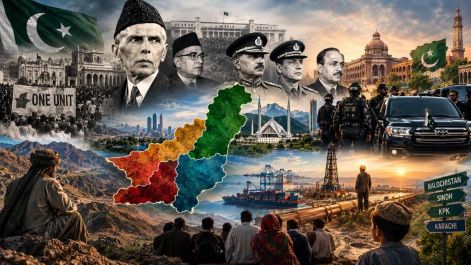
People from Punjab suffered alongside other Pakistanis, but the mistakes of the dominant Punjabi establishment during One-Unit created a perception of exploitation of smaller provinces’ resources
Ambassador M. Alam Brohi
Pakistan has been facing one crisis after the other since its birth. It lost its founder, Muhammad Ali Jinnah within months; its first Prime Minister, Liaquat Ali Khan, was assassinated in October 1951; the Governor General Ghulam Muhammad Malik dissolved the first Constituent Assembly in October 1954; the creation of the One-Unit of West Pakistan was announced in November 1954 and implemented in 1955. The One-Unit scheme amalgamated all the federal units into Punjab and made West Pakistan with Lahore as its capital to counterbalance the majority population of East Pakistan; the Constitution, enforced after a delay of nine years on 23 March 1956, was abrogated by the duo of Iskander Mirza, and General Muhammad Ayub Khan imposing Martial Law in October 1958.
The quasi parliamentary form of governance, and the electoral system of adult suffrage were wrapped up. An all-powerful Presidential form of governance, and a new indirect electoral system were enforced in the country. The President was to be indirectly elected by 80,000 Basic Democrats, divided equally between the eastern and western wings of the country. General Ayub Khan ruled the country as an autocrat for over a decade. There were no institutional check and balance in his rule.
Muhtarma Fatima Jinnah, backed by the combined opposition, challenged General Ayub Khan in his bid for a second term in January 1965. She outvoted him in East Pakistan, but the landed aristocracy in West Pakistan, betraying her, voted en mass for the General. These elections, highly controversial, highly damaged his credibility as the leader of the country. He succumbed to the agitational protests of the Democratic Action Committee (DAC), and handed over power to his Chief of Army Staff General Agha Muhammad Yahya Khan in contravention of the 1962 Constitution. General Yahya miserably failed to manage the state affairs after the general elections of 1970, and the country lost its bigger wing.
Punjab, with its overwhelming majority in the bureaucracy of the country, both civil and military, political, economic and administrative institutions including the executive, judiciary and legislature, public enterprises, corporations, and state’s senior posts became, by default, the focus of anger over the injustices meted out to the people of East Bengal and the small provinces of Sindh, NWFP and Balochistan by federal authorities.
The scholars of Pakistan affairs generally agree on One-Unit being the main cause for our failure in nation building. General Ayub Khan, in his ‘Friends – Not Master’ claimed that he conceived the idea of One-Unit in one of his stays in London to counter the majority of the East Pakistan. He might have taken some of the politicians on board for its implementation. Once the scheme was announced in November 1954, the provinces of Sindh and NWFP put up a tough resistance to it. Balochistan had been reduced to a Commisionerate after its forcible annexation. In Sindh, the federal government had to dismiss Abdul Sattar Pirzada’s Ministry, and bring back the so called iron-man of Sindh – Muhammad Ayub Khan – as the chief executive of the province to have the resolution of One-Unit passed by the Sindh Assembly passed.
He bulldozed the resolution for adoption by a half empty House with the Speaker and over two dozens of defiant members locked up in government rest houses in Hyderabad and Tharparkar. The people of Sindh passed a very harsh judgment on him branding him as traitor of Sindh. This sobriquet haunted him during his remaining years of life destroying his political and electoral career. He met a crushing defeat in general elections of 1970 in his constituency in Larkana. Dr. Khan Sahib was made the first Chief Minister of West Pakistan (1955-1957) to mollify the former NWFP.
The Punjab leadership was very enthusiastic about the One-Unit scheme. All the executive powers of West Pakistan government were concentrated in Lahore. The Punjab establishment was ruling the roost. The politics of permits and licenses was galore. From 1951-1958, a bevy of Prime Ministers was appointed and dismissed. Later, like General Ayub Khan, his Governors – Malik Amir Muhammad Khan in West Pakistan, and Abdul Monem Khan in East Pakistan were autocrats, and ruled with an iron fist.
Punjab, with its overwhelming majority in the bureaucracy of the country, both civil and military, political, economic and administrative institutions including the executive, judiciary and legislature, public enterprises, corporations, and state’s senior posts became, by default, the focus of anger over the injustices meted out to the people of East Bengal and the small provinces of Sindh, NWFP and Balochistan by federal authorities.
The One-Unit added up to the exploitation of the natural resources of East Pakistan, and gas and oil, coal, gold and copper extracted from Sindh, Balochistan and NWFP. The natural gas discovered at Sui was piped to all big cities of West Pakistan except for Quetta and other towns of Balochistan. The bigger share of jobs in West Pakistan went to Punjab. Favoritism was rampant. The government departments in any part of West Pakistan manned by senior officers from Punjab used to have the overwhelming majority of the officials from their home province. Even the Municipal Committees in Sindh had engineers, health and sanitary Inspectors from Punjab. They left after the abolition of the One-Unit.
The schools, offices from division to tehsil, courts, and other public institutions had the overwhelming majority of employees from Punjab. Our middle school in Gandakha a village of Tehsil Usta Muhammad in Balochistan back in 1960s had five teachers including the headmaster from Punjab, two from Sindh, and one from Balochistan. The Bengali officers from the former Civil Service of Pakistan were appointed to side posts in West Pakistan while the CSPs from West Pakistan enjoyed prize postings in East Pakistan.
G.M. Syed has provided a comprehensive list of Officers from the CSP and PSP groups posted in Sindh during the One-Unit in his book The Case of Sindh, which speaks volumes about the observance of merit or the principles of justice and fair play in the federal administrative affairs. The common people from Punjab have suffered as much as their fellow Pakistanis from Sindh, Balochistan and NWFP. However, the mistakes rather blunders made by the dominant Punjab establishment throughout One-Unit created the impression of exploitation of the resources of the small provinces by it, and was further strengthened by its arrogant handling of the federal political, economic and financial, administrative and constitutional matters. In the united Pakistan, the economic and financial resources were divided between the East and West Pakistan on parity basis which was a political gimmick, and the Bengalis had, willy-nilly, accepted it for the sake of Pakistan. They demanded division of the resources from the federal pool on the basis of population.
Read: Zardari, Sindh and the Battle over New Provinces
________________
 The writer is a former member of the Foreign Service of Pakistan and has served as Ambassador for two terms. He is the author of five books.
First published in The Friday Times Lahore