Is the World Entering a New Era of High Inflation and Expensive Money?
By: Ramesh Raja
The world entered 2026 expecting inflation to continue its gradual decline. By September, that optimism has become less certain. A combination of war, energy disruption, supply shortages and persistent price pressures is forcing central banks to reconsider the return of cheap money.
The immediate trigger is energy. On 17 September 2026, Brent crude was around $104.59 a barrel and US West Texas Intermediate around $101.29, despite falling prices that day as Saudi Arabia increased crude shipments to Asian refiners through Oman.
The International Energy Agency (IEA) warned on 11 September that global oil supply in 2026 could decline by 5.7 million barrels per day, about 6%, because of continuing Middle East and Gulf disruptions. Saudi production had fallen to about 6 million barrels per day, its lowest level in more than 30 years.
This energy shock is moving directly into inflation.
The IMF’s July 8 World Economic Outlook projected global growth of 3.0% in 2026 and 3.4% in 2027, but raised its 2026 global headline-inflation forecast to 4.7%, saying the global disinflation process that had begun in early 2024 had stalled.
The OECD, in its 3 June 2026 Economic Outlook, projected G20 inflation rising from 3.4% in 2025 to 4.0% in 2026, before easing to 3.1% in 2027 if the energy disruption remains limited. But under its prolonged-disruption scenario, global growth could fall to only 2.1% in 2026 and 1.8% in 2027, while global financial conditions become considerably tighter.
The United States has already responded.
On 16 September, the US Federal Reserve raised its benchmark rate by 0.25 percentage point to 3.75%-4.00%, the first increase since 2023. Fed policymakers projected another increase before the end of 2026, while raising their 2026 inflation projection to 3.7%, still well above the Fed’s 2% target.
The bond market is also signalling expensive money. On September 16, Germany’s 10-year Bund yield was around 3.50%, after reaching 3.5723%, its highest since June 2009, while the US 10-year Treasury yield approached 5%, its highest level since 2007.
India is feeling the pressure too. On 14 September, August retail inflation rose to 4.82%, from 4.45% in July, while core inflation increased to 4.2%. India’s wholesale inflation rose even more sharply, reaching 9.92%, with fuel and power prices up 22.93% year-on-year.
For Pakistan, the impact is immediate. On 14 September, the State Bank kept its policy rate at 11.5%. August headline inflation had risen to 11.1%, from 9.2% in July. The SBP specifically cited higher global commodity prices and supply-chain disruption.
From 17 September, Pakistan’s petrol price increased to Rs391.22 per liter and high-speed diesel to Rs421.45, following increases of Rs6.88 and Rs5.62 respectively.
This illustrates the larger problem. Higher oil prices raise transportation, agriculture and manufacturing costs. Higher inflation discourages central banks from cutting rates. Higher rates make mortgages, business loans, infrastructure financing and government debt more expensive.
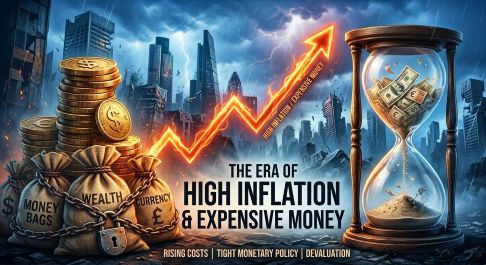
The danger is therefore not necessarily a return to the extreme inflation of the 1970s. It may be something subtler: a world in which inflation remains structurally higher and money remains expensive for longer.
The IMF still sees global growth continuing, while the OECD says renewable energy, lower energy intensity and resilient supply chains provide some protection.
But the September 2026 message is clear: the age of ultra-cheap money cannot be taken for granted. The decisive variables will be the duration of the Middle East energy disruption, oil and gas prices, global trade routes, government debt, productivity and the ability of central banks to bring inflation down without pushing economies into recession.
For ordinary people, the question is ultimately simple: will wages, savings and investment returns rise faster than the cost of living and the price of borrowing?
That may be one of the defining economic questions of the remainder of this decade.
Read: AI: Humanity’s Greatest Promise or Peril?
______________
 The author of this article, Engr. Ramesh Raja, is a Civil Engineer, visionary planner, PMP certified and literary enthusiast with a passion for art and recreation. He can be reached at engineer.raja@gmail.com