Recovering the Sanskrit Record
Why Sindh Needs a Systematic Program for Reconstructing Its Ancient History

Sindh’s ancient history is too important to remain fragmented among isolated chapters, scattered manuscripts and specialized academic traditions.
A sustained Sanskrit-Sindh research initiative could open an important new field of historical inquiry and connect Sindh’s archaeological heritage with the wider intellectual history of South Asia.
By: Ramesh Raja
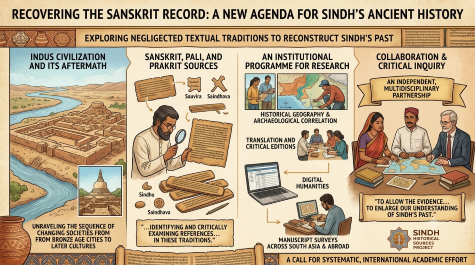
Sindh occupies an exceptional position in the history of South Asia. The lower Indus region was a major center of the Indus Civilization, while later centuries witnessed the interaction of Brahmanical, Buddhist, Jain, Iranian, Central Asian and Islamic traditions. Yet the reconstruction of Sindh’s history remains uneven because the surviving evidence is dispersed across archaeological remains, inscriptions, Arabic and Persian chronicles, local Sindhi traditions, and textual traditions preserved in several classical languages. Among the most important and comparatively underused bodies of evidence are Sanskrit, Pali and Prakrit sources. This article argues for the establishment of a systematic, multidisciplinary research program to identify and critically examine references to Sindh in these traditions. Such a program should combine philology, archaeology, historical geography, manuscript studies and digital humanities and should involve institutions in Pakistan and abroad.
Sindh and the problem of historical continuity
The antiquity of Sindh requires little exaggeration. The archaeological record places major urban settlements of the Indus Civilization within present-day Sindh. Mohenjo-daro, on the right bank of the Indus, represents one of the principal urban centers of the civilization and dates to the third millennium BCE. UNESCO describes it as an exceptionally preserved urban settlement and an important testimony to the Indus Civilization.
It is therefore appropriate to regard the ancient Indus world as an essential component of the historical heritage of present-day Pakistan, particularly Sindh. However, a scholarly distinction is necessary: the Indus Civilization cannot simply be equated with the modern state of Pakistan. Its archaeological distribution extended beyond the borders of present-day Pakistan, and the modern political entity of Pakistan was created in 1947. The continuity that can legitimately be investigated is therefore geographical, cultural and historical—not a simple equation between an ancient civilization and a modern nation-state.
This distinction actually makes the research question more interesting. What happened in the lower Indus region after the decline of the urban centers? Which communities occupied the region? What languages were used? What political formations emerged? How did religious traditions develop? How were Sindh’s cities, rivers and peoples described by neighboring civilizations? These questions cannot be answered from archaeology alone.
The neglected Sanskrit dimension
The word Sindhu itself demonstrates the antiquity of the region’s place in the textual geography of South Asia. Christopher Shackle’s Encyclopedia Iranica study of Sindhi notes that the name Sindh derives from Sindhu, “Indus,” and places Sindhi within the Indo-Aryan linguistic family.
A systematic investigation should examine Sanskrit epic literature, Puranas, geographical traditions, Buddhist Sanskrit literature, Jain Sanskrit texts, grammatical works, political literature, inscriptions and later commentarial traditions. These sources may preserve information about geographical regions, rivers, routes, settlements, political authorities, religious centers and cultural contacts connected with the lower Indus.
Historical scholarship must distinguish between a textual reference to Sindhu, a reference to a geographical region corresponding to Sindh, and a reference to a particular historical settlement or political entity. Identifying these references requires philological and historical analysis rather than simply collecting every occurrence of the word “Sindhu.”
The importance of Buddhist and Jain sources
The proposed investigation should not be restricted to Brahmanical Sanskrit. Sindh’s historical connections with Buddhism and Jainism make Buddhist Sanskrit, Pali and Jain textual traditions equally significant.
Mohenjo-daro itself contains evidence of a later Buddhist presence: UNESCO records a Buddhist stupa constructed over the earlier ruins in approximately the second century CE.
This does not establish a direct continuity between the Bronze Age inhabitants and later Buddhist communities, but it demonstrates that the same landscape acquired new religious meanings over subsequent centuries.
The history of Sindh therefore needs to be approached as a sequence of changing societies rather than as an uninterrupted cultural narrative. Sanskrit, Pali and Prakrit sources can potentially illuminate some of those transitions.
The Arabic-Persian record is not enough by itself
Sindh has benefited from considerable scholarship based on Arabic and Persian materials. Recent manuscript research, for example, has demonstrated the importance of Arabic and Sindhi manuscript collections held in institutions across Sindh and has identified their potential for intellectual, legal and Indian Ocean history.
Yet the existence of substantial Arabic and Persian documentation should not lead researchers to neglect earlier or parallel Indic traditions.
Indeed, the medieval scholar Abū Rayḥān al-Bīrūnī provides an important historical precedent. His engagement with Sanskrit was sufficiently extensive to allow him to translate and interpret Indian intellectual works. Modern scholarship has reconstructed aspects of his Sanskrit sources and methods, demonstrating how Arabic and Sanskrit textual traditions can be studied together.
From individual scholarship to an institutional project
The Government of Sindh should consider establishing a Sindh Historical Sources Project, preferably in collaboration with universities and manuscript institutions in Pakistan and abroad.
Its program could have at least six components:
- A Sanskrit-Sindh bibliographic survey identifying every known Sanskrit reference to Sindh, Sindhu, Sauvira, Saindhava and related geographical or political terms.
- A manuscript survey covering libraries, archives, monasteries, temples, Jain institutions and university collections in South Asia and elsewhere.
- Translation and critical editions of relevant Sanskrit, Pali and Prakrit passages into Sindhi, Urdu and English.
- Historical geography, using GIS to compare ancient place names with rivers, archaeological sites and historical settlements.
- Archaeological correlation, testing textual claims against material evidence rather than treating literary traditions as automatically historical.
- A digital open-access database containing manuscripts, references, translations, dates, bibliographical information and scholarly commentary.
Such a program should also involve departments of Sanskrit and classical languages. Pakistan already possesses relevant academic capacity. The existence of Sanskrit scholarship at institutions such as the University of the Punjab demonstrates that the necessary expertise can be developed institutionally rather than treated as an impossible undertaking.
International academic collaboration
Sindh should also become a legitimate subject of specialized research in Indian and international universities. The Government of Sindh, the Sindhi Adabi Board, the Sindhi Language Authority and universities in Sindh could establish competitive fellowships for doctoral and postdoctoral research on Sindh using Sanskrit, Pali, Prakrit, Bengali and other relevant languages.
The purpose should not be to produce a predetermined historical narrative. On the contrary, the value of international collaboration lies precisely in independent critical examination.
A Sanskrit scholar from India, a historian from Sindh, an archaeologist from Pakistan, a manuscript specialist from Europe and a historical linguist from another institution may approach the same source differently. Bringing those perspectives together can produce stronger scholarship.
A new research agenda for Sindh
The history of Sindh should not be confined to the sources that modern researchers happen to read most easily. Its historical archive is multilingual and geographically dispersed. Arabic and Persian sources are indispensable, but they constitute only part of the documentary landscape.
The Sanskrit, Pali and Prakrit traditions deserve the same systematic attention.
The objective should not be to prove a predetermined theory about Sindh’s antiquity. Nor should ancient Sindh be retroactively identified with any modern political state. The objective is more fundamental: to recover every surviving piece of evidence and allow the evidence, subjected to rigorous scholarly criticism, to enlarge our understanding of Sindh’s past.
There is a particularly important opportunity here. Modern scholarship already possesses sophisticated tools for manuscript digitization, textual comparison, historical linguistics, archaeology and geographic information systems. What is needed is the institutional will to bring these disciplines together.
Sindh’s ancient history is too important to remain fragmented among isolated chapters, scattered manuscripts and specialized academic traditions. A sustained Sanskrit-Sindh research initiative could open an important new field of historical inquiry and connect Sindh’s archaeological heritage with the wider intellectual history of South Asia.
The task is not merely to find forgotten references. It is to build the scholarly infrastructure through which those references can be found, authenticated, translated, interpreted and preserved for future generations.
Read: A Serious Social Question…
_______________
 Hailing from Gambat town of Sindh, Engr. Ramesh Raja, is a Civil Engineer, visionary planner, PMP certified and literary enthusiast with a passion for art and recreation. He can be reached at engineer.raja@gmail.com