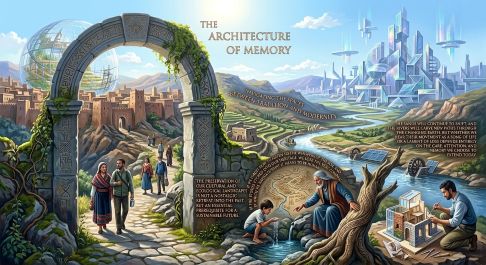
The preservation of our cultural and ecological landscapes is not a nostalgic retreat into the past, but an essential prerequisite for a sustainable future.
- If we forget how to listen to the whispers of the soil and the stories etched into our heritage, we lose the very compass by which we navigate what it means to be human. The sands will continue to shift, and the rivers will carve new paths through the changing earth, but whether we hear their movement as a song of life or a lament of loss depends entirely on the care, attention, and memory we choose to extend today.
Dildora Khojyozova | Uzbekistan
The Tyranny of Speed and the Loss of Place
We live in an era that worships velocity. Information travels across continents in milliseconds, physical distances shrink beneath the wings of commercial jets, and our daily schedules are meticulously chopped into micro-deadlines. Yet, beneath this veneer of hyper-connectivity, a quiet malaise persists—a deep, pervasive sense of displacement. We know more about the world than any generation before us, yet we frequently remain strangers to the landscapes of our own interior lives. We scroll through infinite digital feeds while starving for genuine tactile contact with the earth, mistaking digital noise for community and constant motion for progress.
The Earth as an Archive
To recover our footing, we must look backward before we look forward, returning to the concept of space not merely as geographic territory, but as a living repository of human memory. Across ancient crossroads where monumental architecture stands shoulder-to-shoulder with vast, silent deserts, the earth itself acts as an archive. Every weathered brick, every winding river channel, and every oral epic passed down through centuries carries a distinct structural wisdom. These traditions were never rigid museum pieces designed to be locked behind glass; rather, they were dynamic survival mechanisms crafted to help communities negotiate their place within an unforgiving environment. They taught humanity how to bend without breaking, how to listen to the seasons, and how to build shelter out of mud and straw without destroying the ecosystem that provided it.
The Sterilization of Culture in the Digital Age
In contemporary discourse, however, we often divorce culture from this physical and ecological reality. We containerize art into digital feeds, algorithmic recommendations, and academic metrics, stripping away the unpolished, breathing pulse of daily existence. We seek out culture in climate-controlled archives, attempting to freeze time and catalog human expression as if it were a dead insect pinned to a board. Yet, the true essence of culture resides not in the preservation of static forms, but in the continuous, messy breathing of tradition. It lives in the unspoken understandings between neighbors, the shared recipes passed down through generations, and the unwritten codes of hospitality that welcome strangers as family. True cultural expression resists sterile categorization. It demands the unscripted pauses of conversation, the tactile feel of regional crafts, and the quiet resilience of communities that continue to honor their roots amidst the crushing wave of global homogenization.
Creation as an Act of Resistance
When we write, create, or study these living systems, we are engaging in an act of profound resistance against historical amnesia. We are asserting that local histories hold universal truths. Whether it is through the meticulous study of fragile river basins, the recitation of ancient poetry under starry skies, or the composition of verses that capture the transient weight of a single evening, creative work bridges the vast distance between isolated souls. It invites a reader in a distant city to inhabit our horizon for a fleeting moment, proving that the human desire to be understood transcends both language and geography. When an elder speaks of times past, or a young writer weaves modern anxieties into ancient meters, they are keeping the cultural hearth burning against the encroaching dark.
The Horizon of Tomorrow
Ultimately, the preservation of our cultural and ecological landscapes is not a nostalgic retreat into the past, but an essential prerequisite for a sustainable future. If we forget how to listen to the whispers of the soil and the stories etched into our heritage, we lose the very compass by which we navigate what it means to be human. The sands will continue to shift, and the rivers will carve new paths through the changing earth, but whether we hear their movement as a song of life or a lament of loss depends entirely on the care, attention, and memory we choose to extend today.
Read: Otkir Hashimov: People’s Writer of Uzbekistan
_________________
 Dildora Khojyozova, born in 2005 in the Khorezm Region, Uzbekistan, is a geography student at the Faculty of Natural and Agricultural Sciences at Urgench State University. Actively engaged in both academic research and literary writing, her works focus on the ecosystems of the lower Amudarya basin and ecotourism development, alongside poetry and essays published in international literary journals and platforms.