As society evolves, determining the most beneficial pathway for youth after school remains a crucial debate. Whether entering the workforce early or pursuing higher education better serves young people and national development requires careful evaluation.
By Sarvinoz Aktamjon | Uzbekistan
While some prefer traditional television materials to ensure the spiritual perfection of the younger generation, others consider the role of free information flow to be significant.
The development and future of society directly depend on the spiritual and moral character of the younger generation. Currently, the sources influencing the upbringing of young people are diverse, and there are different views on which of them is more effective. In particular, some believe that traditional television programs are the main means of ensuring spiritual perfection, while others argue that the free flow of information, including the Internet, is more important in this regard.
Those who prefer traditional television in the upbringing of youth explain this situation by safety and reliability. First, programs broadcast on television channels are carefully.
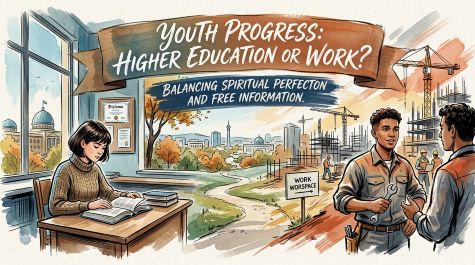
In Uzbekistan, which is gradually entering a new stage of national development, special attention has been paid to the younger generation in recent years. Some people believe that it is preferable for young people to be employed after completing compulsory education, while others consider it a beneficial choice for the younger generation to continue their education in higher education. So, in fact, which is more beneficial?
On the one hand, those who prefer to involve young people in work have sufficient grounds for making this decision.
As a result, the younger generation achieves financial independence from a young age and covers their own expenses. According to statistics, 34.3% of boys and girls who have completed compulsory education are employed in various professions and jobs, which allows them to achieve success faster.
Secondly, the younger generation is not limited only to science, but also communicates with many people and exchanges ideas during their work. As a result, they develop a culture of communication and develop the ability to present their opinions to people and the public. According to research conducted by scientists, young men and women who are engaged in crafts from a young age in 45.2.3% of cases achieve an earlier income than those who are educated.
Nevertheless, for a number of reasons, there are also those who prefer the future generation to continue their studies in higher education. For example, young people were able to refine and further increase their knowledge by continuing their studies in universities. As a result, they will receive a diploma that will be passed on to many government organizations based on the literacy they have gained over the years and become mature specialists in their profession. In addition, there are many opportunities for the future foundations of higher education. In particular, universities provide the opportunity for 2nd-year students to work in government jobs for a salary. As a result, students can more easily achieve financial independence before graduating. According to the latest annual reports of the Ministry of Higher Education, 36.3% of 2nd-year students are currently working in government jobs. And this is the confirmation of my words.
In my opinion, it is much more beneficial for future foundations to study in higher education. As proof of my opinion, I can say that students with a diploma can work in much easier and well-paid jobs than people without a diploma. In particular, in government jobs or private organizations that require a diploma.
In conclusion, the most effective way is not to attract young people to work immediately after graduating from school, but to encourage them to study at higher education institutions. As the great scholar Abu Ali ibn Sina said, “There is no salvation except in acquiring knowledge.” Indeed, today, the education and enlightenment of young people is an important factor in the development of society.
Read: Education – A tool to reduce poverty
___________________
 Abdullayeva Sarvinoz Aktamjon kizi is a student of Samarkand State Institute of Foreign Languages.