Urban collapse in Pakistan stems from systematic institutional decay, unchecked political interference, and centralization. A lack of municipal autonomy, coupled with patron-client politics, has severely paralyzed local administration across major cities.
Ambassador M. Alam Brohi
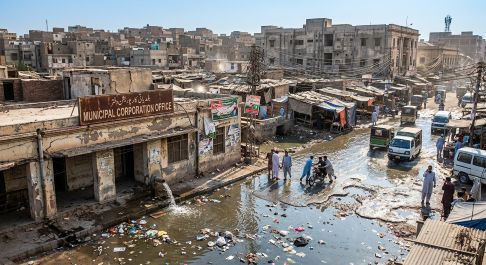
We have big and sprawling cities faced with chronic municipal problems, weak law and order, and lax building and housing regulations. They have grown haphazardly and without planning or regulation. The natural water paths have been encroached upon, obstructing the flow of rainwater. The Municipal Committees regulate new construction within their respective limits by passing maps and ensuring that the construction would not encroach upon any street or choke any drain. These civic bodies keep roads and streets and drainages in good repair. The governmental regulations for controlling the growth of the cities through public and private housing schemes were strict. Gradually, we have lost all this in the epidemic onslaught of corruption, favouritism and bureaucratic inertia.
All big cities of Pakistan have identical problems – overflowing of sewerage and drainage, broken roads and streets, non-functional street lights, inundation, haphazard expansion, and the growth of unplanned, unauthorized, unlawful housing schemes, occupation of amenity plots, encroachment over waterways, street crime etc. In some cities, these problems are more acute because of their overgrown population. Some cities may have more resources for revenue generation. A few cities generate huge revenues. However, the developmental activities of Municipal Corporations and other Municipal Committees of such cities fail to correspond with their generated wealth. These cities need effective local governments.
The political leaders loathe to transfer powers to the grassroots levels. The beginning of the so-called constituency-based development funds from the party-less National Assembly of 1985 to this day has grossly undermined the functions of the Municipal Institutions. The municipal powers to levy octroi tax on the merchandise brought to the market were withdrawn along with many other revenue-generating taxes and levies following the introduction of the District Nazim system by General Pervaiz Musharraf. Instead, a lump sum amount was directly granted to each district and other municipal institutions to make good the above financial loss. One cannot confidently say that this was an effective and adequate financial system for local bodies, or whether this made them free from the bureaucratic control which was undermining their independence as public representative local governments.
I cannot vouchsafe for other provinces. Sindh has been regularly holding elections of Mayors/Chairmen of Corporations or Municipal Committees down to the Union Committee levels. These local governments enjoy adequate financial grants, notwithstanding the provincial government’s failure to devolve finances to the grassroots levels as required under the Provincial Financial Commission Award. These local body governments also face diminished administrative autonomy as the ruling party has suffocating control over them, and its leaders interfere in their functions. This unlawful practice paves the way for corruption and extortion, which is rampant at all levels.
The PPP has made excessive recruitment in all local governments at all levels and in all categories of jobs, so much so that sons and nephews of PPP activists have been recruited as sanitary workers. Obviously, they take their monthly salaries regularly without doing the labor of sanitary workers. This has played havoc with the sanitation and cleanliness in cities and towns. This is what the MQM-Pakistan did in Karachi and Hyderabad Municipal Corporations and other Municipal Committees when its Mayors and Chairmen were voted into power. These recruitments are a drag on the finances of the local governments.
Given the political sensitivity involved, and the scale of high unemployment among the youth, these employees recruited over and above the sanctioned strength of the Municipal Committee and Corporation, as the case may be, are retained by every coming administration. There are reports that some 5,000 employees have been recruited in local governments of Karachi beyond their sanctioned strength. All Municipal Committees in Sindh have overblown expenditures in terms of salaries, pensions, and extortions.
In the recent past, the PPP and MQM have been charging each other with sabotage and subversion during the rainy seasons, with potential inundation of the low-lying areas of Karachi. The sewerage manholes on boulevards were found choked with gunny bags filled with pebbles or boulders, causing them to overflow and inundate the surrounding areas. However, no such subversion is practiced in other cities and towns of Sindh.
We have to reckon with the fact that any flawless and effective system will fail with our current lot of political leaders, activists, administrative machinery, and our people with the wrong behavioural attitude of seeking good governance and showing reluctance to become part of the system. Civic awareness is built by regular grassroots-level political activity within local bodies. These political activities create new leadership by grooming them at the grassroots level as councillors, and catapulting them to leadership roles at various higher levels.
The student Unions also impel, breed, and build a sense of democracy and representative leadership dealing with issue-based problems. Many of our young political leaders found in various political parties were district leaders during General Pervaiz Musharraf’s regime. Some leaders from the PPP’s old guard from Sindh were student leaders in their prime youth. The local bodies and student Unions are the recruitment and training places for effective leadership. Similarly, union activities in public sector institutions were also effective tools to keep governments on the right path. The noise of democracy is safer than the silence sought by guns.
Instead of dissecting the existing provinces into small provinces, the hybrid leadership should ensure that 1) the constitutional imperatives regarding the local governments with full financial and administrative autonomy and necessary powers to generate their own revenues also are fully enforced; 2) the union formation in colleges, universities, and public sector enterprises is revived gradually as part of the national political life supported by regular, free and fair elections as enjoined by the Constitution; 3) the meritocracy in all recruitments and postings from Deputy Commissioner onwards to superior positions in all departments and divisions is observed faithfully; and 4) all controversies between the Federation and the provinces, and among the provinces are referred without fail to the Council of Common Interests.
This is no time to create new controversies in the country. Instead, we should concentrate on challenges facing the country.
Read: The Crisis of Governance in Pakistan
_______________
 The writer is a former member of the Foreign Service of Pakistan and has served as Ambassador for two terms. He is the author of five books.