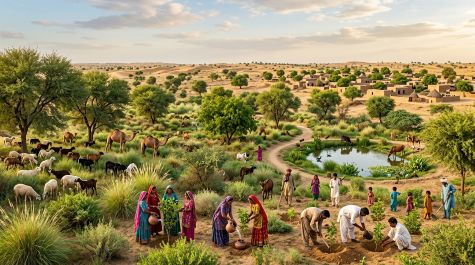
The real wealth of Thar is not its land; it lies in its trees, grasses, animals, people and the natural relationship, between all of them. Protecting this relationship means protecting the environment, livelihoods and future of Thar.
Mir Muhammad Junejo
From the British period to today, official documents, district profiles, NGO reports, websites, Google, and Wikipedia have repeatedly described Tharparkar as a region naturally connected with forests, grazing land, and natural vegetation. If historical records, government documents, and different reports all show that Thar’s land has traditionally supported grazing and natural vegetation, we need to ask ourselves: Why are we trying to convert so much of this traditional grazing land into agricultural land? We should carefully consider the environmental and livelihood impacts of changing the natural land-use pattern of Thar.
Agricultural products are becoming more attractive because cash crops can increase income and improve production. However, agriculture in Thar has one weakness: it depends heavily on rainfall. Rainfall is not under our control. If there is rain, crops can grow well and families can earn a good income. If rainfall is insufficient or there is no rain the money spent on seeds, land preparation, labor and other inputs can be wasted. Crops can also be damaged by diseases, pests, drought and other natural risks. Therefore, agriculture in Thar needs to be planned taking into account the area’s natural environment and strong dependence on rainfall.
Cash crops are important but they cannot be the only foundation of Thar’s economy. Rain-dependent agriculture is always uncertain. We need to rethink development in Thar and build on its strengths. If Thar’s main strengths are grazing land and natural vegetation why not develop an economy around these resources of converting everything into agriculture?
Agriculture and forests often compete for the same land. When agricultural land expands, natural vegetation and forest areas may be cleared or reduced. However, livestock has a strong and natural connection with forests and rangelands because it largely depends on natural vegetation for fodder. Therefore, even if the livestock population increases from 7 million to 14 million, this does not necessarily threaten the forest, as livestock and natural vegetation are closely interconnected and can coexist.
Tharparkar has millions of livestock that provide food, income, employment and economic security to families. By protecting grazing lands and improving livestock value chains communities can benefit from milk, meat, wool hides, manure and other livestock products. There is also an opportunity to develop milk collection points, meat markets and small industries based on wool, hides and manure. These activities can create jobs, increase household income and strengthen the economy.
Honey production is another opportunity. Thar’s vegetation and flowering plants can support beekeeping. With training and support honey production can become an additional source of income for local communities and a marketable product across Sindh. Development in Thar should build on its strengths not destroy them.
The real issue is whether we want an economy that depends on rainfall every year or one that is stable, sustainable, and closely connected to Thar’s natural environment. Therefore, we need to calculate the overall benefits of rain-fed and risk-prone agriculture compared with the year-round availability of natural fodder for the 7 million livestock without requiring major investment or carrying the same level of risk. This natural fodder comes from more than 70 species of trees, bushes, shrubs, and grasses, including kandi, kanbhat, bawri, morari, gangaiti, gugral, phog, ber, karir, jhar, and thor, along with various natural grasses that provide essential food for livestock. Protecting these natural resources can reduce dependence on purchased fodder, support healthy livestock, and strengthen the livelihoods of rural families.
I once visited a village where a man had around one hundred goats. He told me that when the kandi trees produced singri (fruit) his goats hardly left the farmland. There was a dug-well with animal trough in the farmland and many kandi trees provided plenty of singri. The goats could spend the day feeding on the singri that naturally fell from the trees. This simple example shows how valuable Thar’s natural vegetation can be as livestock fodder and for supporting livelihoods.
Some time ago I asked a man why people cut down bushes and trees from boundaries of their farmland every year to make fences. I asked him why we could not leave plants such as thohar, morari, bawri, gangaiti, gugral, jhar, booh, khip and devi growing along the boundaries of the farmland. This would save people the effort of making fences every year and would also help protect the natural vegetation. The old man looked around. Quietly said, “If we do that how will we keep expanding our farmland and illegal occupying more land every year?” His words made me realize that these plants are only removed to claim more land for cultivation or land grabbing. In this way we are gradually losing a resource that has supported the people, livestock and environment of Thar for generations.
The elders of Thar still remember a time when goats were taken into the forest early in the morning during the mandhi season and brought back around noon for milking. They say that after feeding on the vegetation (mandhi) the goats produced so much milk that by evening they could hardly walk. Today however if we stand on a dune and look around we can hardly find Thohar tree in many places. This raises some important questions: if there is no thoharr, where will the mandhi come from; if there is no mandhi what will the goats eat; if the goats do not have enough natural food, where will the milk come from; and if there is less milk how will children and women receive adequate nutrition? This is not a livestock issue; it is also a matter of nutrition, health and family well-being. When local sources of food and fodder disappear families have to buy food from outside increasing household expenses and potentially contributing to nutritional problems. In the run the continued loss of natural vegetation can place a growing burden on both local communities and the government.
Grazing lands and natural forests are also home of, birds, insects and wildlife including deer, hare, peafowl and partridges. All these living things are closely. Depend on each other for their survival. When one part of the ecosystem is damaged or lost it affects the parts as well gradually weakening the balance of the entire ecosystem.
Therefore, development in Thar should not mean turning every area into agricultural land; rather real development should mean using Thar’s natural strengths to create sustainable opportunities for its people. It is not too late. The government, local institutions, Civil Society, experts and the people of Thar can work together to protect grazing lands, natural vegetation and wildlife while promoting livelihoods that are suited to the desert environment. Livestock farming, beekeeping, milk and meat value chains, natural products and local markets can all be strengthened to create income and employment while protecting the environment. Of changing its natural identity we should make that identity its strength. The real wealth of Thar is not its land; it lies in its trees, grasses, animals, people and the natural relationship, between all of them. Protecting this relationship means protecting the environment, livelihoods and future of Thar.
Read: Desert Kilns Destroy Rare Arid Topsoil
__________________
 Mir Mohammad Junejo, Monitoring & Evaluation Coordinator, Research and Development Foundation RDF