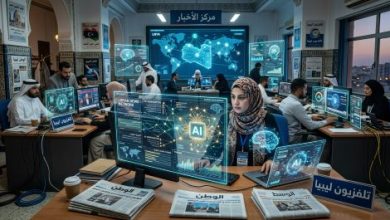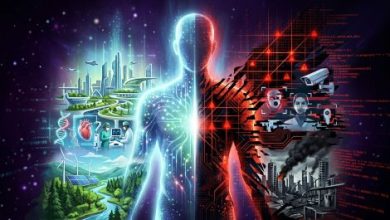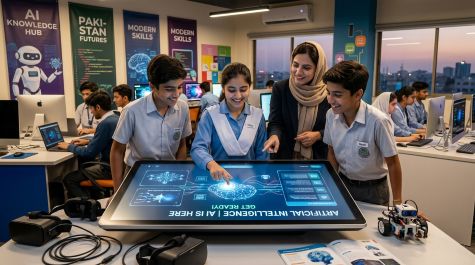
The transformation is already underway. Our education, banking, businesses, jobs and daily lives will be reshaped and we have very little time to prepare.
By Burhan Mehfooz
There are moments in history when the world changes so dramatically that the generations living through them fail to fully appreciate the magnitude of what is happening. The Industrial Revolution transformed physical labor. Electricity reshaped industry and daily life. Computers changed how we processed information, while the internet transformed how we communicated and conducted business.
Today, we are standing at the threshold of another transformation i.e. Artificial Intelligence (AI). But unlike many previous technological revolutions, AI is advancing at extraordinary speed and is moving far beyond the technology sector.
The real question for Pakistan is not whether AI will change our lives. The question is whether we will prepare for that change or allow another technological revolution to widen the gap between Pakistan and the rest of the world.
When people hear “AI”, many think of ChatGPT or applications that write emails, answer questions, create images or translate text. These are merely the visible aspects of a much larger transformation.
AI is increasingly being integrated into banking, healthcare, education, manufacturing, agriculture, logistics, financial services, customer support, software development, marketing and government operations. It can analyze enormous volumes of information, identify patterns, detect risks, automate routine processes and support complex decisions in seconds which represents a fundamental shift. The Industrial Revolution gave machines extraordinary power over physical work. The digital revolution gave computers extraordinary power over information. AI is now giving machines an increasing ability to assist with intellectual work and this distinction deserves serious attention.
Read: Evolution of Artificial Intelligence In Pakistan
Consider banking, the traditional image of a bank’s branches, counters, paperwork, files and routine transactions is rapidly changing. AI can help financial institutions detect fraud, assess credit risk, analyze customer behavior, process documents, respond to routine queries and strengthen compliance.
This does not necessarily mean that banks will simply eliminate employees. Rather, the nature of banking jobs will change. Routine tasks are increasingly to be automated, while skills such as analytical thinking, judgement, relationship management, technology literacy and complex decision-making will become more valuable.
The same transformation will affect almost every profession, an accountant who understands AI-assisted financial analysis may have an advantage over one who relies entirely on traditional methods. A lawyer who can efficiently use AI for legal research may work faster. An HR professional who understands workforce analytics and AI-assisted recruitment can potentially make better and quicker decisions. A teacher who uses AI responsibly may provide more personalized learning.
AI, should not be viewed merely as a technology skill. AI literacy is rapidly becoming a basic professional competency. The impact on businesses could be even more profound. Imagine a company capable of analyzing thousands of customer records, generating market intelligence, preparing marketing material, answering routine customer queries, examining financial information and supporting management decisions in a fraction of the time previously required.
Such organizations can potentially become faster, more efficient and more competitive. This creates a new form of competition. In the future, competitive advantage may depend not simply on how many employees a company has, but on how effectively its people and technology work together.
For Pakistan, this presents both an opportunity and a warning. AI could enable Pakistani businesses to improve productivity and compete more effectively in international markets. A small business in Karachi, Lahore or Islamabad could potentially provide sophisticated services to clients in Dubai, London, Singapore or New York without maintaining the enormous workforce traditionally associated with international operations. If businesses in other countries rapidly adopt AI while Pakistani organizations continue relying on outdated processes, the productivity gap could become even wider.
Perhaps the most important question is not what AI will do to today’s workers, but what it will mean for our children. Millions of Pakistani parents invest heavily in their children’s education, hoping that degrees will eventually lead to secure and respectable careers. But when today’s students enter the workforce, will the jobs they are preparing for still look the same?
Will memorizing information remain as valuable when machines can retrieve and process vast amounts of information instantly? Will a degree, by itself, continue to guarantee employability?
Our education system must prepare students for a world in which knowledge is readily accessible and technology is increasingly capable of performing routine cognitive tasks.
The objective is not to turn every student into a software engineer. Instead, schools and universities should focus on developing qualities that become more valuable in an AI-driven economy, critical thinking, creativity, communication, problem-solving, judgement, curiosity, collaboration and the ability to learn continuously. The future is unlikely to be simply about humans versus machines. It will increasingly be about people who know how to work effectively with machines versus those who do not.
Pakistan has an opportunity, Pakistan should not approach AI only with fear. We have significant advantages, a large young population, talented graduates, a growing technology sector, an established freelancing community and a generation already familiar with digital services.
With the right investment in education and skills, Pakistan could become a significant provider of AI-enabled services to the global economy. A young Pakistani with a computer, internet access and the right expertise can potentially serve an international client without leaving the country.
But talent alone is not enough. Talent needs preparation, infrastructure, investment and policy support. AI adoption cannot be left entirely to individuals and private companies. The government has a critical role in preparing the country for this transformation.
Pakistan needs a practical, long-term national AI strategy covering education, employment, industry, public administration, data protection, cybersecurity and responsible use of technology.
Universities need to modernize curricula, teachers need training, Government employees need digital and AI literacy. Businesses particularly small and medium-sized enterprises need support to adopt productive technologies. Financial institutions require appropriate governance and safeguards, while regulators themselves must develop sufficient understanding of the technology they seek to regulate.
AI education should also move beyond isolated training programs. Digital and AI literacy should become part of mainstream education and professional development. The greatest danger for Pakistan may not be AI itself. It may be our failure to adapt quickly enough.
We have often responded to technological change after it has already transformed the world. AI may not give us that luxury. This does not mean that doctors, teachers, bankers, lawyers, engineers, accountants or HR and Management professionals will suddenly become unnecessary. It means that professionals in every field will need to understand how AI can improve their work.
The message is not to fear AI, but to learn it, use it responsibly and prepare for its consequences. Pakistan still has time but not unlimited time. The next few years could determine whether AI becomes a powerful economic opportunity or another technological gap that we struggle to close.
We need to prepare our children today, retrain our workforce today, encourage businesses to experiment responsibly with AI today, modernize university curricula today and build AI capability within government institutions today.
History rarely gives nations a second opportunity to respond to major transformations. The Industrial Revolution changed how human worked. The internet changed how human communicated. AI may change how human learns, works, creates and makes decisions.
This is our choice we can watch this revolution from the sidelines and later complain that the world moved ahead without us or we can prepare now, invest in our people, modernize our institutions and equip our young generation to compete in the global economy as AI is not coming tomorrow. It is already here. For Pakistan, the time to prepare is not next year. It is now.
Read: Moving Beyond Minimum Wage
______________
 Burhan Mehfooz is HR professional with over 15 years of diverse experience across both the public and private sectors. He is currently serving as Deputy Director of Human Resources with the Sindh Education Foundation, Government of Sindh.