Maanik did not die in 1982; he is merely still unpublished in the languages that run the world. Publishers, translators, book lovers around the world must take note.
By: Raphic Burdo
It is never easy to judge a writer. Everyone has their own style, way of feeling and thinking. We cannot assess Franz Kafka against the rules set by James Joyce. Manto wrote quite differently from Asmat Chugtai. What Albert Camus wrote cannot be applied to Gorky.
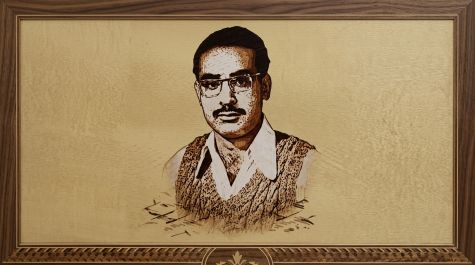
Therefore, Munir Ahmed Maanik has been read, reviewed, and judged by the rules he set for himself. Maanik is the pen name adopted by Munir Ahmed early in his career as writer. He began as “Muneer Sindhi”.
Let us read and review Maanik’s classic “Saah Mutth Mein” (ساھ مُٺ ۾) which literally translates in English as “Breath in the Fist” but metaphorically it means Suffocated or Stifled or, “At the Verge of Death.” Both translations work, and both are the book. It is a masterwork of Sindh’s modernist rebellion, still waiting for the world to notice it.
Some books demand translation before they can be judged; “Saah Mutth Mein” demands judgment precisely because it has resisted translation. It is a novel about life held hostage: breath, cupped in the hand, persisting only so long as the ‘fist’ does not close.
Maanik (1943–1982) was arguably the most dangerous writer Sindh produced in the twentieth century. He was dangerous to everyone with power. Over one hundred stories, several novels, and a handful of dramas constitute his output, and the societies he dissected punished him for the dissection.
Maanik’s “Saah Mutth Mein’ sits among his novels and other works that chronicled a generation of Sindhi youth whose dreams had been shattered, leaving behind only rebels against “the oppressive systems”, seekers of a justice that their world refused to grant.
To read ‘Saah Mutth Mein’ is to feel the air thinning. Maanik seems have read and learned partly from Kafka and Camus, whose absurdist shadow falls unmistakably across his prose. He places ordinary, trapped people inside structures so rotten that even breathing becomes a political act.
Death in Manik’s novel is never merely an ending; it is the final truth-telling. In a culture where pirs, syeds, landlords, and politicians wore morality like a costume, Maanik’s insistence on dragging his characters to the edge was itself the indictment. He wrote, as one critic has noted, as “a figure like Manto or Nabokov” walked among us, and the comparison to Manto is apt since both writers treated taboo not as decoration but as evidence.
As a novel, Manik’s ‘Saah Mutth Mein’ is taut, despairing, and unsparing. This is the work of a writer who silenced the lamp of his own life at thirty-eight. One reads it now with the eerie awareness that its author was rehearsing his own exit; the book becomes doubly devastating, and may be read as a suicide note written in third person, many years in advance.
Flaws of Maanik’s writing are those of its era and urgency. His symbolism presses too hard, the anger occasionally outruns the art, and readers outside Sindh may have difficulty against the cultural density Maanik never bothered to dilute. But ‘Saah Mutth Mein’ is a novel that insists literature is “a call to action, urging readers to wake up and challenge the status quo”. Maanik has successfully delivered it.
This is not so fortunate that the world, so far, has not been allowed to read Maanik, and his ‘Saah Mutth Mein”, widely enough.
Maanik, ‘Saah Mutth Mein’ and his other works deserve not just introduction and review but total resurrection. Maanik did not die in 1982; he is merely still unpublished in the languages that run the world. Publishers, translators, book lovers around the world must take note.
Maanik’s ‘Saah Mutth Mein’ was called Mohan Kalpana’s essay “Sindhit ji Andruni X-Ray” (An X-Ray of Sindh’s Interior). That title is the best single description of the novel itself ever written. Maanik’s work should be available in every language that takes literature seriously. It is currently available in one.
Read: Manik – The Rebel Writer of Sindh
_____________
Raphic Burdo is student of Finance, Entrepreneurship, Public Policy, Psychology and Literature. He writes on the intersection of these subjects. He can be approached at RaphicBurdo@gmail.com