Palermo’s Salinas Museum hosted the presentation of The Canticle of Love: In Francis’s Footsteps, from the Word to Mystery. Marking the 800th anniversary of St. Francis’s death, the event highlighted the saint’s enduring legacy of peace, ecology, and interfaith dialogue.
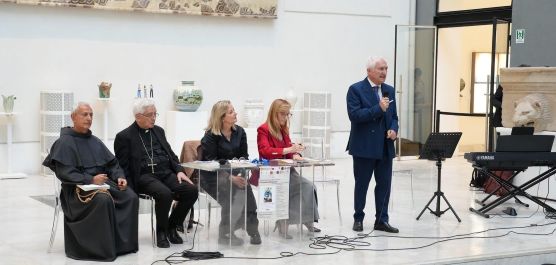
Palermo (Italy) – The presentation of the volume The Canticle of Love: In Francis’s Footsteps, from the Word to Mystery, edited by Franca De Santis, with the scholarly coordination of Pierfranco Bruni and published by Edizioni Solfanelli, drew a large audience on 16 October at Palermo’s Regional Archaeological Museum “Antonio Salinas.”
The event was included in the national program of celebrations marking the eight-hundredth anniversary of the death of Saint Francis of Assisi (1226–2026). It was organized by the Sicilian branch of the National Association of the Infantryman – Civil and Environmental Protection ODV, chaired by Dr Vincenzo Nuccio, together with E.R.A.P., chaired by Dr Giovanni Arcuri.
The event was held under the patronage of the Department of Culture of the Municipality of Palermo, the Sicilian Delegation of the Sacred Military Constantinian Order of Saint George, the Tiberine Academy, the Academy of Sicily, the Lympha Association, the Salinas Museum, Palermo’s Franciscan institutions, including the Franciscan Library and the Fraternity Park, and Rotary Club Bagheria.
The meeting was opened by the Museum’s director, architect Giuseppe Parello, who thanked the organizers for choosing such a significant venue for a cultural event of profound symbolic value. In his address, he recalled Francis’s message of peace, a message of particular relevance in a world that often seems deaf to dialogue.
Following his institutional greetings and expressions of thanks, Dr Vincenzo Nuccio emphasized the significance of the venue, evoking the squares associated with the history of two great figures: Frederick II and Francis. The agora of the historic monumental complex was thus transformed into a space for reflection and spirituality.
The volume is a collective work bringing together contributions from 26 authors, including academics, journalists, theologians and religious figures, who examine the figure of Francis anew through literary, theological, philosophical, anthropological and mystical perspectives.
The meeting was moderated by lawyer Rosa Maria Sciortino, president of Rotary Club Bagheria. The scholarly discussion was introduced by Professor Antonietta Micali, director of the Department of Literature of the Tiberine Academy, who also conveyed greetings from the Academy’s president, Knight Dr Franco Antonio Pinardi.
In her address, she highlighted the significance of the work, focusing on the communicative strategy of the Canticle of Brother Sun, its theological scope and its literary comparison with Pablo Neruda. She also underscored the educational and therapeutic value of the Franciscan model, which can teach younger generations a sense of wonder and an acceptance of human vulnerability.
The volume’s editor, Franca De Santis, president of the National Association for Cultural Activities and of the “Land of the Fathers” Literary Prize, took part remotely, having been unable to travel to Palermo because of a strike affecting road transport.
In her remarks, she stated: “This book was born out of a desire to free Francis from rhetoric. It is not merely a commemoration, but a living question. In an age marked by wars and by a crisis of language, The Canticle of Love retains an astonishingly powerful contemporary relevance.”
The contribution from Friar Gesualdo Ventura, director of Palermo’s Franciscan Library, was particularly significant. The friar recalled Francis’s vision of the world: he recognized creation as a gift from God and referred to its creatures as “brother” and “sister.”
In the Canticle of the Creatures, the praise addressed to the sun, the moon, water, fire and even death expresses a profound sense of connection with nature, making the saint an important point of reference for contemporary reflection on ecology and sustainability as well.
Monsignor Michele Pennisi, emeritus Archbishop of Monreale and Grand Prior for Sicily of the Sacred Military Constantinian Order of Saint George, focused on Francis’s tireless commitment to peace among individuals, peoples and religions.
He recalled the saint’s celebrated meeting with Sultan al-Malik al-Kamil during the Crusades, an example of dialogue and mutual respect that continues to inspire interfaith engagement.
As was emphasized during the meeting, Franciscan spirituality is founded on a positive vision of life and creation. Francis sought God in everything and in every circumstance, encouraging people to live with joy, simplicity and love.
Prayer and silence accompanied his life, without separating faith from practical commitment, especially alongside the poor and marginalized. It is a message that continues to speak to all those who seek peace, justice and a harmonious relationship with nature.
The address by the Undersecretary at the Ministry of Culture, Hon. Giampiero Cannella, was also eagerly anticipated. He conveyed both the Minister’s greetings and his own personal message:
“When an institution such as the Salinas Museum opens its doors to a volume of this caliber, the Ministry’s very mission is fulfilled: culture must be a lived experience, not something merely preserved. Francis is part of the heritage of all Italians. To commemorate 800 years since his death here in Palermo means reaffirming that the South is not a cultural periphery, but a true laboratory of identity.”
The series of addresses was brought to a close by Dr Antonio Rini, Palermo’s Councillor for Culture, who highlighted the city’s profound historical connection with Franciscan spirituality.
“Palermo has always been a city of dialogue and welcome. Saint Francis’s message speaks directly to our history and our identity.”
____________