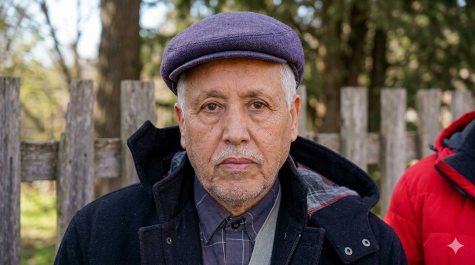
To stop writing—that is, to stop feeling, dreaming, and building worlds—would be death for me, a suicide. So, in spite of myself, despite my disappointments and exhaustion, I still write and I still have projects – Algerian Writer and Playwright Mohamed Bourahla
In an exclusive interview that unveils the early worlds of formation and the pathways of consciousness, the writer and playwright Mohamed Bourahla—born in Qasr Al-Boukhari on August 27, 1950—opens the vault of his memory to the key of creativity. He speaks of his inspiring grandmother, of Akbat Al-Souq, of the shock of Balzac, and of theatre, the novel, and the future of culture in Algeria.
Interviewed by: Turkia loucif | Algeria
We begin our dialogue by evoking the inspiring figure who held the key that unlocked the door of creativity. How was the cultural environment during your childhood?
 My grandmother—may God Almighty have mercy on her—was my muse and my first teacher of literature. To this day, I still remember how, during the long winter nights, in front of the nafekh [traditional clay brazier], under the dim light of a kanki_ lamp—since we had no electricity back then—she would take my hand to help me explore the marvelous worlds of wonder through riddles and folk tales. At times she would narrate, at others she would sing, and at times she would recite poems and Sufi invocations. I would fall silent, but I listened without missing a single word, letting myself drown in the dreams of boyhood. Back then, I was building my own private worlds in a primitive way, of course; perhaps that was an instinctive form of writing.
 I was also infected with a passion for literature and thought through reading. My family consisted of only two people—my mother and my grandmother—and books were the companionship that allowed me to bear my solitude, and also to build the pillars of my subjectivity and individual being. At first, it was comic books. I devoured them insatiably. Later, I turned to poetry, but after reading Honoré de Balzac’s _Louis Lambert_ and _Le Père Goriot_ in 1965, I developed a passion for the novel and for writing. It was then that I discovered my talent for writing, and became certain that I would write my own book one day; for me, it was only a matter of time.
I will not hide that, later on, I was shocked when I learned that Balzac—the eloquent, perspicacious writer, the genius of detail and precision, renowned for his prolific output, who considered himself a historian of customs and traditions—had seen nothing, or had not wanted to see anything, of the horrific tragedy that French colonialism was perpetrating in Algeria. Perhaps this biting observation is what gave rise to my conviction that an author can be, at once, incidentally brilliant and fundamentally shortsighted… or that appealing to authority can be a form of sophistry.
I must say that my passion for literature, thought, and writing also stems from the nature of my birthplace at that time—up until the 1970s. Culture then captured the interest of the inhabitants of Qasr Al-Boukhari, the town where I was born on August 27, 1950 and which I left in March 1977, to the extent that I can almost assert that, from middle school through higher education, the exception among young people there was the one who did not read, did not frequent the two cinemas, or did not visit its two libraries.
I once wrote in an article titled “My Story with Writing and Theatre” dated January 31, 2025: “In my town, culture was present without pretension and in a natural way in the conversations of ordinary people—in cafés and in the market—and it was dominant in the dialogues of the men of the National Movement, who represented our school and the touchstone for anyone who wanted to test his cultural and political mettle. To them I owe a great deal. Qasr Al-Boukhari was, above all, the hometown of towering theatrical figures such as Abdelkader Farah, Mohamed Farah, and Hassan El-Hassani.” And it was in Qasr Al-Boukhari that I formed this firm conviction: that a human being without critical thought and without taste is less than human.
A creator is born burdened with a weight that makes him fragile, his soul like crystal glass. To what extent were these circumstances inspiring for you?
Everything affects the writer; everything provokes and moves him, arouses his wonder or challenges his ideas: good and evil, noise and silence, major events and ordinary matters… nothing can leave him indifferent. There are, for example, places I can never forget. I recall, for instance, _Akbat Al-Souq_ [The Market Slope] in Qasr Al-Boukhari. There, standing in a circle watching the _maddah_ [traditional storyteller/chanter] perform, my passion for theatre was born. And there are also unforgettable things like disappointments, the sting of love and sorrows, or the magic of joys such as those that followed independence in July 1962, or chants like “Seven years is enough!”
But it must be said that a writer is not merely an empty vessel without particularities, a container that reacts to every influence. A writer is also a critical eye. He has, or must have, a cultural background that allows him to situate himself in a world that is increasingly ambiguous and obscure, then to interpret it and construct his fictional worlds from the raw materials of reality.
“The King Plays” is a play considered a hallmark in Algerian dramatic writing. Did you begin with theatre or with the novel, and why?
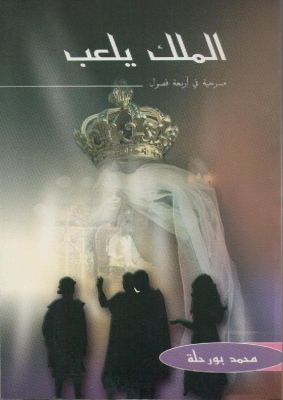
I wrote the play _The King Plays_ in a context in which I was questioning the individual’s place within the system, and whether he could think freely. This questioning intensified later due to Michel Foucault’s statement, in which he confronts with a “philosophical laugh” those who refuse to think without directly acknowledging that man is the thinker. This does not mean that I had read Foucault’s _The Order of Things_—I was incapable of that. Nevertheless, it was from this question that _The King Plays_ was born.
The play was published and then produced by the Regional Theatre of Skikda, directed by my dear friend Abderrahmane Zaaboubi. It won the award for Best Original Text at the National Festival of Professional Theatre in Algeria in 2012. Since then, the play has been the subject of numerous academic studies, and to this day it continues to attract the interest of theatre practitioners.
 Prof. Dr. Hamid Allawi of the Central University of Algiers wrote of the play: “The dramatic text _The King Plays_ by the novelist Mohamed Bourahla seeks to employ heritage and its figures such as the king, the barber, the clan chief, and the chief merchant. These characters take us back to the atmosphere of _One Thousand and One Nights_, the alleys of Baghdad, and the corridors of its palaces, but with a new employment that projects onto current reality and penetrates its cultural and social structures, which makes this text rooted in the fragrance of Arab cultural history while opening windows onto modern life in its various aspects.”
Prof. Dr. Issa Rass El Ma from the University of Oran added: “It is a play replete with dramatic intensity, rich in situations, its style engaging and subject to the structure of dramatic composition. The action is clear, the characters are well-studied and their relationships logical, and the conflict contains all the indicators of rising and falling action.”
As for your question about beginnings, I say they were with poetry, and perhaps my view that literature must be practiced by all stems from the influence of the poet Lautréamont, author of _Les Chants de Maldoror_. Here I must acknowledge that Eastern Arab _tarab_ music was my gateway to Arabic literature and poetry, and for that I owe credit to the city of Qasr Al-Boukhari, which was passionate about it. Except for Ahmed Shawqi, I did not know most of those who wrote the lyrics or composed the poems. Their identities did not matter to me. I thought they had written the poetry and I, by savoring it and repeating its songs, was the one using it, and thus had the right to possess it.
Later, after a long time, I learned that the true owner was Al-Akhtal Al-Saghir, or Ibrahim Naji, or Abdullah Al-Faisal. Through Umm Kulthum’s “_Araka ‘Asiya al-Dam‘_”, Mohamed Abdel Wahab’s “_Cleopatra_” and “_Indama Ya’ti al-Masa’_”, which he sang to a rumba rhythm, Abdel Halim Hafez’s “_Lastu Adri_”, and Farid Al-Atrash’s “_Adnaytanī bil-Hajr_”, I came to know Abu Firas al-Hamdani, Ahmed Shawqi, Mahmoud Abu al-Wafa, Bishara al-Khouri, and many other poets.
Then, before theatre seized me because of the proximity to life it afforded, the novel imposed itself. I read world literature insatiably. Among the novels that influenced my literary path, many stand out. I mention Jean-Paul Sartre’s trilogy _The Roads to Freedom_, and the two novels _1984_ and _Brave New World_ by the English writers George Orwell and Aldous Huxley—both of whom instilled in me a love of dystopia. I cannot forget Franz Kafka’s two novels: _The Trial_ and _The Metamorphosis_. After reading them, I would wake from sleep thinking I had been arrested for a crime I did not know, and go to sleep fearing I would turn into a cockroach.
I also read Algerian literature with great interest and pleasure. Among its writers, Malek Haddad managed to capture my attention and admiration thanks to the themes of his novels and the beauty and elegance of his style, in which poetry blended with prose. It should be said that there are remarkable talents in the younger generation, among them Abdelwahab Aissaoui, El Kheir Chouar, Abdellatif Ould Abdallah, Samia Ben Driss…
 Given your experience in judging theatrical performances, how do you assess the future of the dramatic text in Algeria?
The world of culture, and hence the world of theatre, is an ecosystem—that is, a living entity in which every element depends on the others. The artists within it—writers, as well as directors, actors, etc.—are linked to the other components of that system: theatres, audiences, institutions, critics, publishing houses… Consequently, the future of the dramatic text, and the literary text, does not depend solely on individual effort. Of course, the exception does not make the rule.
This future is contingent on these interconnections within the ecosystem and is tied to a cultural strategy and policy that are clear in their features, standards, means, and objectives—one that does not regard culture as a mere luxury but makes it a driver of growth, a tributary of Algerian identity, and the cement of national cohesion.
Therefore, the crisis of the text, whether literary or dramatic, is not a crisis of inspiration as much as it is a crisis of the ecosystem, and the solution will not come from authors alone, but from restoring value to culture. Otherwise, our hopes for change will remain mere wishes, for it is difficult to speak of the future of the dramatic or literary text when good authors are drained or exhausted, or forced into exile; when there are no publishing houses worthy of the name; when theatre is distant from schools; when audiences abandon the theatres; when great works are not translated; when libraries close their doors one after another; when there is a lack of training; when the city finds no place in festivals… But let us be optimistic, or “optimistic-pessimistic” [_mutasha’ilin_].
Ksar El.Boukhari is your birthplace, and you have memories and obsessions tied to the city. Do you see the cultural climate as conducive to reviving the spirit of theatre in Qasr Al-Boukhari?
Yes. When I recall my youth in Qasr Al-Boukhari, memories return… some beautiful, some painful, I admit. And how could I forget the scent of my parents, the companions of the path, the alleys of the _Qasr_ laden with childhood dreams, and the wondrous _Akbat Al-Souq_ where I found the _maddah_ who, weekly, fed my imagination and refined my taste. Those performers offered the audience an authentic form of aesthetic expression that enchanted the young man I was.
Therefore, I can say that it was in the _Qasr_ that my talent blossomed, that I came to know the contours of civilized dialogue, and that I attended, in the circle of _Akbat Al-Souq_, my first practical lessons in the art of theatre. This legendary place later prepared me to understand professionals when they spoke of the _halqa_ [performance circle], the _qawwal_, and performance spaces, and of the critique of Aristotelian theatre or the characteristics of epic theatre. [Narrator]
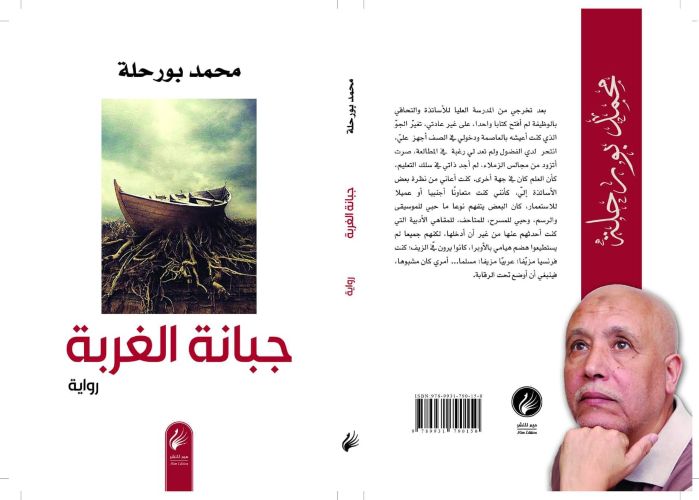
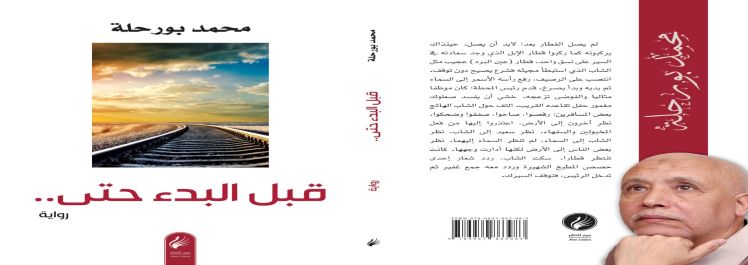
I must clarify that I would be ungrateful if I did not mention the merit of the city of Médéa and its influence on me. It was there that I had my decisive and passionate encounter with the Arabic language… and it was there that I wrote what became the novel _Bread and Condiment_ [_Al-Khubz wa al-Idam_].
As for the second part of your question, I know, through meeting some of them and through my continued connection with the city despite work and distance that Qasr Al-Boukhari abounds with young talents. It is up to them to believe in themselves, to work hard, and to create the moment that will lead to a cultural flourishing and a revival of theatre in the city.
In light of developments in Algerian and Arab society, we recall the title of the novel _Bread and Condiment_. How did the literary community explain the thought of the writer Mohamed Bourahla?
 I believe my first novel was well received. Qasr Al-Boukhari—or the vision I had formed of it—was strongly present in it, from its alleys, characters, names, and events, to my theatrical experience there, though it was not an autobiographical novel. In the novel I experimented with a spiral narrative structure, with chapters that evoke Professor Malek Bennabi’s equation of civilization—may God have mercy on him: Man, Soil, Time.
The text was the subject of several university studies. In 2012, the novelist Mohamed Miflah wrote: “I read it over two nights, enjoying its dramatic atmosphere, and I found in it poetic language, profound wisdom, sincere emotion, and human knowledge. In it, the author addresses thorny issues with a very beautiful suggestive style. […] What I admired in its poetic language was Bourahla’s intelligent use of colloquial words, which gave his work a local flavor with a human dimension; the reader will not find in it any colloquial word except one that has deep meaning in the community’s conscience […] As for the novel’s dialogue, it proceeds in eloquent language pregnant with maxims and philosophical ideas, and colloquial language was used only in a few dialogues.”
Is there a cultural project on the horizon? And what is your view on the international cultural bridge?
Frankly, sometimes, when I am exhausted, I vow to myself that I will not write again, but I keep breaking that vow. Is the reason that I do not find myself in the current cultural scene that the birth of the cultural world as I imagine it is difficult, or that what exists before me is merely a dull substitute for culture? I do not know.
Nevertheless, despite everything, to stop writing—that is, to stop feeling, dreaming, and building worlds—would be death for me, a suicide. So, in spite of myself, despite my disappointments and exhaustion, I still write and I still have projects. In fact, I never stop having them. I have projects for novels, plays, and autobiographical works. My projects also include adapting the short stories in my collection _Oleander Flower_ [_Zahrat al-Difla_] into film scripts.
Read: The Power of Children’s Literature
___________________
 Turkia Loucif is an Algerian writer who grew up in a family of many members and lived in a house left over from the houses of French centenarians in the neighborhood of arches. Her passion began with telling oral stories to her two sisters before bed, her mother realized her talent and she loved nature, flowers and squirrels, she frequented the school library and read novels in French. She dreamed of becoming a journalist and used to take this profession as a child, she used to make her notebook a microphone and talk to some of her family members. Her writing style caught the attention of her teacher, who registered her in a literary competition and won first place at the age of 12.