

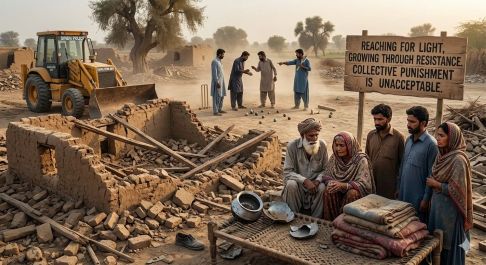
The Law and Justice in Sindh, Pakistan has become “Spitting in the Pit” as the crime is committed by one, but others face the punishment
- A troubling pattern is emerging: one person commits a crime, but others suffer the consequences. When institutions fail to apprehend an accused individual, they often act against their families instead.
By Abdullah Usman Morai | Sweden
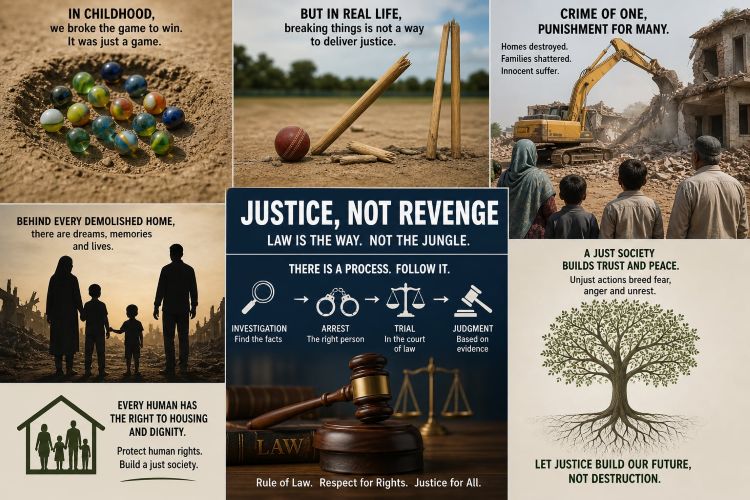
Childhood and its memories are always strange and fascinating times when everything felt like just a game. These memories sometimes make us laugh, and at other times force us to reflect deeply. Piles of dirt, dusty streets, and the companionship of friends, these are scenes we all remember. As children, playing marbles was incredibly engaging. Yet, even in that simple game, there was a darker side: friends would argue, clash, and fall out.
When a child realized they were about to lose, or felt there was no way left to win, they would create chaos. To disrupt the game, one might spit into the small pit of marbles and run away, or simply pick up the marbles, put them in one’s pocket, and declare the game over.
A similar pattern existed in cricket. If someone didn’t get a chance to bat or refused to accept being out, they would angrily pull out the stumps and run off if they had taken revenge on the entire world. Back then, such actions seemed like innocent expressions of childish emotions, stubbornness, or naivety.
Today, when we recall those memories, they bring a smile. But at the same time, when we observe similar behavior in some institutions of our society, especially law enforcement that smile turns into deep concern. It feels as if our state system has not yet outgrown that childish stubbornness, where instead of resolving the game, the entire field is destroyed.
What was once an innocent childhood behavior has now evolved into a serious social issue. When we examine certain actions of law enforcement agencies today, an important question arises: Are we truly delivering justice within the framework of law, or are we still “spitting in the pit” and breaking the stumps to end the game?
 Crime by One, Punishment for Another: A Disturbing Trend
A troubling pattern is emerging: one person commits a crime, but others suffer the consequences. When institutions fail to apprehend an accused individual, they often act against their families instead.
However, the principles of law are clear:
An accused must be arrested, investigated, tried in court, and judged based on evidence.
In contrast, what we see is collective punishment like homes demolished, shops burned, properties bulldozed, and families displaced. This is not justice; it resembles vengeance.
This behavior is no different from our childhood reactions. When we couldn’t win or compete, we would destroy the entire game. The difference is that, back then, we were children playing with other children. Today, the “players” are innocent women, children, and the elderly facing powerful institutions that hold the authority of the state.
This raises a fundamental question: If one person is guilty, how can their crime be extended to their children, parents, or relatives?
A house is not merely bricks and cement; it is a sanctuary. When a home is destroyed, it is not just a structure that collapses, but the dreams, dignity, and security of entire families. The crime may belong to one individual, but the suffering is borne by many. Can this truly be called justice?
Rule of Law or Law of the Jungle?
A civilized society is built upon law and justice. In such societies, there is a defined process to punish wrongdoing. If law enforcement agencies begin to bypass the law themselves, chaos and disorder inevitably follow.
Courts, constitutions, and legal systems exist to ensure fairness and prevent injustice. If someone is guilty, they must be arrested, investigated, presented before a court, and punished according to the law.
But when authorities ignore these steps and instead demolish homes or target families in the name of enforcement, it reflects the “law of the jungle” where power determines right and wrong.
While collective punishment may still exist in some parts of the world, it is deeply alarming in a democratic state. Such actions may instill fear, but they destroy public trust and respect for institutions. When people see that those responsible for upholding the law are violating it, they, too, may begin to justify taking the law into their own hands.
A Grave Violation of Human Rights
Whether in international human rights charters or national constitutions, every individual is guaranteed the right to life and shelter. Depriving someone of their home without due process is a violation of human dignity.
A home is not just a physical structure; it is a center of memories, emotions, and security. Innocent children who may not even understand the accusations against their family members watch their homes being destroyed before their eyes. In that moment, it is not just a building that falls, but countless dreams.
The seeds of resentment and hatred planted in such moments can grow into long-term social unrest.
Imagine a mother struggling to provide shelter for her children, suddenly losing everything. Imagine an elderly man who spent his life building his home, only to see it reduced to rubble. These are not just incidents; they are human tragedies.
Institutions must abandon this “game-breaking” mindset and act professionally. Catching criminals is their responsibility, but displacing innocent people is never justified. When homes are destroyed, instead of prayers, curses emerge, something no society can afford.
Such actions are not only morally wrong but also a blatant violation of internationally recognized human rights. Every individual has the right to housing, and taking it away without legal justification is a grave injustice.
Social Consequences and Growing Distrust
The impact of such actions extends far beyond affected families. Fear, uncertainty, and mistrust spread throughout society. People begin to fear the law rather than trust it.
Young people may start believing that justice exists only for the powerful, while the weak are destined to suffer. This perception fuels anger, frustration, and rebellion, undermining the stability of any nation.
Way Forward
Instead of emotional reactions, we must seek rational and lawful solutions, for example, ensure the rule of law in all actions, avoid punishing anyone without evidence, train law enforcement in human rights principles, hold officials accountable for overreach, strengthen the judicial system for timely and transparent justice, and promote public awareness about rights and responsibilities
This Is Not a Game
In essence, in childhood, breaking a game was a momentary act of stubbornness with little consequence. But such behavior, when replicated in real life, especially by state institutions, becomes a serious tragedy with far-reaching consequences.
Society is not a game where losing justifies destroying everything. Every decision affects human lives.
If we truly aspire to build a civilized and progressive society, we must move away from the “law of the jungle” and embrace the rule of law, respect for human rights, and the true spirit of justice.
Justice must be precise, should weigh only the guilty, not throw entire families and communities into the pit of punishment.
Politicians, intellectuals, and civil society must raise their voices against such practices. We owe our children a future where they feel safe in their homes, not one where they fear sudden destruction.
A system built on fear can never be sustainable. Justice is the only force that binds society together.
If we remain silent today, this same injustice may knock on our doors tomorrow. And then we, too, will become part of a game that everyone is trying to destroy.
Read: Silent Grammar of Human Interaction
_______________
 Abdullah Soomro, penname Abdullah Usman Morai, hailing from Moro town of Sindh, province of Pakistan, is based in Stockholm Sweden. Currently he is working as Groundwater Engineer in Stockholm Sweden. He did BE (Agriculture) from Sindh Agriculture University Tando Jam and MSc water systems technology from KTH Stockholm Sweden as well as MSc Management from Stockholm University. Beside this he also did masters in journalism and economics from Shah Abdul Latif University Khairpur Mirs, Sindh. He is author of a travelogue book named ‘Musafatoon’. His second book is in process. He writes articles from time to time. A frequent traveler, he also does podcast on YouTube with channel name: VASJE Podcast.


