

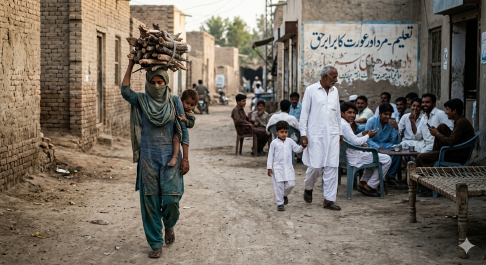
Gender inequality remains deeply systemized rather than eradicated, embedded within social, economic, and institutional structures. This can only be addressed by structural changes, especially quality education and economic empowerment.
Kashif Rauf Niazi
“One is not born, but rather becomes, a woman,” wrote famously Simone de Beauvoir. This quote underscores the notion that ideas like muscularity and femininity are more of a social construct and not a natural determinant. In practice, men and women are equal, and they are two key pillars of the society; ignoring one of them will not favor social development and growth.
Women have been leading marginalized lives, denied basic rights like education, political rights and self-determination among others, over the centuries. They have even been deprived of control over their bodies in most societies. Women are often confined to relational roles such as daughter, sister, wife, or mother, rather than being recognized as independent individuals. As a result, they live a socially defined existence with little space for a self-determined identity.
On the same note, Betty Friedan stated that” women had no real avenue to express their desires except through marriage and the raising of children”. In spite of the contemporary technological world, women still experience obstacles in the achievement of their rights and opportunities. Women have both potential to play reproductive and productive in the society, but their potential is not fully harnessed.
As Malala Yousafzai rightly noted, “We cannot succeed when half of us are held back.” Women make up half the world, though they are not equally represented: only 29 women are heads of government, according to the World Economic Forum, and 17 percent of the nations still do not have 16 years of compulsory education of girls constitutionally guaranteed. These realities demonstrate that social structures continue to systemize gender inequality rather than fully embedding women’s empowerment within state institutions and societal values.
Read: Becoming A Woman: Simone de Beauvoir on Female Embodiment
Women in the world are stereotyped to be weak emotionally, have poor self-esteem, anxious, depressed, and have lower intellectual capability than men. At the same time, male-dominated societies encourage women to join the labor market to contribute to family welfare and national development. Although the productive potential of women is now being recognized as a source of growth and prosperity, they are often compensated less than men doing the same job and are more susceptible to harassment at work. As such, social justice to women in most of the societies is a far-fetched desire and they are left to live what Simone de Beauvoir termed as the second gender in the patriarchal system.
Justice is the main condition to control the power and prevent exploitation, but in most societies, the legal system has traditionally protected inequality instead of getting rid of it. Women have been subjected to the subordination of the male counterparts and victims of domestic violence, religious coercion and cultural taboos, as it has been the case over centuries. Even though liberal institutions say that they have passed laws that safeguard the rights of women, a law is not enough to change entrenched social attitudes. This reality is reflected in a remark attributed to Dwight D. Eisenhower during the era of Martin Luther King Jr., “that laws cannot easily change the hearts and minds of people”. Modern statistics also support the systemic character of inequality: the Global Gender Gap Report 2023 suggests that it might take 133 years to bridge the gender gap in the world. This and similar evidence proves that gender inequality is not incidental but entrenched in the legal, social, and cultural systems of the world.
Gender inequality is systemized within households through the unequal distribution of domestic responsibilities. Women are culturally associated with family honor and are often confined to domestic roles, limiting their participation in public life. Women do approximately 4.4 hours of unpaid care work a day (as compared to 1.4 hours by men) and the difference is much larger in South Asia and Africa. This unequal division of unpaid labor institutionalizes gender inequality at the family level and strengthens the inferior status of women in society.
Gender inequality remains deeply systemized rather than eradicated, embedded within social, economic, and institutional structures. This can only be addressed by structural changes, especially quality education and economic empowerment, so that women can assert their rights and be given equal opportunities in development. Societies which invest in education of women and opportunities are able to make sustainable advancement and stability. Thus, real gender equality requires the regular practical adherence to the basic rights of women in all sectors of society.
Read: When Education Loses Purpose in Pakistan
_________________
 Kashif Rauf Niazi is a graduate of Political Science from the University of Peshawar. He is currently pursuing MPhil in Strategic Studies at the National Defence University (NDU), Islamabad. His academic interests include international relations, strategic affairs, and public policy.


