Translator and writer Angela Kosta was awarded the “Branko Merxhani” Prize for a specific contribution to intercultural and literary relations between Italy and Albania
Tirana, Albania
The Albanian Journalists Union, in its first event Italo-Albanian Cultural Expressions, in collaboration with the Italian association “VerbumlandiArt,” opened an international dialogue between culture, journalism, and social engagement: “Verbum Mundi”.
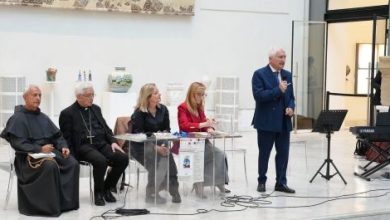
On April 28, 2026, in Tirana, the Albanian capital, the inaugural event of the international project “Verbum Mundi,” promoted by the Italian association VerbumlandiArt APS and carried out in cooperation with the Albanian Journalists Union (UGSH), took place. A high-level activity that brought together Italian and Albanian representatives in the name of intercultural dialogue and cooperation between peoples.
The official opening of the initiative was marked by the President of the Italian association, Regina Resta, and Aleksandër Çipa, key figures in a meeting that laid the foundations for an international cultural network aimed at promoting excellence in the fields of literature, art, journalism, and social engagement.
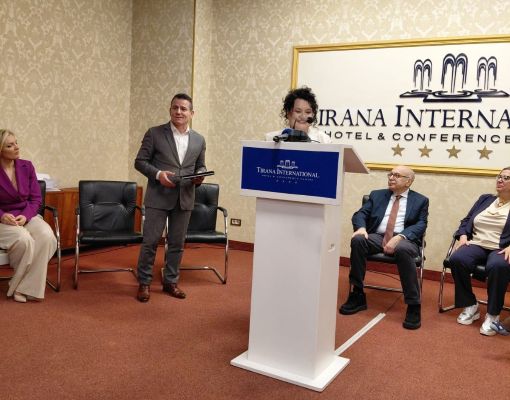 The “Verbum Mundi” project was presented as an authoritative space for dialogue and collaboration, based on shared values such as peace, justice, human dignity, and cultural responsibility. These themes, in the current global context, were repeatedly emphasized during the speeches, highlighting the need to create spaces for genuine and sustainable dialogue.
One of the main moments of the day was the award ceremony for personalities distinguished in their respective fields. Among those honored were writers, scholars, publicists, and translators such as Xhevahir Spahiu, Virion Graci, Behar Gjoka, Namik Dokle, Viola Isufaj, Engjell Seriani, Erion Kristo, Flutura Acka, Mujo Bucpapaj, Aleksandër Çipa, and Artur Nura. They were recognized by VerbumlandiArt with various awards, including the Special Excellence Award in several fields and Journalism, demonstrating the project’s attention to the value of international information and dialogue between different media systems.
“Verbum Mundi represents a broad and concrete vision: the creation of real connections between different cultures, valuing merit and promoting a culture of responsibility and dialogue,” stated Regina Resta during the event, emphasizing that Tirana is only the first step in an international journey that will include other European countries and beyond.
The project envisions a series of stops and itineraries, with high-level cultural and institutional activities designed as meeting points between institutions, intellectuals, and cultural operators, with the aim of building an international community based on shared values and cooperation among excellence.
The Italian delegation, present in large numbers, included among others Mirella Cristina, Francesco Lenoci, Eugenio Bisceglia, Maria Pia Turiello, Vinicio Leonetti, Tommaso Filieri, and Angela Kosta.
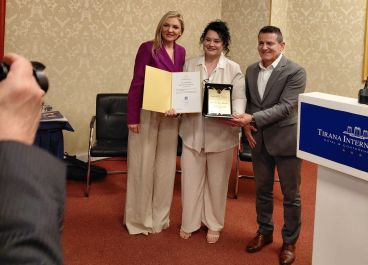
 On this occasion, translator and writer Kosta was awarded the UGSH “Branko Merxhani” Prize with the motivation: “For a specific contribution to intercultural and literary relations between Italy and Albania. Through her work as a writer, translator, poet, and publicist, she stands out as a representative of Albanian cultural expression in Europe.”
With this first event, moderated by the journalist, poet, and well-known TV host from Pristina, Ms. Alketa Gashi Fazliu, “Verbum Mundi” aims to become a reference point in the international cultural landscape, strengthening the role of VerbumlandiArt APS as a dynamic and active entity in promoting dialogue between cultures.
Afterwards, the book by author Regina Resta, “I REMAIN WORD,” translated by Angela Kosta, was presented.
Angela Kosta writes: In the book I REMAIN WORD by the author Regina Resta (while translating it), in every poem, in every verse, I touched her beautiful and noble soul—one not confined to thoughts, expressions, desires, or words, but expanding into a narrative psychological oneirism as well as an extreme animism. As also mentioned by Aleksandër Çipa in the foreword of this book:
“Regina Resta has the Olympic traits of an odyssean lady, ceaseless and tireless, with a spirit and breath that climb toward heights, with the restraint of a mind that, while keeping the forge of the word lit every day, seeks to leave it written and spoken. As a writer herself, she aspires to ‘remain word.’ This non-biblical desire conveys a biblical message to present and future readers, and now also to Albanian readers…”
I, as a translator, am convinced that this will be confirmed in the continuity and presence of this poetic work within the Albanian literary and artistic landscape. I add “artistic” because this book extensively addresses artistic contexts. The rich metaphors, the multiple perspectives—with and without conceptual frameworks (yet always clearly and rightly detailed)—embody not only her personality but also her figure as a multifaceted author, who addresses contemporary themes, asks questions, provides answers, and at the same time responds to the injustices of every era, every individual, every society, every moment of life.
In her poetry, Resta paints precisely the universal human existence; she does so by using brushes and colors that correspond to the stages of life, beginning from childhood, adolescence, the first heartbeats, unrealized loves, along with the sufferings, impulses, joys, and disappointments that pour through waves, flowing into the ocean of expectation, loneliness, distance, those once warm and friendly embraces now far from memory—or lost in oblivion itself.
Through her pen, the author Resta examines with precision and temporality every aspect of life, because she knows very well that, as the great philosopher Plato said: “The unexamined life is not worth living,” and this is the right path to achieve that.
This is why Regina Resta is and will remain “word,” because by examining life, she adds value to herself and maintains awareness over the steps she takes toward tomorrow. A tomorrow that invites her—and invites us—to know how to observe, to listen, to speak, so that we too may remain “word,” words of love, peace, and harmony.
I would like to express my deep gratitude to the President of the Albanian Journalists Union, Dr. Aleksandër Çipa, for sponsoring the publication of this book by the association “Lefter Çipa Museum,” which bears the name of his father—a well-known Albanian figure who dedicated many years to preserving Albanian cultural heritage, our folkloric costumes, and everything that enriches our homeland.
______________