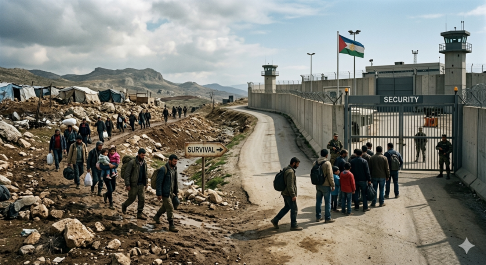
The journey from survival to security, therefore, is not merely a story of progress. It is also a story of transformation, where the original purpose of the state—to protect human beings from suffering—risks being overshadowed by its own instinct for preservation.
- The challenge for modern society is to revisit this foundation and to ask whether security is serving human welfare, or whether human welfare has been subordinated to the demands of security.
Noor Muhammad Marri, Advocate | Islamabad
Human beings did not arrive at the idea of the state in a single moment; it was the result of a long and difficult journey shaped by fear, necessity, and survival. In the earliest stages, humans lived in conditions close to the jungle, where life was uncertain and governed by sheer strength and instinct. Gradually, they moved into nomadic and semi-nomadic patterns, forming small groups for hunting and gathering. These early societies were constantly exposed to natural disasters such as floods, diseases, and scarcity of food, along with the ever-present threat of external aggression from rival groups. Survival in such conditions was fragile, and individual strength alone was not enough.
It was within this environment that the first seeds of collective organization were sown. Humans began to recognize the need for a larger, organized force that could offer protection and stability. Initially, this took the form of alliances between powerful tribes. These unions were practical arrangements aimed at mutual defense and resource sharing. Over time, such alliances evolved into more structured configurations of authority, where leadership became more defined and systems of control began to emerge. Eventually, these arrangements hardened into despotic forms of governance, where power was centralized in the hands of a few. Despite this concentration of authority, the underlying justification remained rooted in welfare and protection. The state, in its earliest recognizable form, was meant to shield people from chaos and insecurity.
The moral foundation of the state, therefore, was grounded in the idea of collective welfare. It existed as a response to human vulnerability, a mechanism to ensure that individuals could live with a degree of safety and predictability. However, as human societies expanded in size and complexity, the character of the state began to transform. With the accumulation of resources and the emergence of ruling elites, power itself became an objective. Institutions that were originally designed to serve the collective gradually began to serve their own continuity. Security, which was once a means to ensure welfare, slowly turned into an end in itself.
This transformation became more pronounced as states came into competition with one another. External threats, territorial ambitions, and the desire for dominance pushed states to prioritize military strength and centralized control. Internally, maintaining authority required surveillance, discipline, and coercion. In this process, welfare did not disappear, but it was pushed into a secondary position. The success of the state increasingly came to be measured by its ability to maintain order, defend its borders, and assert its power, rather than by the well-being of its people.
The shift from welfare to security became unmistakable during the great wars of the twentieth century. The World War I and the World War II were not ordinary conflicts; they were total wars that mobilized entire populations and economies. Every aspect of society—industry, science, agriculture, and human labor—was redirected toward the war effort. These wars taught states a decisive lesson: in the modern world, survival depends upon military capability. Strength was no longer optional; it was essential.
Following the devastation of the World War II, this lesson did not fade. Instead, it was institutionalized during the Cold War, a period defined by constant tension and preparation for conflict. Although direct war between major powers was largely avoided, the entire global system was organized around the possibility of war. Military readiness, deterrence, and technological superiority became permanent priorities. The war industry, which had once expanded during times of conflict, became a continuous and central feature of the state.
It was in this environment that modern science and technology accelerated at an unprecedented pace. Institutions like NASA emerged not only from a desire for exploration but from strategic competition between powerful states. The space race symbolized technological achievement, yet it was deeply connected to missile development and military capability. The same rockets that could carry humans into space could also deliver destruction across continents.
The development of computers followed a similar path. Early computing systems were created to solve military problems such as artillery calculations and code-breaking. Over time, these systems evolved into the backbone of modern information technology. The internet itself has origins in defense projects designed to ensure communication during times of war. Today, fields such as Artificial Intelligence, cyber technology, and advanced data systems are increasingly integrated into military strategies, from surveillance to autonomous weapons and cyber warfare.
Even disciplines that appear purely civilian often carry the imprint of military priorities. Advances in aviation, materials science, and biotechnology have frequently been driven by defense needs. The boundary between civilian innovation and military application has become increasingly blurred, revealing a deeper pattern in the evolution of modern progress.
Thus, the state, already transformed into a security-centered institution, found in technology a powerful extension of its priorities. Scientific progress continued, but its direction was shaped by the imperatives of power and survival. The central question shifted from improving human welfare to enhancing the state’s capacity to defend and dominate. Technology became both a tool of protection and an instrument of control.
This does not mean that humanity has not benefited from these advancements. On the contrary, modern life has been profoundly improved by developments in communication, healthcare, and transportation. However, the underlying structure of innovation reveals a persistent truth: the most advanced technologies are often first developed in the service of war and only later adapted for peaceful use.
In this way, the evolution of the state and the trajectory of technological progress reinforce one another. The security state justifies its expansion through the language of threat, while technological advancement provides the means to respond to that threat. Together, they create a continuous cycle in which preparation for war becomes a permanent condition of peace.
The journey from survival to security, therefore, is not merely a story of progress. It is also a story of transformation, where the original purpose of the state—to protect human beings from suffering—risks being overshadowed by its own instinct for preservation. The challenge for modern society is to revisit this foundation and to ask whether security is serving human welfare, or whether human welfare has been subordinated to the demands of security.
Read: Nietzsche Thesis on Liberalism and Equality
__________________
 Noor Muhammad Marri is an Advocate and Mediator, based in Islamabad