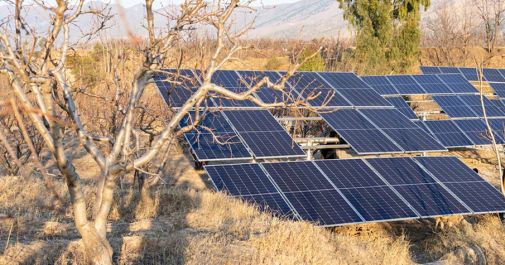
The world’s main fossil fuel production centers are unstable. As a result, demand is growing to replace oil and gas with renewable energy
By Tom Arms | London
Energy Security. The Ukraine War made it a hot topic for a Europe dependent on Russian oil and gas. The Iran War—alongside the climate change debate– has revived the issue for the rest of the world.
The world’s main fossil fuel production centers are unstable. As a result, demand is growing to replace oil and gas with renewable energy. Furthermore, the renewable energy should be produced in areas which the consuming countries control. Many countries are already doing just that. Some better than others.
Surprisingly, Trump’s “drill, baby, drill” America does well when it comes to renewable sources of energy. Forty-six percent of US electricity is produced by renewables. The bulk of it – 19 percent—comes from the world’s largest “fleet” of nuclear reactors—94 spread over 54 sites.
The next largest provider are the windmills that Donald Trump hates. They produce 10.8 percent of the country’s electricity. Nine percent comes from solar power and hydro is six percent. Energy from biomass brings up the rear with 1-2 percent.
Three of the worst countries for renewable energy—and thus heavily dependent on Middle Eastern oil—are Japan, India and South Korea. Japan (the world’s third largest economy) and India both derive only 25 percent of their electricity needs from renewables. But South Korea’s energy supplies are even less secure. Only about 9 percent of its electricity comes from renewables.
China is a bit better. Thirty-eight percent of its electricity comes from renewable sources. Solar and wind provide 18 percent, and China operates the world’s largest solar farm in Xinjiang. It covers 33,000 acres and is said to produce enough energy to power two million electric cars a year. Even larger solar farms are planned on the Tibetan Plateau.
The Tibetan Plateau is also the fount of another of China’s renewable energy sources—hydro power. The Himalayan mountain range is the source of many of the world’s great rivers which the Chinese have dammed to produce 13 percent of their electricity. But it is not as much as wind power which produces 18 percent of Chinese needs.
 Read: How the War in the Middle East Is Affecting Energy, Trade, and Finance
European countries are at the top of the scale when it comes to renewables and energy security. In the EU, an average of 45 percent of all electricity was generated from renewable sources. One of the renewable source leaders in the EU is Spain with 57 percent of its energy from renewable sources in 2025. Some diplomatic observers maintain that Spain’s energy security contributed to Prime Minister Pedro Sanchez’s tough stance towards Donald Trump.
France depends heavily on nuclear energy for its electricity supply. It boasts the world’s largest “fleet” of nuclear reactors after America—56 plants on 18 sites. These plants supply 61 percent of the country’s electricity. Another 18 percent comes from hydro, 15 percent from wind, three percent from solar and two percent from biomass. Only about seven percent comes from oil and gas. Coal—in common with most of the rest of Europe– provides less than one percent of France’s energy needs.
Germany used to have a large nuclear industry—29 reactors. But the Germans started to de-commission their nuclear power plants after the 1986 Chernobyl disaster. It revived slightly in the early 2000s and then plunged again after the 2011 Fukushima disaster in Japan. The last German reactor shut down in April 2023. But Germany is still able to generate 56 percent of its electricity needs from renewable sources. Most of it comes from onshore windmills, but a growing proportion of the wind turbines are in the Baltic. Offshore wind energy is popular throughout northern Europe. In Germany, windmills produce 33 percent of the country’s electricity.
Wind is also a growing energy source in Britain, especially offshore wind. A third of Britain’s electricity is produced by windmills dotted around the coast and on hilltops. In total 52.5 percent of British electricity comes from renewable sources. Unfortunately, most of the remainder comes from fossil fuels, but not from the Middle East. Eighty-six percent of Britain’s fossil fuels come from oil and gas platforms in the British and Norwegian sectors of the North Sea. About nine percent is liquefied natural gas which crosses the Atlantic from America.
The UK is thought of as wet, cold and sunless. Despite the weather, a growing source of British energy is solar. In fact, near Newport, Wales (one of the wettest parts of the UK) is Llanwern Solar Park which supplies electricity to 108,000 households.
Llanwern is the second largest solar farm. The largest is Cleve Hill Solar Park on the North Kent coast. It was connected to the national grid in July 2025.It boasts 550,000 solar panels; a 150-megawatt battery storage system to stabilize supplies and supplies electricity to 120,000 homes.
Solar power is growing in popularity because it relies more on the number of hours of daylight rather than just the intensity of the heat generated by the sun. That is not to say that hot, desert countries do not have the advantage when it comes to solar power. They do.
Saudi Arabia, with its vast hot deserts, is perfect for solar power and it plans to generate half of its electricity from the sun by 2030. Morocco is hoping to become a solar superpower. Its Noor Quarzazate complex in the foothills of the Atlas Mountains already produces electricity for more than three million Moroccan homes and a power cable has already been laid across the Strait of Gibraltar to connect with Spain’s power grid. Morocco plans to derive more than half of its electricity from the sun by 2030 and Moroccans claim that they could in future supply half of Europe’s electricity needs.
Read: Observations of an Expat: The Cost
_____________________
 Tom Arms is foreign editor of Liberal Democrat Voice. He also contributes to “The New World” magazine and lectures of world affairs. He is the author of two editions of “The Encyclopedia of the Cold War,” “The Falklands Crisis” and “America Made in Britain.”