A Tribute: Syed Muhammad Alam Shah (8 May 1942 – 6 May 2026)
By: Kalavanti Raja
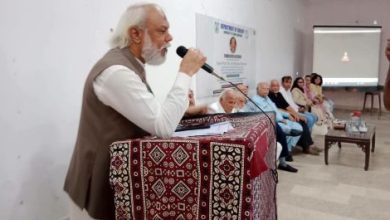
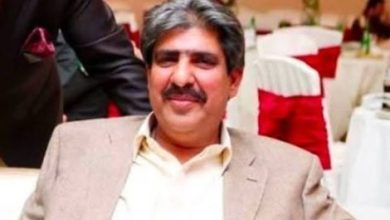
The red flag of Awami Tehreek flew at half-mast on 6 May 2026. With the passing of Syed Muhammad Alam Shah at 84, Sindh lost not just a politician, but an era of principled, uncompromising struggle. His life was a long march from the feudal courtyards of Matiari to the prison cells of martial law, from the dusty fields of Sujawal to the funeral grounds of Jalalabad. He was born into a class that rules, and he chose, every single day for six decades, to stand with the class that toils. This is his story, told with the detail his struggle deserves.
From Landlord’s Son to Peasant’s Comrade: The Making of a Revolutionary
Syed Muhammad Alam Shah was born on 8 May 1942 in Isa Pota locality of Matiari, Sindh, into a respected Syed and landlord family. The path laid before him was predictable: privilege, education, status. He began that journey conventionally enough. His early schooling took him to Darro in district Thatta. In 1961 he matriculated from Noor Muhammad High School, Hyderabad. A year later, in 1962, he enrolled at Sindh Agriculture University, Tando Jam ; a choice that reflected both family standing and the agrarian roots of his home.
 But in 1964, Alam Shah made the first of many decisive breaks with expectation. He left formal education and returned to his village to take up agriculture. For most, that would have been a retreat into comfort. For him, it became his first political education. Working the land tied him to the peasant — to their debt, their droughts, their dignity. The soil became his syllabus.
The second, irreversible turn came in 1966. Through Rajab Ali Memon, former Vice Chancellor of Sindh Agriculture University and a close associate, Alam Shah met Rasool Bux Palijo. Palijo’s revolutionary thought — rooted in Marxist, Leninist, and Maoist philosophy — did not just influence Alam Shah; it transformed him. As he would later tell comrades: that meeting was when he “stepped out of the class he was born into and stood with the class that history had burdened.” From that point, he belonged not to land, but to the people.
A Personal Shade: The Man Beyond the Movement
For me, he was like a protective shade. Whenever he came to Karachi, he would surely visit my home. He would always ask about my children and family, especially inquiring, “How is my daughter?” His affection and the love he showed me will remain unforgettable throughout my life.
That was Alam Shah; a man who could debate feudalism and imperialism for hours, then sit on a floor charpai and ask a child if she’d done her homework. He carried no distance between ideology and humanity. In the world of progressive politics, where personal sacrifice is common, personal warmth is rare. He had both. Leaders trusted his counsel; workers trusted his heart. And in homes like mine, his visits were not political calls; they were the arrival of an elder who remembered names, birthdays and sorrows.
Six Decades in the Trenches: Organizer, Prisoner, Builder
By 1969, Alam Shah had formally entered organized politics as President of Awami Tehreek Thatta district and a member of its Central Committee. Geography never limited him. He built cadres from Thatta and Sujawal to Hyderabad, Larkana, and Karachi. Comrades remember his style: no speech from a stage when a circle on the ground would do; no jeep when a motorcycle or public bus could reach a village faster.
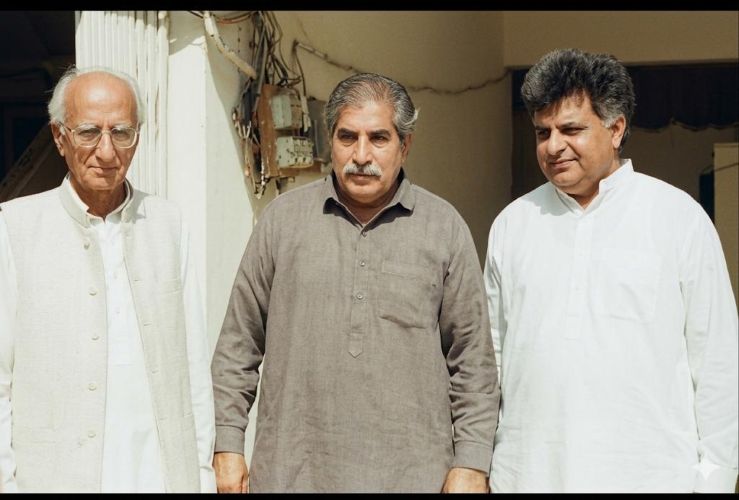 The 1970s sharpened him. In 1975 he took charge as editor of the magazine “Tehreek,” using it to defend democratic values and freedom of expression at a time when both were dangerous. The cost came in 1979. Under Zia’s martial law, he was arrested for publishing anti-regime material and imprisoned for nearly two years. Prison did not break him; it deepened him. He emerged with the same resolve, but with the moral authority that only jail can give a political worker.
The 1980s were the furnace of the Movement for the Restoration of Democracy. Alam Shah stood shoulder to shoulder with Fazil Rahu and worked closely with Qazi Ghaffar, remaining in Palijo’s inner circle. His stature grew beyond Sindh. In 1986 he was elected President of the Awami National Party, Sindh chapter, working with Khan Abdul Wali Khan. By 1987 he rose to Senior Vice President of ANP nationally. In 1988 he became Central General Secretary of Awami Tehreek — a position of trust he would hold in various forms for decades, becoming Central Senior Vice President in 2009.
He did not avoid electoral politics, but he never made it his purpose. In 1988 he contested from the Sujawal constituency on the ANP’s lantern symbol. The campaign became legend in Darro, where Sajag Baar Tehreek youth organized evening torch marches that turned elections into political schools. He lost the seat. He won the people.
 Declassing: The Politics of Personal Example
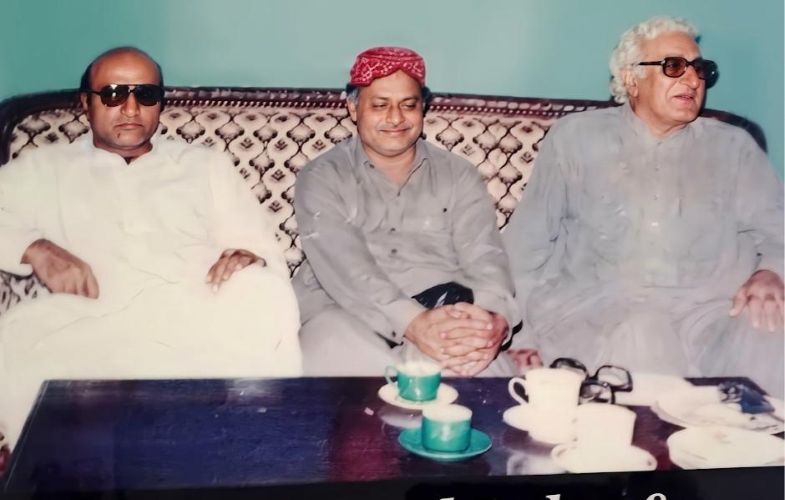
What separated Alam Shah from many born to privilege was declassing; a conscious, daily rejection of feudal behavior. He shed the cultural markers of a Syed landlord. He refused to let his birth decide his politics. That choice cost him: traditional circles kept distance. But among workers, peasants, students and political prisoners, it earned him a credibility no title could buy.
He spent his personal wealth on the movement. Funding rallies against Kalabagh Dam in Darro in 1998. Organizing June 10 rallies in Thatta for the martyrs of May 22. Supporting election campaigns for Sardar Anwar Soomro in 1990 and 1993. Traveling modestly, joining door-to-door fundraising, sitting with comrades at Standard Book House on Zeb-un-Nisa Street, Karachi; the haunt of leftist intellectuals like Professor Zafar Arif. His humor was his diplomacy. He called his method “WAPDA”; his own shorthand for untangling complex political knots with tact and wit. He maintained friendships across lines, from Benazir Bhutto to Ghulam Ishaq Khan, from G. M. Syed to Mumtaz Ali Bhutto. He believed you could disagree without being disagreeable, and resist without being rigid.
Beyond Borders: Solidarity as Practice
Alam Shah’s internationalism was not rhetorical. Twice in the late 1980s he traveled to London during Rasool Bux Palijo’s medical stay with Sarwar Bari and Dr. Farzana Bari. But his most defining journey was in January 1988, to Jalalabad, Afghanistan. With Mir Afzal Khan, he attended the funeral rites of Khan Abdul Ghaffar Khan. He helped lower Bacha Khan into the grave — a moment of history he carried in his bones. The ceremony, attended by Afghan President Mohammad Najibullah, was shattered by a bomb blast that killed dozens. He survived. The lesson he took was not fear, but the cost of freedom.
Loss, Land, and Unbroken Principle
His life was not without deep personal wounds. He endured the loss of his wife Fakhr-un-Nisa and his grandson Shayan Shah. In later years, illness came. He bore it with quiet resilience, cared for by a devoted family. Even the illegal occupation of his land in Matiari and the silence of institutions did not move him to violence. Others urged force. He refused. “We do not risk human lives for material recovery,” he said. For him, restraint was not weakness; it was ideological strength.
Ministries were offered. Business interests were dangled. Influence was available. He turned them all away. Politics, to him, was never a ladder. It was a lifelong responsibility to the oppressed. Asked what he would do if given life again, his answer never changed: “The same path, the same struggle, for humanity.”
 The Closing of an Era, Not the End of a Struggle
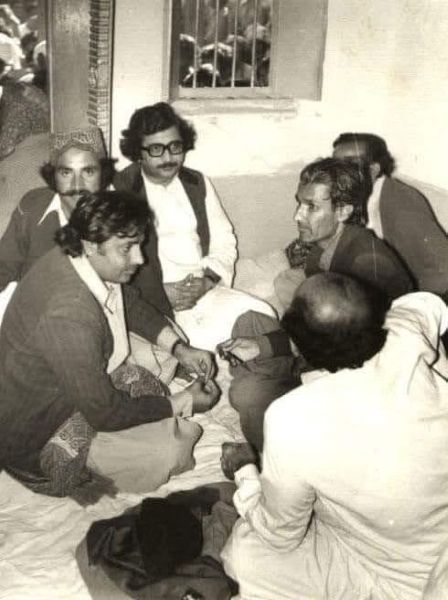
It is sad news for all pro-people political workers that one era of struggle has come to a close with the departure of Syed Muhammad Alam Shah. He did not merely live a life; he waged it. He paid the price that real struggle demands: his youth, his energy, his inherited wealth, his health, his personal peace, even the comfort of family life. He faced brutality, jail, and life threats, but compromise was never an option. For him, retreat was betrayal.
He stood firmly against feudal domination, economic exploitation, and all structures that reduce human beings to subjects. He believed, practiced, and propagated a simple but radical truth: that every human being has an equal right to dignity, freedom, and justice.
His role in the Movement for the Restoration of Democracy stands as a defining testament to his courage. In a time when repression was policy and fear was widespread, he chose defiance. He mobilized, resisted, endured imprisonment and torture, yet never allowed the machinery of the state to break his will. That was not just political participation; it was ideological commitment in its purest form.
With his departure, we do not just lose a person. We witness the closing of a chapter of committed, ideological politics. But such lives do not end. They merge into the ongoing struggle; into every voice that refuses injustice, into every hand that rises for equality.
Syed Muhammad Alam Shah is survived by the movement he helped build, the comrades he mentored, the family that stood by him, and the countless ordinary people who saw in him proof that a different kind of leader is possible: one who chooses principles over privilege, and service over status.
Red Salute, Saeen. Your shade remains.
Read: Deepa Mehta: Voice of Courage
______________________
Kalavanti Raja is a social and political activist from Gambat, Khairpur Mirs, with 30 years of work on women’s rights, minorities, and social justice. She has served in Sindhiyani Tahreek and participated in national and international forums across Asia, Europe, and America.. She can be reached at kalavanti.raja@gmail.com