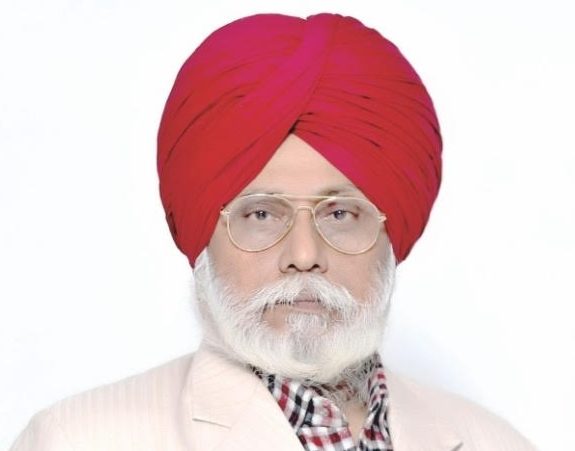
Man is not even a social entity. He belongs to the cosmos. And his essential education should be to connect him back to the cosmic reality- Dr. Jernail Singh Anand
Interviewed by Maja Milojković
1.
“If you had to describe yourself in one word—not as a poet or a professor, but as a human being—what would that word be, and why?”
Cosmozen. Because I believe that man is never an individual entity. He is not even a social entity. He belongs to the cosmos. And his essential education should be to connect him back to the cosmic reality. We are citizens of our cities, but, as members of this cosmos, we are Cosmozens. This word is rooted in cosmic awareness and cosmic responsibility. We must rise above our petty personal interests, and think of our duties as cosmic beings. It goes far beyond nations and nationalities. Because nations are artificial entities. The moment we start feeling we are a part of this cosmos, our hatreds, jealousies, anger and distrust will evaporate. It has to be understood and realized by every person that he is here to perform a duty as a human beings and the foremost of all, is to strike a harmony between his person and the impersonal forces, and remain helpful to the designs of the Almighty.
2.
“As a co-author of the Bio-Text Theory, do you believe that literature today shapes human beings more, or that human beings shape literature?”
Literature, by and large, is an active force which does not actively lead the world, but forms an ethical synthesia directs its movement towards a better value system. Literature is shaped by human beings down the ages, and how much literature shapes human conduct is open to debate. In my opinion, literature is only a very small fraction of the influences which shape the thinking patterns of human beings. The forces which actively work on their mental and psychological formations are contemporary politics, and social necessities in which survival is a major question. What shapes a modern man, the answer is very clear. It is social forces which articulate his mental architecture, and literature, if he is interest in it, does exert a moral pressure on his choices. As at presence, literature has been lying isolated in libraries, and only scholars visit these cold stores. For the general run of humanity, literature does not matter much. It is painful to see that we have a vast reservoir of great literature coming to us from our previous centuries, yet it has impacted the scholarly circles only, and is used in literary discussions, which have hardly any impact on how the ordinary people live and think. This is a flaw which has never been addressed by scholars. The wisdom of centuries does not flow into the lives of the people for whom literature is being written. The neglect that literature has suffered during the present times is also responsible for creating a society which is blatantly commercial and down to earth. To use an expression from William Wordsworth, they have no “interest unborrowed from the eye”.
3.
“You have received numerous international awards. Which recognition has most changed your perspective on your own work—and why?”
The most important international award that came to my way was the Charter of Morava followed by Seneca Award ‘Laudis Charta’. Charter of Morava was conferred by Association of Serbian Writers, Belgrade, which conferred on me Honorary Membership, and my name was inscribed on the Poets’ Rock. These recognitions brought my work into the notice of the literary elite after which the Academy of Arts and Philosophical Sciences, Bari, Italy, conferred on me the Seneca Award. The Serbian Award was followed by the publication of my work Epicasia in two volumes, which contained 12 epics written by me, and it was dedicated to Serbia and Dr. Maja Herman Sekulic. This connection changed my own perspectives as well. As my work has continuously grown in volume and spread, at present I have a tally of 200 books out of which 18 are epics, and I have a feeling of fulfilment when I see my work being acknowledged all over the world.
4.
“As President of the Academy of Ethics, how do you see the role of ethics in a modern world where technology often advances faster than moral norms?”
International Academy of Ethics has been established in an effort to make the idea of ethics a household name. Our Ethical Alphabet has caught the imagination of several teachers and students are quite comfortable with it, when they make small posters showing E for Ethics and K for Kindness. In addition to it, we have proposed that on every graduate or postgraduate degree certificate, there should be an oath signed by the student, that he will not use his knowledge for harming the interests of the human community. In this way, we are trying to foster consciousness among the youth regarding a life of righteousness. We also focus on a new idea, to tell the youngsters, what not to do. For example, not to hurt anyone, not to tell lies, not to steal things. When a young child is made to think of right and wrong, he will develop into a man who has a higher sense of the ethical values.
So far as the advance of technology is concerned, I would like to say that when we try to drive a car, the first thing that we check is: its brakes. Technology is also a fast pacing rocket, and would you like that it has no brakes? Ethics apply brakes on our passion for unbridled growth and success. The Universities are churning out technocrats and IT specialists, who have nothing to do with ethics. The IAE wants to create human beings with a highly developed sense of cosmic responsibility, not just self-centered automatons.
5.
“Your work brings together spirituality, literature, and ecology. After 200 books, what is something you still feel you haven’t managed to express—something that continues to stay with you as a persistent thought?”
In my books, one after the other, I have pursued with a dream: to bring higher thought to the ordinary people, and make them think of things higher than just survival. I think the scholars are discussing things among themselves, and knowledge is lying frozen in refrigerators. That is why, in spite of great Universities like Oxford, Harvard and Indian universities which have a high ranking, we have not been able to impart to the our scholars, a higher sense of being human. Even literature has been side-lined, and what matters finally with our students is subjects which bring higher packages, or departments which bring power and wealth [civil services, etc.]. The idea of education as a service to society has died long ago. We have to reorient our education to teach what the present and the future needs, instead of focusing on the past.
If men are not human, it is because our teaching has been flawed. We find no problem if a person ignores his duties, and keeps garnering wealth. There is a huge sickness in society, because the value system has destabilized and criminalized the idea of goodness, and integrity. We need to reverse this prevailing sickness, and recraft the educational focus on humanity, literature, and, as I said earlier, every student, before he leaves the portals of the University, must give an affidavit that he will not use his knowledge for destroying the values of this society. We need a new ETHICAL CONSCIOUSNESS to fight the onslaught of technology. Technology is like fire. Fire can be used for a thousand good things, but it can also be used for destroying habitations. Similarly, it is man’s wisdom which needs to be honed so that he uses technology only for the benefit of mankind. WE have knowledge, but we lack ESSENTIAL, ORIGINAL AND ELEMENTAL WISDOM.
Read: Third Dimension Thinking: Beyond Dualities
___________________
 An India poet and philosopher hailing from Chandigarh, Dr. Jernail S. Anand, with 200 books [18 epics] to his credit, is a formidable presence in the contemporary world literature, a polymath, and a vital architect of the 21st century ethical literature whose seminal work ‘Lustus: The Prince of Darkness’ challenges the moral complacency of our era. Founding President of the International Academy of Ethics, and Laureate of Charter of Morava [Serbia], Seneca [Italy], Franz Kafka [Germany, Ukraine, Czech Rep], Maxim Gorky [Russia] Soka Ikeda [Japan] and Mahankavi Bharathi [India] awards, his name is inscribed on the Poets’ Rock in Serbia. He is an Honorary Member of the Serbian Writers Association, Belgrade, a Member of the Honorary International Boule and Honorary Academic Senator of International Academy of Rome, and an Academic Member of the Academy of Arts and Philosophical Sciences, Bari [Italy]. Anand has built a poetics that unites ethics, Vedic spirituality, social critique, and the philosophy of meaning. Anand presents an articulated perspective on poetry as an instrument of planetary consciousness. A moral philosopher, professor, and international speaker, Anand has devoted much of his research to the ethical dimension of language, to the responsibility of the individual within a globalized society, and to the relationship between matter, consciousness, and transcendence. Email: anandjs55@yahoo.com.
 Maja Milojković was born in Zaječar, Serbia. She is the deputy editor at “Sfairos” publishing house in Belgrade, Serbia. She is the vice-president of the association “Rtanj and Mesečev poetski krug”. She is the author of 2 books: “The Circle of the Moon” and “Trees of Desire”. She is the editor of the International Anthology “Rtanjski stihopevi”. One of the founders of the poetry club “Area Felix” from Zaječar, Serbia and the editor of an international e-magazine for creative literature and culture “Area Felix”.