Flash lights of motorcycle have become a road-safety hazard in Sindh
- Growing use of high-intensity and improperly fitted motorcycle lights raises concerns for drivers, riders and pedestrians across highways, rural roads and urban streets
By Nuzair Ahmed Jamro
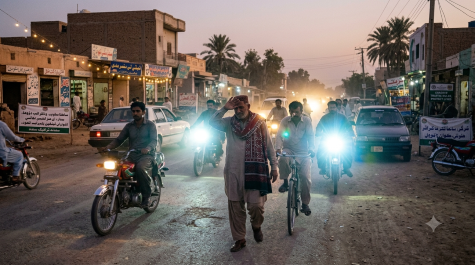
At night, a clear view of the road can make the difference between reaching home safely and becoming involved in a serious accident. Yet on many roads across Sindh, motorists and motorcyclists increasingly face another challenge: extremely bright, modified and sometimes improperly positioned motorcycle lights.
The trend is particularly noticeable among young riders, some of whom install powerful LED or high-intensity lights on motorcycles, including around the handlebars, near the mirrors or on both sides of the motorcycle. In some cases, these lights appear considerably brighter than the standard headlamp and are used even when other vehicles are approaching from the opposite direction. For the rider, the purpose may be to improve visibility, enhance the appearance of the motorcycle or simply follow a popular modification trend. However, when a light is excessively bright, incorrectly aimed or used without consideration for approaching traffic, it can produce glare and make it difficult for other road users to see clearly.
This raises a legitimate road-safety question: how bright is too bright, and when does a useful headlight become a hazard for others?
A Growing Concern, But Not a Proven Cause of Every Accident
It is important to approach this issue carefully. Not every LED or aftermarket motorcycle light is dangerous, and motorcycles need effective headlights, particularly on highways and poorly illuminated rural roads. The concern is specifically about lights that are excessively bright, improperly aimed, incorrectly mounted, flashing or otherwise not compliant with applicable vehicle-safety requirements. There is, however, official recognition that excessive and unauthorized vehicle lighting can create a serious visibility problem.
In a response submitted to the National Assembly, the National Highways and Motorway Police said that indiscriminate use of high beams and unauthorized or modified high-intensity vehicle lights can produce glare and cause a temporary visual impairment for other road users. NHMP described the practice as a potential road-safety hazard. The warning is significant because it comes from the agency responsible for enforcing traffic safety on Pakistan’s motorways and national highways.
Thousands of Lighting Violations Recorded
Official enforcement figures also show that improper lighting is not a minor issue. According to NHMP data for January 1 to December 15, 2025, officers issued: 145,494 tickets for failing to dip headlights for other traffic; 13,431 tickets for driving at night without proper lights; 345 tickets for failure to observe prescribed lighting hours; and 8,656 high-intensity lights were removed. The fines imposed for the three reported lighting-related violations totaled approximately Rs212.994 million.
These figures do not establish how many crashes were caused by high-intensity motorcycle lights. Nevertheless, they demonstrate that improper use of vehicle lighting is already a recognized enforcement concern on Pakistan’s highways. That distinction matters. A responsible road-safety debate should acknowledge what the evidence establishes while avoiding claims that cannot yet be proved.
A Wider Road-Safety Crisis in Interior Sindh
The concern over motorcycle lighting must also be viewed within the broader road-safety situation in Interior Sindh. The region’s highways carry buses, trucks, cars, motorcycles, rickshaws, agricultural vehicles and pedestrians, often through areas where road lighting is limited. Consequently, even ordinary driving can become challenging at night.
Recent accidents reported in the region illustrate the seriousness of the problem.
In February 2025, two separate accidents involving vehicles carrying devotees to Sehwan resulted in 16 deaths and 45 injuries. In one incident near Ranipur in Khairpur district, 11 passengers died and 35 were injured when a bus collided with a rickshaw on the National Highway. In another crash near Qazi Ahmed, five people died and 10 were injured.
In April, five people were killed and 10 critically injured when a speeding van and an SUV collided on the Mehran Highway near Karoondi in Khairpur district. Those injured reportedly attributed the crash to speeding by both vehicles. Another accident near Gambat in April claimed the lives of a father and his two daughters, while four other people were injured when a car and passenger coach collided. Police cited possible loss of control or driver fatigue, while noting that the precise circumstances were not immediately established.
In July, six people died and 16 were injured when a passenger van overturned on the National Highway near Gambat. The report said the van’s rear tyre deflated before the vehicle overturned. Later that month, three people were killed when a speeding container-mounted trailer struck a parked tractor-trolley near Khairpur. In September, three men riding a motorcycle were killed after a passenger coach struck their motorcycle near Pir Budhiro on the Mehran National Highway in Khairpur.
These incidents had different reported causes and circumstances. Therefore, it would be inaccurate to suggest that motorcycle lights caused these deaths. What they do demonstrate, however, is that road users in Interior Sindh are already operating in an environment where speed, vehicle condition, road design, traffic behavior and visibility can all affect safety.
The Problem Becomes More Serious at High Speed
Bright lights become particularly concerning when combined with high-speed riding. A motorcyclist travelling quickly gives an approaching driver less time to identify and respond to the motorcycle’s movement. If the motorcycle is also producing intense glare, the approaching driver may find it more difficult to judge its exact position and speed.
The same applies in the opposite direction. A rider exposed to the headlights of an approaching vehicle may have difficulty seeing pedestrians, road edges, animals, potholes or vehicles ahead. This does not mean that every accident involving a motorcycle with bright lights is caused by those lights. Rather, excessive glare represents a potentially avoidable risk that deserves the same attention as other road-safety factors.
Young Riders and the Motorcycle Modification Culture
The popularity of motorcycle modifications among teenagers and young adults is another aspect that deserves discussion. For many young riders, modifying a motorcycle is simply a hobby. Better-looking lights, decorative accessories and LED systems can make a motorcycle appear more modern and attractive. There is nothing inherently wrong with motorcycle customization when it remains within safety and legal requirements.
The difficulty begins when appearance or brightness takes priority over the safety of other road users. A young rider may see a powerful light as an advantage because it illuminates the road ahead. However, the same light may appear painfully bright to someone approaching from the opposite direction. Therefore, awareness is just as important as enforcement.
Young riders should be encouraged to understand that responsible riding is not about having the brightest light or the fastest motorcycle; it is about being able to see and being seen without endangering others.
The Answer Is Regulation, Not a Blanket Ban
There have been calls for a complete ban on powerful motorcycle lights. However, a blanket prohibition would not necessarily be the most practical solution. Motorcycles need good lighting. In many parts of Interior Sindh, roads and village approaches are poorly illuminated, making an effective headlamp essential. The better approach would be to establish and enforce clear standards.
Authorities could specify:
- Acceptable headlight intensity;
- Proper beam alignment;
- approved mounting positions;
- Permissible colors;
- Requirements for high- and low-beam operation;
- Restrictions on flashing or strobe lights; and
- Standards for front and rear visibility.
This would allow riders to use effective lighting while preventing equipment that creates unnecessary glare for other road users. Traffic Enforcement Should Focus on Night-Time Violations. Traffic authorities could conduct targeted inspections during evening and night hours, particularly on highways, major district roads, village crossings and busy market areas.
During these inspections, officers could check motorcycle headlights, high- and low-beam operation, rear lights, indicators, mirrors, helmets and other basic safety equipment. Where a lighting modification is found to be unlawful or dangerously non-compliant, the appropriate legal action should be taken.
At the same time, enforcement should be proportionate. A rider with a minor first-time violation should have the opportunity to understand and correct the problem, while repeated violations and dangerous riding should attract stronger penalties.
Motorcycle Workshops Also Have a Role
The responsibility should not fall entirely on riders. Motorcycle accessory shops and modification workshops are an important part of this growing market. If unsafe lights are being sold and installed, authorities should consider whether these businesses are complying with applicable vehicle standards. Clear guidelines could help workshops understand which lighting systems are appropriate for public-road use.
Where legally appropriate, repeated installation of prohibited equipment could result in penalties or action against the business. This approach would address the problem at both ends of the supply chain: the person installing the equipment and the person using it.
Should Violators Face Heavy Fines or Imprisonment?
Public concern is understandable when dangerous driving contributes to serious injuries or deaths. However, penalties should be proportionate and based on the seriousness of the offence. A simple lighting violation could result in a fine and removal of the non-compliant equipment.
A repeat offender could face higher fines and license-related consequences where permitted by law. Where reckless or dangerous driving is established and the conduct results in serious injury or death, prosecution should take place under the applicable criminal and traffic laws. In this way, the law can distinguish between an equipment violation and genuinely dangerous conduct. The objective should be strong enforcement without arbitrary punishment.
Better Accident Data Is Essential
Perhaps the biggest weakness in the current discussion is the lack of comprehensive publicly available data showing how many road crashes in Interior Sindh specifically involve dangerous motorcycle lighting. This gap can be addressed. Whenever a night-time accident is investigated, police and relevant agencies could record whether:
- High beams were being used;
- Modified lights were installed;
- Excessive glare was reported;
- The vehicle had appropriate lighting;
- Mirrors and indicators were functioning; and
- Lighting may have contributed to the circumstances of the crash.
Over time, such records would provide researchers and policymakers with reliable evidence. Until then, claims about the exact number of deaths caused by modified motorcycle lights should be avoided.
The Wider Picture: 609 Highway Crashes in One Year
The scale of the broader highway safety problem is already substantial. The NHMP’s 2024-25 Year Book recorded 609 accidents on the motorways and highways under its jurisdiction during that year. These included 308 fatal and 301 non-fatal accidents, resulting in 503 deaths and 1,250 injuries.
These figures cover NHMP’s motorways and highways nationally and should not be presented as Interior Sindh-specific statistics. Nevertheless, they underline an important point: road safety requires attention to many contributing factors. Driver behavior, speeding, overtaking, vehicle condition, road design, lighting and visibility all deserve consideration.
The National Assembly response from NHMP also stated that driver-behavior factors including careless driving, sudden lane changes, wrong overtaking, improper U-turns, distracted driving, sharp cutting and failure to maintain a safe following distance collectively accounted for approximately 51.6 per cent of reported accidents in its 2025 data up to November. Therefore, dangerous motorcycle lighting should be addressed as one part of a broader road-safety strategy, rather than being presented as the single explanation for road deaths.
A Public-Awareness Campaign Could Help
Sindh could consider a province-wide awareness campaign focusing on responsible motorcycle lighting and night-time riding. A simple message could be used:
“Don’t Blind the Road, Use Your Lights Responsibly.”
The campaign could be promoted through schools, colleges, driving schools, motorcycle markets, social media, traffic checkpoints and local communities. The message should not be directed only at young riders. Commercial drivers, car owners and all motorists should be reminded of the importance of dipping headlights and avoiding unnecessary glare. After all, the problem of dazzling lights is not exclusive to motorcycles.
Every Road User Has a Right to See
A highway is shared by everyone. A bus driver has the right to see the road ahead. A car driver has the same right. A motorcycle rider travelling in the opposite direction also needs clear visibility. Meanwhile, pedestrians, children and elderly people are often the most vulnerable when crossing roads. Or that reason, the principle should be simple: lighting should improve visibility without unnecessarily reducing the visibility of others.
Sindh already faces serious challenges involving speeding, dangerous overtaking, road conditions, vehicle safety and compliance with traffic rules. Consequently, every avoidable risk should be taken seriously. The issue of modified motorcycle lighting should therefore be approached with evidence, fairness and common sense.
Conclusion: A Shared Responsibility
The growing use of excessively bright and improperly fitted motorcycle lights is a concern worth addressing, but it should be discussed responsibly. At present, there is insufficient evidence to claim that these lights caused a particular number of deaths in Sindh. However, official highway authorities have recognized that excessive and unauthorized lighting can create glare and temporary visual impairment, while enforcement figures show that lighting violations are already widespread.
The answer is neither to blame all motorcycle riders nor to prohibit useful lighting. Instead, authorities should establish clear technical standards, remove dangerous modifications, regulate commercial installation where necessary, conduct night-time inspections and apply proportionate penalties.
At the same time, rider’s especially young people need greater awareness about the consequences of excessive speed, reckless riding and dazzling lights. Workshops and motorcycle dealers should also play their part by promoting equipment suitable for safe road use.
Most importantly, Sindh needs better accident data. If police and investigators systematically record whether glare, high beams or modified lighting were present in night-time crashes, future road-safety policies can be based on evidence rather than assumptions.
Ultimately, road safety is a shared responsibility. Everyone using a public road has the same basic right: to see clearly, react in time and reach home safely. A motorcycle headlight should illuminate the road not turn the road into a field of glare for those coming in the opposite direction. The goal is simple: safer lights, responsible riding and safer roads for everyone in Sindh.
Read: The Green Road Corridors
__________________
 Hailing from Shikarpur, Sindh, Nuzair Ahmed Jamro is a civil servant and MS research fellow in Public Administration. He writes on governance, public policy, and digital transformation. Email: najamro@gmail.com.