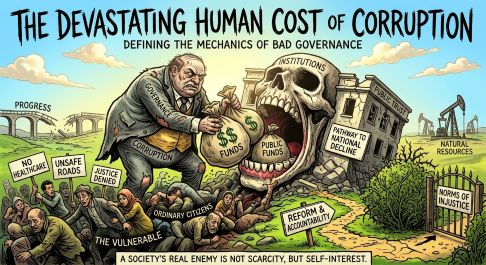
Exploring how bad governance hollows out institutions, destroys public trust, and disproportionately impacts ordinary citizens, while offering a clear pathway toward institutional reform and civic accountability.
Author discusses the core mechanisms that lead to national decline, asserting that systemic corruption and normalized injustice pose a far greater threat to a society than mere financial or resource constraints.
By Hakeem Prem Chandwani
A nation does not decline merely because its economy is weak, its institutions are burdened, or its resources are limited. The deeper danger begins when corruption becomes normal and injustice becomes acceptable. At that point, governance ceases to be a public trust and gradually becomes an instrument of private interest.
Corruption is not simply the taking of a bribe. It is the selling of responsibility, the manipulation of rules, the misuse of authority, the concealment of truth, and the conversion of public resources into personal privilege. Injustice, meanwhile, is not confined to a courtroom. It exists whenever merit is pushed aside, rights are denied, the weak are ignored, and power receives a different standard of accountability from ordinary citizens.
Together, corruption and injustice create the architecture of bad governance.
A corrupt system does not always look corrupt from the outside. It may have impressive offices, elaborate laws, committees, regulations and official statements. But if decisions are influenced by money, connections, fear or favour, the appearance of administration remains while the spirit of governance has already disappeared.
The most dangerous stage is when people begin to believe that nothing can change.
Once citizens start saying, “This is how the system works,” corruption has achieved something more powerful than financial gain: it has captured the public imagination. People stop demanding fairness and begin searching for influence. They stop asking whether something is lawful and start asking whom they know. They stop trusting institutions and begin trusting personal connections.
That is how a bad system reproduces itself.
Injustice deepens this crisis. When two citizens commit the same wrongdoing but face different consequences because one is powerful and the other is powerless, the law loses its moral authority. When an honest person waits endlessly while an influential person receives immediate attention, society receives a devastating lesson: integrity has a price, while influence has a shortcut.
No country can build lasting prosperity on such a foundation.
Good governance is ultimately a relationship of trust between institutions and citizens. Citizens pay taxes, obey laws, respect public institutions and contribute to society with the expectation that the state will protect their rights and administer public affairs fairly. When that expectation is repeatedly violated, trust begins to evaporate.
And once trust disappears, development becomes extraordinarily difficult.
A road may be constructed, but if its funds were stolen, its quality will suffer. A hospital may be inaugurated, but if appointments are based on favour rather than competence, patients will suffer. A school may exist on paper, but if teachers are appointed through influence and resources disappear before reaching classrooms, the building alone cannot educate a generation.
This is why corruption should never be measured only by the amount of money lost.
The real cost is measured in opportunities denied, lives damaged, talent wasted, institutions weakened and public confidence destroyed.
The poor often pay the highest price for bad governance. A wealthy person may find an alternative when a public service fails, a poor family may have no alternative at all. A powerful individual can obtain private justice, private healthcare or private education, while an ordinary citizen remains dependent upon institutions that may have been hollowed out by corruption.
Thus corruption is not merely an economic crime. It is a social injustice.
Yet the answer cannot be found only in speeches, slogans or occasional punishments. Sustainable reform requires institutions strong enough to function without fear and transparent enough to be examined without intimidation.
Public money must be treated as a public trust. Government decisions must be explainable. Recruitment must reward competence. Public procurement must be transparent. Auditing must be independent. Courts and accountability institutions must be able to operate without political, financial or social pressure. Whistleblowers who expose wrongdoing should not become its victims.
Above all, the same standard of accountability must apply to everyone.
The real test of justice is not how the powerless are treated when they make mistakes. It is how the powerful are treated when they abuse authority.
There is another dimension that is often overlooked: the culture of everyday corruption. A society cannot demand honest government while celebrating dishonesty when it serves personal convenience. If people condemn corruption in public offices but justify cheating, bribery, favoritism or deception in their private lives, the problem is deeper than government alone.
Governance reflects, to some extent, the values that society tolerates.
Therefore, the struggle against corruption must begin both above and below. Institutions must become cleaner, but citizens must also become less willing to participate in corrupt arrangements. Silence may appear harmless, yet prolonged silence gives wrongdoing the space to become permanent.
The greatest danger is not a corrupt individual.
It is a corrupt culture.
An individual can be removed. A corrupt culture replaces one individual with another.
History repeatedly demonstrates that nations do not become strong merely by accumulating wealth. They become strong when their institutions become trustworthy, their laws become credible and their citizens believe that effort and honesty have meaning.
Good governance is therefore not simply an administrative technique. It is a moral commitment.
It means that public office is service, not ownership. Authority is responsibility, not privilege. Law is protection, not intimidation. Public resources belong to the people, not to those temporarily entrusted with managing them.
A nation may survive a financial crisis. It may recover from natural disasters. It may rebuild after economic setbacks. But when corruption and injustice become embedded in the machinery of governance, the damage reaches the character of the state itself.
That damage must be confronted before it becomes irreversible.
The way forward is neither despair nor blind optimism. It is institutional courage, civic responsibility, transparency, equal justice and an uncompromising respect for public trust.
The foundation of good governance is not merely a strong government.
It is a government that deserves to be trusted.
And trust cannot be purchased with slogans. It is earned—decision by decision, law by law, institution by institution.
Where corruption is tolerated, governance loses its soul.
Where injustice is normalized, governance loses its legitimacy.
But where honesty is protected, justice is equal and public authority remains accountable to the people, governance becomes more than administration, it becomes an instrument of human dignity, social stability and national progress.
A better future begins when power learns that it is not above the law, and society learns that silence is not neutrality in the face of injustice.
Read: Live, Let Live, and Share Rights
_________________
 Hakeem Prem Chandwani, a poet and column, is based in Dokri town of Sindh. This is translation of his Sindhi article