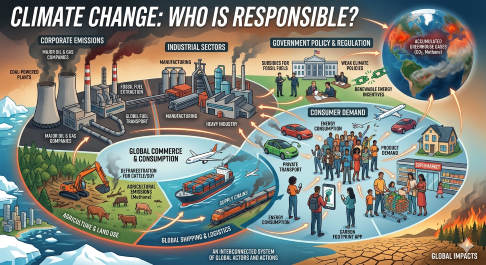
The globalization has complicated the issue of responsibility.
Sevara Matnazarova
Climate change has become one of the most pressing and complex challenges of the 21st century. Across the globe, its effects are increasingly visible: rising temperatures, prolonged droughts, stronger storms, melting glaciers, and rising sea levels threaten ecosystems, economies, and human lives. As the crisis intensifies, an important and often controversial question arises: who is responsible for climate change? While it may be tempting to point fingers at a single group, the reality is far more complicated. Responsibility is shared among governments, corporations, and individuals, but it is not equally distributed. Historical context, economic systems, and global inequalities also play a crucial role in shaping this issue.
To begin with, governments hold a primary responsibility in addressing climate change. They have the authority to establish environmental laws, regulate industries, invest in renewable energy, and participate in international agreements aimed at reducing greenhouse gas emissions. Over the years, global efforts such as climate summits and agreements have attempted to unite countries in the fight against global warming. However, many governments have been criticized for their slow response, lack of commitment, or prioritization of economic growth over environmental sustainability. Political interests, short-term goals, and pressure from powerful industries often prevent strong climate action. In addition, some countries fail to meet their emission reduction targets, weakening global progress. Therefore, governments are key actors whose decisions significantly influence the pace and effectiveness of climate solutions.
Equally important is the role of corporations, particularly large multinational companies. Industries such as fossil fuel extraction, manufacturing, agriculture, and transportation are among the largest sources of greenhouse gas emissions. For decades, certain corporations have continued environmentally harmful practices despite scientific evidence about their impact. In some cases, companies have even funded misinformation campaigns to downplay the severity of climate change and delay regulatory action. Although many businesses today are adopting greener strategies and promoting sustainability, these efforts are often criticized as insufficient or as “greenwashing”—a way to appear environmentally responsible without making meaningful changes. Given their economic power and environmental impact, corporations bear a substantial share of responsibility for the climate crisis.
At the same time, individuals also contribute to climate change through their daily choices and lifestyles. Activities such as excessive energy consumption, reliance on fossil-fuel-powered transportation, overconsumption of goods, and improper waste disposal all increase carbon emissions. Modern consumer culture, driven by convenience and mass production, encourages habits that are harmful to the environment. However, it is important to recognize that individual choices are often shaped and limited by larger systems. For example, people may rely on cars due to inadequate public transportation, or consume plastic products due to lack of alternatives. Despite these limitations, individuals still have the power to influence change by adopting sustainable practices, supporting eco-friendly policies, and raising awareness within their communities.
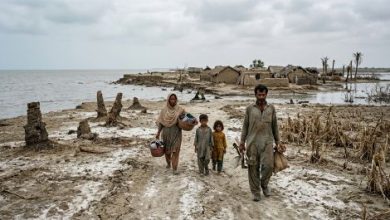
Another crucial aspect of this debate is historical responsibility. Developed nations, which industrialized earlier, have contributed the majority of greenhouse gas emissions over the past century. Their economic growth was largely built on fossil fuels, leading to long-term environmental consequences. In contrast, many developing countries have contributed far less to global emissions but are often the most vulnerable to climate impacts, such as floods, droughts, and food insecurity. This imbalance has led to discussions about climate justice and fairness. Many argue that wealthier nations should take greater responsibility by reducing emissions more aggressively and providing financial and technological support to developing countries.
Furthermore, globalization has complicated the issue of responsibility. Production and consumption are often spread across multiple countries. For example, goods consumed in one nation may be produced in another, where environmental regulations are weaker. This creates a situation where responsibility is difficult to assign clearly, as emissions are effectively “outsourced.” As a result, both producing and consuming nations share accountability for environmental damage.
In addition, the role of international organizations and global cooperation cannot be overlooked. Climate change is a borderless problem that requires coordinated efforts from all countries. However, disagreements between nations—especially regarding economic priorities and responsibilities—often hinder progress. Without strong global collaboration, individual efforts may not be enough to address the scale of the crisis.
In conclusion, climate change is a shared global responsibility that cannot be attributed to a single group. Governments, corporations, and individuals all play significant roles, but their levels of influence and accountability differ. Governments must enforce strong policies and lead international cooperation, corporations must adopt genuinely sustainable practices, and individuals must make conscious choices and advocate for change. At the same time, historical responsibility and global inequality must be considered to ensure fairness in climate action. Ultimately, solving climate change requires collective effort, long-term commitment, and a shift in how humanity interacts with the planet. Only by working together can we hope to create a sustainable future for generations to come.
Read: Education – A tool to reduce poverty
__________________
 Sevara Matnazarova is student at Urgench State University named after Abu Rayhan Beruni in Khorezm, Uzbekistan