From Moro to Nacka Stockholm – A Journey Through Letters and Time
Time changes how we communicate, but memories remain beautifully handwritten in the heart.
By Abdullah Usman Morai | Sweden
A few days ago, a message arrived informing us that we now need to collect our physical mail from the post office. It seems that new regulations in Nacka, Stockholm, where letters are delivered only to mailboxes placed on the ground floor, have reshaped the routine of our postal system. Until the arrangements are completed, I visit the post office twice a week to collect whatever paper mail still makes its way through, despite most communication having long shifted to digital platforms.
Yet when I stepped into the main post office in Nacka, something unexpected happened.
The space, the quiet hum of activity, the shelves of letters waiting to be claimed, they transported me instantly back to another time, another country, another version of myself. In that moment, I was no longer in Sweden. I was back in Moro, Sindh, a middle and high school student, full of curiosity about the world, waiting eagerly for letters from distant lands.
Those were wonderful days. Through the International Youth Service in Turku, Finland, a service that connected young people across continents through pen-friendship, I built bridges to lives and cultures I had never seen. You paid to receive addresses and gave yours in return, so sometimes you reached out first, and sometimes a surprise letter arrived from someone you had never heard of before.
 And each surprise was magical
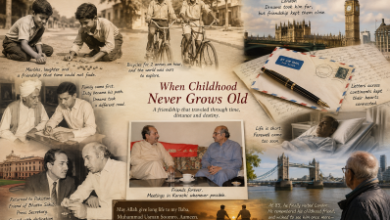
I still remember the address of my very first pen friend by heart. It was a hot afternoon when I came home from school and, as usual, stopped by Baba’s shop first. There, among ledger books and papers, lay a letter addressed to me, from Clare F., Swindon, Wiltshire, England.
Holding that envelope felt like holding the world.
Each time I received an international letter, I would pull out my world atlas, trace my finger across maps and borders, and search for the town it came from. Once I found it, I would smile, feeling somehow both small and connected to something vast and beautiful.
 Letter writing was not just communication; it was an experience
I wrote to friends not only abroad but also across Pakistan, especially in Sindh. I wrote to universities around the world for prospectuses, to tourist offices for brochures, to embassies for study and travel information. And almost every day, I visited the post office.
There, I met postman Mr. Shuhab Memon, a humble, sincere man who traveled daily from Tharushah to Moro to perform his duties with quiet dedication. The postmaster and other postal staff knew me well. Whenever I entered the post office and looked toward Shuhab from a distance, he would gently nod his head, signaling whether a foreign letter or a local package had arrived for me.
That simple nod carried more excitement than modern notification tones ever could.
Sometimes we shared tea in the sorting room. I would sit there, half-present in conversation, half-lost in anticipation of returning home to open the envelope and read new stories from another corner of the world. There are some emotions that cannot be translated into words: the excitement of waiting, the joy of connection, the thrill of discovery.
I sometimes pity new generations who may never feel that same anticipation of waiting days or weeks for a reply, of rereading handwritten letters, of recognizing a friend’s handwriting before even opening the envelope. Today, messages appear instantly, fast, convenient, and efficient, yet something deeply human seems to have faded in the process.
 And still, the world of letters has not disappeared entirely
Here in Sweden, post offices continue to function, though more communication is on other digital and modern platforms and scales. I am certain that in Pakistan, post offices, too, still operate, perhaps more quietly now, alongside private courier companies, but still carrying forward decades of service, memory, and connection.
Walking back from the post office in Nacka that day, I found a smile on my face, not just because I collected my mail, but because I revisited my own past. A teenage version of myself, curious, hopeful, and endlessly fascinated by the world.
Time changes how we communicate, but memories remain beautifully handwritten in the heart.
And perhaps, every now and then, stepping inside a post office is not merely about collecting letters but about collecting moments from our own lives that still whisper softly, reminding us where we come from.
Read: Meeting One’s Self, Seeking Peace
____________________
 Abdullah Soomro, penname Abdullah Usman Morai, hailing from Moro town of Sindh, province of Pakistan, is based in Stockholm Sweden. Currently he is working as Groundwater Engineer in Stockholm Sweden. He did BE (Agriculture) from Sindh Agriculture University Tando Jam and MSc water systems technology from KTH Stockholm Sweden as well as MSc Management from Stockholm University. Beside this he also did masters in journalism and economics from Shah Abdul Latif University Khairpur Mirs, Sindh. He is author of a travelogue book named ‘Musafatoon’. His second book is in process. He writes articles from time to time. A frequent traveler, he also does podcast on YouTube with channel name: VASJE Podcast.