Maghno Kolhi was not a man of privilege. He had no university degrees, no political office, and no inherited power
- Sindh has lost a lion of Parkar, but the world has gained a story of resistance — a testament to the power of courage, integrity, and unwavering commitment to justice.
By Kalavanti Raja
In the windswept deserts of Nagarparkar, a remote region in southeastern Sindh, Pakistan, a voice once rose from the dust — a voice that demanded justice, equality, and dignity for the marginalized. That voice belonged to Comrade Maghno Kolhi, who passed away this week in his native village of Adhigam. Sindh has lost not just an activist, but a living symbol of defiance.
 Maghno Kolhi was not a man of privilege. He had no university degrees, no political office, and no inherited power. He was a son of the Kolhi community, one of the most marginalized groups in Thar, a desert region long burdened by caste hierarchies, feudal domination, and economic deprivation. Yet, in his lifetime, his moral authority and courage made him more influential than many ministers and parliamentarians.
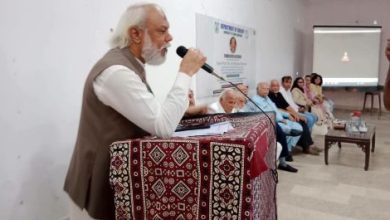
He was schooled in struggle, not classrooms. I first encountered him at a public meeting of the Awami Tehreek, a progressive political movement. Standing on a modest stage, turban tied firmly, his voice carried across the crowd like a roar. Speaking in his native Parkari dialect, he urged the poor to educate their children and resist humiliation. It was not rhetoric; it was rebellion wrapped in hope.
His journey was profoundly shaped by his association with the late Rasool Bux Palijo, a revolutionary Sindhi politician and thinker. During a false and malicious legal case in the 1990s, Palijo’s guidance strengthened Maghno’s commitment to organized struggle. Where others might have crumbled, he became unyielding.
Maghno Kolhi’s activism took him across Sindh. He marched against the controversial Kalabagh Dam, feared for its threat to the province’s ecological and economic survival. Later, when the Gorano Dam emerged as a concern for Thar’s fragile environment, he led a long march from Islamkot to Karachi — not as a politician seeking office, but as a custodian of land and dignity.
 Within the Kolhi community, Maghno Kolhi became a figure of historic significance, following in the footsteps of Rooplo Kolhi, the 19th-century warrior who resisted colonial authority. For decades, Maghno confronted illegal land occupations, caste oppression, and abuses of power. Where police brutality occurred, where feudal intimidation prevailed, he stood beside the oppressed. In a culture where compromise and convenience often prevail, he remained unbowed.
In recent years, illness slowed him. Diabetes made the long marches of his youth impossible. Yet those who met him in his final days recall a sharp mind and a restless heart, still driven by justice.
His passing in spring carries a symbolic weight. For those who struggle, hope is the season that defines life. Maghno Kolhi’s death feels like autumn in Parkar, yet his legacy remains evergreen. Movements do not die with men; they live on in memory, in example, and in unfinished tasks.
Every red flag raised in Parkar, every young activist who finds courage in adversity, continues the path he walked. In an era dominated by transactional politics, Maghno Kolhi embodied something rarer: conviction without calculation.
Sindh has lost a lion of Parkar, but the world has gained a story of resistance — a testament to the power of courage, integrity, and unwavering commitment to justice.
Red salute to Comrade Maghno Kolhi.
________________