In Sindh, Engineers are Denied Technical Allowance. Engineers Demand Recognition, Inequality and the Justice
By Ramesh Raja
Engineers are nation builders and the invisible backbone of development. Engineers stand at the center of national progress. Every bridge that connects cities, every dam that stores water, every highway that drives trade, and every power system that keeps industries running exists because of engineering expertise. They design, supervise, and maintain the entire physical and technological infrastructure of a country.
From Mangla and Tarbela Dams to modern motorways, from energy grids to telecom networks, Pakistan’s development story is deeply tied to engineers. Their work also extends to urban planning, disaster management, environmental protection, and defense infrastructure. Without engineers, sustainable economic growth and modern public services would simply not exist.
Globally, this importance is well recognized. Countries like the United States, Germany, Japan, China, and Gulf States treat engineers as high-value professionals, offering them competitive salaries, risk allowances, research incentives, and structured career growth. Engineering is not just a job in these systems, it is a strategic national investment.
The Nature of Engineering Work: Responsibility, Risk, and Pressure
Engineering is often misunderstood as a routine government profession, but in reality, it is one of the most demanding and high-risk fields in public service.
Engineers are responsible for structural safety, design accuracy, cost estimation, contract management, and field supervision. A single miscalculation can result in bridge collapse, dam failure, industrial accidents, or loss of human lives. Unlike many administrative roles, engineers carry direct technical and sometimes legal liability for their decisions.
Their working environment is equally challenging. They operate in flood-affected regions, deserts, mountainous terrain, construction sites, and emergency situations. They are frequently required to work under extreme weather conditions, tight deadlines, and 24/7 crisis situations such as floods, infrastructure failures, or power breakdowns.
This combination of technical accountability, field hardship, and public safety responsibility makes engineering a uniquely demanding profession.
Global Practice: Why Technical Allowance Exists Worldwide
In many developed and developing countries, governments formally recognize the hardship and responsibility of engineering through special financial incentives.
In India, engineers in central engineering services receive technical allowances often linked to basic pay. In Gulf countries such as UAE, Saudi Arabia, and Qatar, engineers working on mega projects receive site allowances, hardship allowances, housing, and transport benefits. In the United Kingdom, engineering professionals working in field conditions are compensated through structured allowances. Even in Europe and North America, licensed engineers enjoy higher pay scales, professional premiums, and career-based financial progression.
Pakistan’s demand for Technical Allowance is therefore not unusual. It is aligned with international practice where technical expertise and field risk are formally compensated.
Technical Allowance in Pakistan: A Long-Struggle for Recognition
In Pakistan, engineers have long demanded a Technical Allowance to bridge the gap between their responsibilities and compensation. The Pakistan Engineering Council (PEC) has consistently raised this issue, describing it as a decades-old demand and a matter of professional justice.
The issue gained formal institutional attention through parliamentary forums, particularly after discussions in the Senate Standing Committee on Science and Technology in May 2026, where implementation across Pakistan was recommended. Earlier, the Standing Committee on Government Assurances had also pushed for implementation of engineering allowances in federal departments.
The allowance structure that emerged in different government notifications is generally based on 1.5 times the initial basic pay of the BPS-2017 scale, making it a significant financial recognition of engineering services.
Provincial Implementation: A Tale of Uneven Progress
The implementation of Technical Allowance across Pakistan has been uneven, reflecting institutional and financial disparities among provinces.
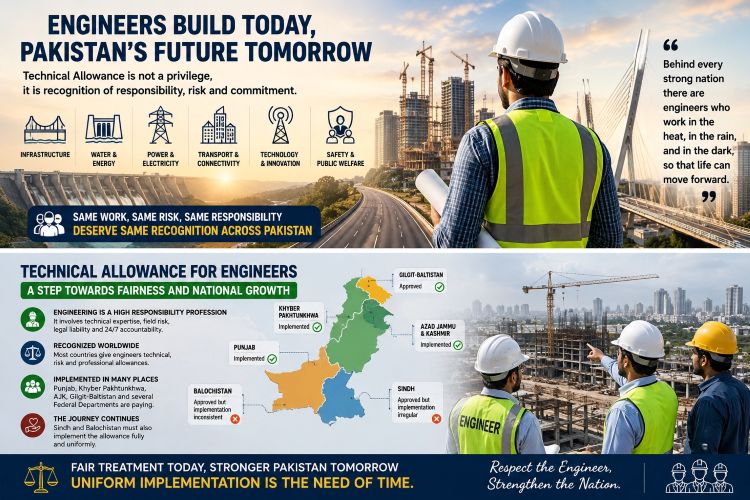
Punjab and Khyber Pakhtunkhwa have implemented the allowance more systematically, with engineers receiving regular payments in major technical departments. Azad Jammu and Kashmir and Gilgit-Baltistan have also extended similar benefits.
However, Sindh and Balochistan remain areas of concern. Although approvals have been reported in both provinces, full and consistent implementation is still lacking. In Sindh, despite cabinet-level approval, engineers continue to face delays and partial or irregular payments in certain departments. In Balochistan, implementation is also inconsistent, often constrained by budget limitations and administrative delays.
 Sindh and Balochistan: The Question of Equity and Professional Respect
The continued non-uniform implementation in Sindh and Balochistan has raised serious concerns within the engineering community. Engineers working in these provinces are performing the same technical, field-based, and safety-critical duties as their counterparts elsewhere, yet their financial recognition differs.
This disparity has created a perception of institutional inequality. It is particularly noteworthy that in Sindh, where leadership includes individuals with technical backgrounds, engineers still await consistent recognition of their professional demands. Such inconsistencies affect morale, retention, and the overall efficiency of public sector development work.
Federal Implementation and Remaining Gaps
At the federal level, several departments including major engineering organizations and infrastructure bodies have implemented Technical Allowance following Finance Division notifications issued in 2019. However, gaps still remain in autonomous bodies and some ministries where engineers continue to seek uniform application of policy.
Parliamentary oversight committees continue to monitor compliance, but full standardization across all federal entities is still in progress.
Beyond Allowance, a Question of Professional Justice
The demand for Technical Allowance is not merely about financial benefit. It represents recognition of technical responsibility, field risk, and the critical role engineers play in national development.
While progress has been made through parliamentary support, PEC advocacy, and provincial reforms, the persistence of disparities; particularly in Sindh and Balochistan; highlights the need for a unified national policy.
Ensuring uniform implementation across all provinces and federal departments would not only restore professional equity but also strengthen engineering institutions, improve motivation, reduce brain drain, and ultimately accelerate Pakistan’s development trajectory.
Engineers are not just service providers. They are builders of the nation’s future, and their recognition must reflect the weight of that responsibility.
Read: Thar Coal and the Community Rights
_______________________
 Engr. Ramesh Raja is a civil engineer and managerial/ planning professional who also contributes as a freelance writer on technical matters. He may be reached at engineer.raja@gmail.com