America: The Age of Invisible Transformation
Society, Demography, and the Quiet Reordering of Power

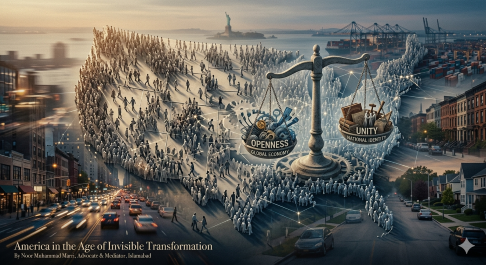
The future will not be decided only by borders or armies. It will be decided by how societies balance identity with openness, and stability with transformation.
By Noor Muhammad Marri, Advocate | Islamabad
Modern America is not only a state; it is a global idea, and today that idea is going through a deep and silent transformation. Politics is no longer limited to governments, courts, or parliaments. It now lives inside society itself—inside migration patterns, demographic shifts, media narratives, and cultural debates. What was once called “high politics” and “low politics” has now merged into one continuous struggle over identity, power, and the future direction of the state.
In earlier times, high politics meant war, diplomacy, and national security, while low politics meant culture, economy, and social life. Today this separation no longer exists. Migration affects elections, demographics influence foreign policy, and cultural debates shape national security itself. In this way, societies are no longer changed only by wars or revolutions, but by slow and continuous internal transformation.
I observe this shift as a legal professional and mediator. In modern systems, change rarely comes through visible force. It comes through institutions, policies, incentives, and population movement. A state may appear stable on the surface, but underneath, its social composition and political direction may be changing step by step. This is why many people now feel uncertainty, even in strong democracies like America.
Supporters of open systems argue that migration and globalization are natural and necessary. According to them, no modern economy can survive without movement of people, ideas, and skills. They believe diversity strengthens societies and creates innovation. In their view, identity is flexible and constantly evolving, and the strength of America lies in its openness.
However, another large section of society sees this differently. They feel that uncontrolled migration and rapid demographic change can weaken national cohesion. For them, a nation is not only an economic system; it is also a shared culture, memory, language, and sense of belonging. When this balance is disturbed, they fear that the state may lose its inner unity even if its institutions remain intact.
This is where the real debate begins in America today—not only about immigration policy, but about the future definition of the nation itself.
In strategic discussions, three historical examples are often discussed to explain how migration can become politically sensitive.
The first example is Cuba during the Mariel Boatlift. During that period, large numbers of people were sent from Cuba to the United States. Some analysts later argued that among ordinary migrants there were also individuals with criminal backgrounds and possible intelligence links. Whether fully accurate or not, this event created a lasting belief in some circles that migration flows can sometimes be used not only for humanitarian purposes, but also as a tool of political pressure. It showed that population movement can create social and security challenges inside another state without any military conflict.
The second example is Mexico and migration into the United States. Over decades, large-scale movement from Mexico into American territory has reshaped many regions in the southwest. Some political groups interpret this as a natural continuation of historical ties and economic necessity. Others argue that it has also changed the cultural and electoral balance of those regions. There are even symbolic narratives suggesting that borders do not only divide land, but also divide identities—and when people move, identities move with them. This debate is not only political; it is deeply emotional and cultural.
The third example is China, particularly related to birth tourism and long-term global strategies of its diaspora. Some Chinese families travel abroad so their children can obtain foreign citizenship at birth, especially in countries like the United States. In some cases, these children later return to China and grow up within Chinese cultural and ideological environments while still holding foreign citizenship rights. From one perspective, this is a normal global practice in an interconnected world. From another perspective, it raises questions about dual identity, long-term influence, and the meaning of citizenship itself. It reflects how modern power is no longer only territorial, but also demographic and institutional.
These examples show a common pattern: in the modern world, influence does not always come through armies or direct control. It can come through people, movement, legal systems, education, and long-term demographic change.
This is why American society today is deeply divided on questions of identity. What defines America? Is it land? Is it constitution? Is it shared values? Or is it something deeper like language, culture, and historical memory? These questions are not theoretical anymore—they are political realities shaping elections, policies, and public debates.
Similar discussions are also visible in Europe and other parts of the world. Globalization promised unity, economic growth, and cultural exchange. But at the same time, it also created anxiety about identity, sovereignty, and social cohesion. Many societies now feel caught between openness and protection, between diversity and unity.
As a mediator, I see this as a balance problem rather than a pure political conflict. Every society must manage two needs at the same time: openness to survive economically, and cohesion to survive socially. If openness becomes absolute, identity weakens. If closure becomes absolute, growth and innovation suffer. The challenge is to maintain equilibrium.
Another important factor in today’s world is technology. Social media and digital platforms have made it possible for ideas, emotions, and political narratives to spread instantly across borders. This has turned information into a form of power. Public opinion can shift rapidly, and societies can become polarized within days. In such an environment, perception often becomes more powerful than reality.
Because of this, modern politics is no longer only about policies; it is about narratives. Whoever controls the narrative often influences the direction of society more than traditional institutions.
Citizenship has also changed in meaning. Earlier, it was a stable identity tied to one nation. Today, many individuals live with multiple affiliations—economic, digital, cultural, and national. This creates opportunities, but also confusion about loyalty and belonging. The question is no longer only “Where do you belong?” but also “To what extent do you belong?”
At the heart of all these debates lies a deeper issue: the changing nature of power. Power is no longer always visible. It does not always come through force or law. It now operates through systems, institutions, population flows, education, and long-term social change. This makes it difficult for ordinary citizens to fully understand how societies are being shaped.
This is why many people feel that change is happening faster than their ability to understand or control it. It creates fear in some and hope in others.
In my view, the real challenge for America—and for all modern societies—is not to reject change, but to understand it. No society can remain static. But every society must decide how to manage change without losing its core identity.
The future will not be decided only by borders or armies. It will be decided by how societies balance identity with openness, and stability with transformation.
The central question remains simple, but very powerful:
Can a society remain united while constantly changing itself?
This is the real political and philosophical challenge of our time.
Read: State Formation and the Military Power
____________________
 Noor Muhammad Marri Advocate & Mediator is based in Islamabad