Trauma, Commodification, and Radical Empathy in Sherzod Artikov’s Fragmented Worlds
By Nguyen Quynh Huong Eira
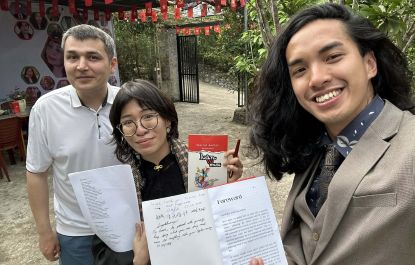
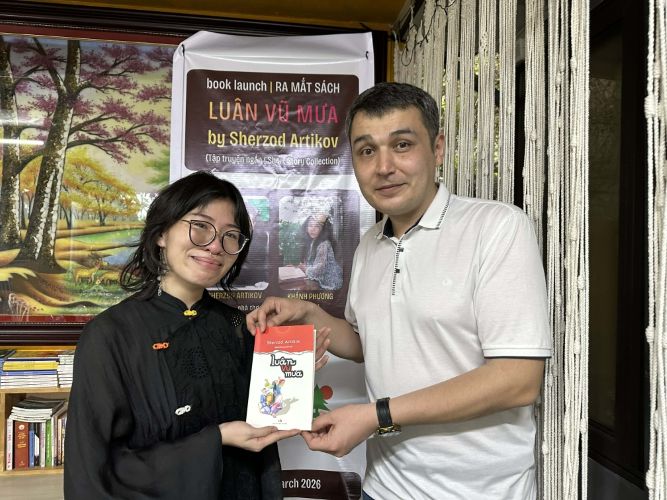
Sherzod Artikov’s short story collection Luân Vũ Mưa, translated by Khánh Phương, plunges the reader into a deeply haunting setting of human suffering, where the structure of the book speaks just as loudly as its devastating content. Deliberately presenting as a collection of isolated narratives, the book brilliantly mirrors the alienated, disconnected lives of the protagonists, and Artikov’s work, including stories such as Bản giao hưởng mùa thu (Autumn Symphony), Chiếc mfiy tính xfich tay màu đen (The Black Laptop), and Vũ công Tango (Tango Dancer), are jigsaw pieces that show humans’ fragility.
Being a mixture of Franz Kafka’s existential alienation and Primo Levi’s sobering humanism, Artikov’s oeuvres carefully look at the causes of human hopelessness. He moves seamlessly from intimate suffocations of domestic abuse to the vast, generational scars of war and modern diaspora. Through the lenses of trauma theory, feminist critique, and Marxist socio-economics, Artikov paints a devastating portrait of survival in which people must keep on living in a world driven by apathy and violence.
 To understand Artikov’s landscape of despair, one must first consider how he weaponises the setting to externalize psychological trauma. This theme becomes particularly apparent when examined through the lens of trauma theory, especially in Cathy Caruth’s statement¹ that trauma is an overwhelming experience that repeatedly shatters the victim’s sense of time and reality. The technique is masterfully applied in Bản giao hưởng mùa thu (Autumn Symphony), when Paris is divested of its romanticism and becomes an ironic cage. Reflecting the romantic disillusionment in Gustave Flaubert’s Madame Bovary, Artikov’s narrator coldly dismisses the myth of Parisian love as merely a baseless rumour (“một tin đồn không có căn cứ”). The city’s physical atmosphere, with its ever-clouded sky and continuous rain, reflects the “autumn” of the protagonist Maftuna’s traumatised soul. Despite standing in an open, beautiful city, Maftuna finds it suffocating here (“ngột ngfit ở đây”) because there isn’t enough air (“không có đủ không khí”), which demonstrates the nature of her psychological imprisonment and how she feels trapped in her own mind. Her suffocation is, in fact, due to the intangible, crushing weight of her abusive marriage, suggesting that trauma cannot be cured by a change of geographic scenery.
This theme, the feeling of being stuck, can also be found in Chiếc mfiy tính xfich tay màu đen (The Black Laptop), where a physically paralysed protagonist is trapped in his bed. Looking out the window at the gloomy view, he kills time by counting the raindrops that fell on the indo that day (“những hfit mưa rơi đậu vào cửa sổ ngày hôm đó”). The awful slowness of counting raindrops highlights how time is distorted for a person who is not physically capable. Outside, autumn is no longer just a season; it is an illustration of his rotting body and a tribute to a life violently stopped by an unforeseeable event (“bfinh ung thư chết tifit ấy!/that damn cancer!). If the hospital and the home lose their traditional meanings of healing and comfort, they are reduced to sterile geographical coordinates for mortality.
- “…trauma is described as the response to an unexpected or overwhelming violent event or events that are not fully assimilated or experienced at the time, but only belatedly, in their repeated possession of the one who experiences them.” – Caruth, C. (1996). Unclaimed experience: Trauma, narrative, and history. Johns Hopkins University Press.
However, the core tragedy of Artikov’s characters often results from forced powerlessness. A feminist critique of Bản giao hưởng mùa thu exposes a scathing indictment of patriarchal commodification. Maftuna’s suffering begins with her father’s insistence that she marry at sixteen, when he did not pity her youth (“không xót xa đến tuổi trẻ”). Being forced to stay at home, in this sense, signifies an intellectual death when the protagonist speaks of her unfulfilled dreams of studying law and learning languages. Furthermore, the tragedy is amplified by internalised misogyny, as her mother rationalises the marital transaction by saying that everyone does it (“mọi người đều làm như thế”). Artikov brilliantly contrasts Maftuna’s grim reality with her childhood dreams of marrying a noble literary figure like Mr Darcy (Jane Austen’s Pride and Prejudice). Her story also reflects a society complicit in the patriarchal takeover of women’s basic right to self-determination, turning the female body into male property.
This psychological erasure inevitably escalates into visceral physical violence. After years of numbness, Maftuna finds a replacement for her lost dreams through pregnancy, noting that the thought of motherhood spreads happiness (“lan tỏa niềm hfinh phúc”) throughout her body. The introduction of this hope makes the subsequent violence more horrific when her drunken husband beats her so severely that it results in a miscarriage. The bitter, grotesque irony of her life is expressed in her hysterical realisation that the man who killed the child in his ife’s omb (“giết chết đứa con trong bụng vợ”) is the same man who brought his ife to Paris to have fun (“lfii đưa vợ đến Paris để vui vẻ”). Through this juxtaposition, Artikov exposes the absurdity of an abuser attempting to cover his doings with the superficial veneer of a luxury vacation.
Following such devastating physical and emotional destruction, Artikov shifts his thematic focus to the role of art, literature, music, and dance as both a life-saving tool and a victim of modern capitalism. Viewed through a Marxist framework, Artikov’s stories investigate the “alienation of labour” in the realm of art. In Vũ công Tango (Tango Dancer), socioeconomic desperation reduces a highly trained artist’s passion for the consumption of the capitalist class. The dancer, in a restaurant full of drunk and distracted patrons, feels dizzy from the stifling atmosphere (“không khí ngột ngfit”). Having wanted to devote her life to tango, a discipline traditionally associated with deep passion and dignity, she now has to dance at restaurants, bars, and events for the rich to make a living and support her family. Similarly, in Chfiy theo giấc mơ (Chasing your dream), the actor’s devotion to his craft borders on self-destruction. He becomes obsessed with trying to perfect a monologue from King Lear, and he collapses physically, surrounded by scattered scripts alongside a bottle of ine and a syringe (“chai rượu và một ống tiêm”). Through these details, Artikov’s work demonstrates that while art can provide momentary sanctuary, consuming it within a harsh, commodified world can utterly destroy the artist’s body and soul.
As the collection continues, Artikov widens his lens to examine macro-level historical traumas, bringing a deep moral ambiguity that elevates the text. In a father’s recounting of a
Nazi concentration camp, Artikov strips human existence down to mud, starvation, and the constant threat of the gas chambers. However, rather than presenting a one-dimensional binary of good and evil, Artikov complicates the narrative. When the father is rewarded with a plate of white bread for cleaning a German officer’s car, he resists the biological agony of starvation, allowing his conscience to prevent a selfish act (“hành động ích kỷ”). He ends up sharing the bread with his fellow prisoners.
The German officer sees the scene and is now baffled, asking why the father would give away his only piece of bread. The fascist mentality, based on a strict hierarchy of power and survival of the fittest, cannot comprehend self-sacrifice. Artikov forces readers to face a stunning moment of ambiguity when the German officer mutters, “Got vergib uns, ir sind alle Geschöpfe” (God forgive us, e are all creatures). By giving the Nazi officer a moment of conscience and the realization of his dehumanisation, Artikov denies the readers’ simple judgements. Like Primo Levi’s reflections on the “grey zone” of the camps (The Dro ned and The Saved), Artikov has proved that human solidarity is indestructible. The sharing of the bread not only reclaims the prisoners’ humanity, but it also reveals the spiritual emptiness of the oppressors.
Moving from the horrors of the past to the insidious tragedies of the present, Artikov turns his attention to the modern diaspora and domestic apathy. In stories about migration, where the central theme is the concept of the “empty home,” the author critiques how globalisation hollows out families: Zarina’s father leaves for work in Moscow, leaving a void; his letters are obvious symbols of burden, requesting more cigarettes instead of offering connection; the old teacher Rasul Azizovich, who looks at the crowds rushing home for New Year’s Eve, laments a son who went abroad for a degree and is no far, very far a ay! (“giờ nó đang ở xa, rất xa rồi!”).
Finally, Artikov returns to the theme of alienation in the intimate space of the modern marital home, depicting modern domestic apathy as a kind of emotional starvation. In Căn hộ trên tầng bốn (The Apartment on The Fourth Floor), a wife, Nargiza, begs her husband to either scold her or divorce her instead of torturing her ith silence (“bằng cách im lặng”). In this story, silence is not just the absence of talking but a weapon to declare dominance and purposely cause harm. In addition, when a husband in business repeats toxic behaviours, shouting at his wife that he is disturbed by her affection for him over “trivial things” (những điều tầm thường) and scolding her for wanting to spend time with him, this behaviour reflects a modern man hurting his home by caring more about earning than about his loved ones.
In conclusion, Sherzod Artikov’s Luân Vũ Mưa is a masterful, heart-wrenching harmony of human endurance. The book’s structure reflects the broken lives of its protagonists. Whether it is the suffocating reality of a battered teenage bride or the agonising wait of a paralysed man, the alienation of a proud dancer or the quiet defiance of a Holocaust survivor, Artikov refuses to offer any neat or idealised resolutions. Instead, he makes the audience witness the deep scars of a lost sense of agency across generations. Yet, within this dread, there is a tribute to the indestructible nature of the human spirit. In the end, the collection reminds us of a universal truth: the world can be ruthless, tearing apart our bodies, our homes, and our art through war, apathy, or abuse. Still, the conscious act of reaching out to another human being, whether through a shared piece of bread or the silent understanding of shared grief, may be our ultimate and only salvation.
Read: World Poets meet at Artists’ Hill
______________
 Nguyen Quynh Huong (Eira Nguyen) is a Vietnamese language lover and multidisciplinary art practitioner. Falling in love with poetry through her study of American and British Literature, she draws inspiration from Emily Dickinson and William Shakespeare. Her work often takes the form of storytelling, blending prose, poetry, bilingual wordplay, and performing arts. Beginning her writing journey in 2017, Quynh Huong found her way to poetry in 2022 before expanding into spoken poetry and experimental performance in late 2025. Writing in both Vietnamese and English, with most of her work composed in English, she also engages in bilingual poetry translation, primarily sharing her work through online platforms.