Stories of Karachi’s Taxi Drivers from 1993 to 2000
Zaffar Junejo
[Author’s Note: I joined a non-government organization in mid-1993. In those days, we were frequent travelers to other Asian countries, and during that period I maintained a diary. I once showed the notes to Muhammad Ibrahim Joyo — the legendary scholar, translator, and intellectual giant of the Sindhi world — who suggested categorizing the entries by theme and getting them published. He recalled that long ago, perhaps in 1955, the Sindhi journal Mehran had launched a similar idea titled ‘Hik Deenh Ji Ghaleh’ (The Story of a Day), even offering a prize for it. He himself had submitted the first story, he told me with a smile, just to set a standard for other writers. Later, Maulana Ghulam Muhammad Girami, a scholar of high standing and journalist; Shamsher ul Haidri, a distinguished Sindhi poet, journalist, and playwright; and Siraj ul Haq Memon, an iconic novelist, linguist, and journalist, all contributed their observations of a single day. These writings were published until 1968.
I agreed with Joyo Sahib that I would group the write-ups by subject and get them published, but I failed to do so. Recently, I sat down to organize my notes. I found various entries about the taxi drivers of Karachi city. Some were very brief and incomplete; others were short but held a finished truth. I have chosen five stories from each year, all of them gathered from the drivers of those cars. In total, there will be thirty-five stories covering the period from 1993 to 2000.
On the surface, these pieces appear to be simple narratives. However, beneath the prose, they depict the complex socio-political and cultural landscape of Karachi during those turbulent days. They are the echoes of a city in motion. I present here the first instalment, which includes two stories: ‘Jinnah Sahib,’ ‘Nothing’ and ‘The Weight of the Boot.’]
***
Jinnah Sahib
I left the Pakistan Arts Council just after sunset.
The evening traffic had begun to thicken. A warm breeze drifted in from the sea. The lights along the road were coming on one by one.
I walked towards taxis that stood near the Secretariat’s back gate. Their drivers leaned against their cars and talked among themselves.
I approached the first taxi in the queue.
“I need to go to Gulshan-e-Iqbal,” I said. “Near the Accountant General Sindh office.”
The driver nodded.
“Please sit, Saeen.”
It was around 7:30 in the evening.
I took the front seat beside him. The taxi pulled away from the curb and merged into traffic.
Out of habit, I asked a question.
“Why do taxis stand here, behind the Sindh Secretariat?”
The driver glanced at me and smiled.
“Saeen, today is the weekend.”
“So?”
He smiled again but said nothing.
For a while, we drove in silence.
The Sindh Assembly disappeared behind us. The lights of the city stretched ahead.
Then he spoke.
“Saeen…”
His tone suggested he was starting a new conversation rather than answering my question.
“These taxis stand there because some officers hire them.”
“There is nothing unusual about that,” I said. “People hire taxis everywhere.”
“True,” he replied. “But some drivers were very lucky.”
The statement seemed incomplete.
Before I could ask what he meant, he asked me a question.
“Do you work in the Sindh Secretariat?”
“No.”
He nodded and fell silent again.
We crossed the signal near Avari Towers.
Then he resumed.
“Those good days are gone now.”
“What good days?”
“The years from 1988 to 1990.”
I turned towards him.
“Good days for whom?”
“For the taxi drivers standing behind the Secretariat.”
He paused.
“Every weekend, some officers hired taxis. Some only needed a single ride. Others asked the driver to stay with them for the whole night.”
He looked at me briefly, as if checking whether I was still interested.
I was.
The encouragement was enough.
“They would go to Gulshan-e-Iqbal, Sindhi Muslim Housing Society, Clifton, DHA, and Bath Island. Sometimes even Hyderabad.”
“And why did they ask the drivers to stay?”
He smiled.
“Drives were instructed that after mehfils. They have to drop them to their residence.”
“What kind of mehfils?”
He laughed softly.
“Saeen, do not ask me to explain that.”
I smiled.
After a moment, he continued.
“Let us just say: ‘mehfil’ means sharab, shabab, and kabab.”
The taxi rolled past the Habib Tower.
The city lights reflected on the windshield.
“Still,” he said, “those gatherings helped some drivers.”
“How?”
“They gained the confidence of officers. Later, many became government drivers. Some got permanent jobs. Others became family drivers.”
He adjusted the rearview mirror.
“They learned how to win the trust of Sahib and Mem Sahib.”
He chuckled.
“Now, Sahib believes the driver was loyal to him. Begum Sahiba thinks the driver was trustworthy to her.”
Then he stopped speaking.
The silence lasted nearly a minute.
Finally, he added,
“But, Saeen, those drivers were loyal neither to Sahib nor to Begum Sahiba.”
I looked at him.
“Then who were they loyal to?”
He laughed.
“Jinnah Sahib.”
For a moment, I did not understand.
Then he tapped his fingers together, as though counting banknotes.
I laughed too.
The meaning was clear.
We drove the rest of the way in silence.
The taxi turned onto University Road. The traffic had thinned. Some shops were closed. Tea stalls were crowded.
In a few minutes we reached the destination near the Accountant General Sindh office.
I paid the fare.
The driver thanked me.
Before leaving, he smiled once more.
“Allah Hafiz, Saeen.”
The taxi pulled away.
I watched the taxi merge into the traffic and disappear.
Karachi was full of Sahibs, Mem Sahibas, officers, drivers, and stories.
Then a thought came to me.
There was perhaps only one ‘Sahib’ trusted by everyone.
It did not matter what language they spoke. It did not matter where they came from. It did not matter whether they were rich or poor.
Everyone trusted Jinnah Sahib.
And many served him faithfully.
***
Nothing
I landed at Jinnah International Airport, Karachi, with a colleague at the NGO. We were returning from Colombo, Sri Lanka, where we had facilitated a training program with trainers from the Sarvodaya Shramadana Movement.
Outside the arrival terminal, the night air felt heavy. The airport lights glowed through a thin haze. My colleague lived in Saddar and I lived in Gulshan-e-Iqbal, so we parted ways and hired separate taxis.
My driver’s name was Sultan.
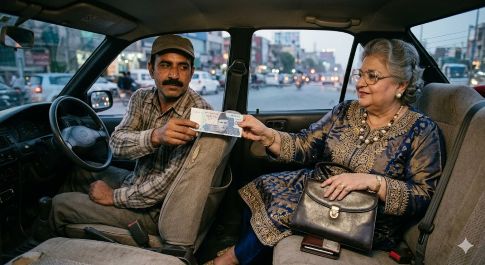
We agreed on a fare of Rs.1, 500.
After loading my bag into the trunk, I settled into the back seat.
“If you don’t mind,” I said, “you could take the old airport road, pass Johar Mor near Habib University, then continue to University Road. My destination is near the Accountant General Sindh office.”
He looked at me through the rear-view mirror and smiled.
“Thank you, sir.”
“It is only a suggestion,” I said. “You are the driver. You know the roads better.”
“No, sir. It is a good route. We will go that way.”
His agreeable manner encouraged me to ask an aimless question.
“There seem to be a lot of yellow taxis these days.”
He laughed.
“You can thank Nawaz Sharif Sahib for that.”
“Too many taxis have not created problems?”
I expected him to agree. Instead, he shook his head.
“Every category of driver has its own problems.”
“What do you mean?”
“Some drivers are government employees. Their salaries are low. After office hours, they drive their own cars as taxis to earn extra money. Full-time taxi drivers have different problems. But airport taxi drivers face another set of challenges.”
His answer made me curious.
“What kind of challenges?”
“Many.”
“Tell me a few.”
He took a deep breath.
“First, we must always look presentable. Clean clothes. No smell of sweat.”
He paused.
“The airport serves wealthy and educated passengers. Some judge us before we even speak.”
I nodded.
“Sometimes even the beard becomes a problem,” he continued. “People assume things. They think we are Afghans, or worse.”
The taxi moved steadily through the city. The airport disappeared behind us. Traffic thinned as we approached Gulistan-e-Johar.
“What other problems do airport taxi drivers face?” I asked.
“There are many,” he said. “Union fees. Airport stand charges. Flights from Saudi Arabia and the Gulf getting cancelled. Sudden demands from contractors. Sometimes airport police and security staff conduct crackdowns. Every few months there is something new.”
We passed the Rabia City apartment blocks. I looked at my watch. Fifteen or twenty minutes remained before I reached home.
I asked him one last question.
“In your experience, what are the worst problems?”
He was silent for a moment.
“The worst?”
“Yes. The ones that worry you most.”
He repeated the question to himself.
Then he answered.
“There are only two.”
“What are they?”
“The first is a never-ending queue of taxis.”
I waited.
“You can stand in that queue for four or five hours,” he said. “Sometimes longer.”
“And the second?”
“You finally reach the front. You finally get a passenger. Then he wants to go only a few kilometers away.”
He smiled, but there was no humor in it.
“Malir Cantonment. Airport Colony. Places like that.”
I understood.
“So after waiting half a day, you earn the fare of a very short trip.”
“Exactly.”
The taxi rolled forward beneath the streetlights.
“What can be done about it?” I asked.
“Nothing.”
He said it firmly.
Nothing.
For a moment I wondered what he meant. Was it frustration? Resignation? Or simply experience speaking?
The city moved past the window. Shops were closing. Motorcycles slipped through traffic. A bus rattled by.
Sultan, as he had introduced himself, kept his eyes on the road.
I looked outside.
Karachi was still awake.
And I was no longer sure whether “nothing” meant that no solution existed, or that people had stopped expecting one.
***
The Weight of the Boot
The air in Karachi was heavy. Dust hung over University Road, thick and gray from the construction work on both shoulders of the road.
I was living in Gulshan-e-Iqbal then. Our flat was near the Accountant General Office. There were four of us in the flat: my wife, my sister, and my younger brother. We had to leave the city. A relative was getting married in Boriri, our village back in Dadu.
To get to Dadu, we needed to reach Sohrab Goth first. That was where the long-haul buses waited.
I walked out to the main road to find a taxi. A few were parked in front of the Galaxy Complex. I walked up to an old driver who stood smoking a K2 cigarette against his fender.
“Sohrab Goth?” I asked.
“Four hundred rupees,” he said. He did not look up.
“Agreed,” I said. “But we have to pick up the others from Crescent Complex.”
He took a long drag. “How many people?”
“Four.”
“Luggage?”
“Yes,” I said. “Some bags.”
“How many bags?” His eyes narrowed. He wanted a firm number.
“I am not sure,” I said.
He spat onto the tarmac. He looked irritated.
“Why do you need all these details?” I asked.
“I just fitted a gas cylinder,” he said flatly. “It takes up the whole boot. There is no room. And you do not even know how many bags you have.” He pointed to the top of his car. “Look. No roof rack either. Where will the bags go?”
I stayed quiet. The traffic roared behind us.
“I tell you what,” the driver suggested. He leaned closer. “Go buy some big plastic shopping bags. Empty your luggage into them. We can stuff the loose plastic bags under the seats and on the floor.”
“No,” I said.
I turned away and crossed University Road, leaving him there.
As I walked toward another line of taxis, the old man’s advice made me smile. It reminded me of a joke Professor Aijaz Qureshi used to tell. He said whenever he drove his family to their village, they would watch the cars ahead of them on the highway.
If a car passed with its rear windscreen completely blocked by a mountain of multi-colored plastic shopping bags, the whole family would laugh.
“Look,” they would say. “There goes a Sindhi family.”
________________
 Dr. Zaffar Junejo has a Ph.D in History from the University of Malaya. His areas of interest are post-colonial history, social history and peasants’ history. He may be reached at junejozi@gmail.com