Sanwal stood up and walked to the old water spot in the courtyard. There was still no bucket. But he washed his feet anyway.
By: Raphic Burdo
Village Gozo lay quietly on the edge of the Rice Canal, as if the water itself had decided to pause there and listen to the land. In season, the canal carried a slow green sheen from the paddy fields it fed; in off-season, it became a thin reflective ribbon cutting through dust and millet-colored earth.
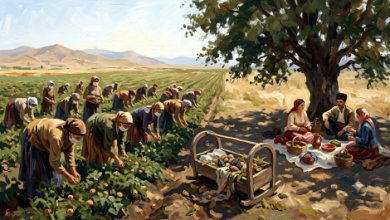
Sanwal grew up there. His childhood was stitched together from three crops: paddy in the wet months, wheat in the dry months, and barseem and lucerne that kept the cattle alive between harvests. Time in Gozo was not counted in dates but in sowing and reaping. When the rice shoots were transplanted into flooded fields, he was small. When the wheat turned gold under the wind, he was taller. When fodder was cut and tied into green bundles, he had learned to carry more than his own weight.
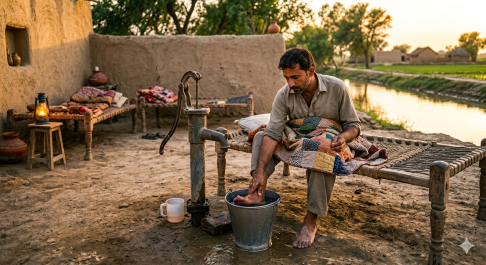
Home, however, never changed. The courtyard was raw earth, hardened by footsteps and softened again by rain. The charpais stood in uneven lines like tired soldiers. On them lay quilts, the rallis stitched from old shirts and dupattas, and razais filled with whatever cotton life had already abandoned elsewhere. Nothing was new in Gozo. Everything was reused, repurposed, remembered.
His mother was Bakhawar. She ruled the house without raising her voice. Her authority came from repetition: wake before dawn, finish chores, respect water, do not waste what cannot be replaced. His father, Haji, was a man of the fields and the canal, speaking little, trusting the earth more than words.
Sanwal’s world ended each day the same way. He would return from the fields at dusk, feet thick with mud from the rice paddies or powdered with dust from wheat threshing. Sometimes the smell of barseem clung to his clothes, sweet and green, and sometimes lucerne hay scratched his skin like dry memory.
At the threshold of the house, Bakhawar would be waiting: “Wash your feet,” she would say. It was not anger. It was law. A bucket of water always sat nearby, drawn from the hand pump, slightly cold even in the burning summers of Gozo. He would sit on the edge of the courtyard while she watched him wash the day away. The canal was never far, but this water was different. It belonged to the house, to the bed, to the night.
Only when the dust disappeared completely would she step aside. “Now sleep.” And Sanwal would sleep as if nothing in the world had ever been unclean.
Years passed like seasons that refused to announce themselves. Sanwal left Gozo eventually. There were jobs in cities beyond the canal, roads that did not smell of wet earth, floors that did not remember footprints. His feet learned tiles and concrete, then polished stone, then carpets in rooms where water was only a tap and never a necessity. But the habit did not leave him.
Even in places where no field touched him, even when his shoes were clean and his day was spent behind desks, he still felt it at night, the quiet insistence that feet must be washed before sleep. Not from logic. From something deeper, older than explanation.
Then one winter, he returned. Gozo had not grown. It had only aged. The Rice Canal still flowed, but slower, as if tired of carrying so many seasons. The fields were the same, paddy reflecting sky, wheat bending under wind, barseem and lucerne feeding animals that no longer seemed as strong as before. Even the dust felt familiar, as though it had been waiting for him. At home, the courtyard was emptier.
Haji sat near the charpai, thinner now, his gaze fixed on nothing in particular. When he saw Sanwal, he did not stand immediately. He only nodded, as if recognition required permission from memory.
“Amaan Bakhawar?” Sanwal asked, before he could stop himself. Haji did not answer at first. Then he pointed toward the corner of the house where the light did not fall easily. “She is not here anymore.”
The words did not land like news. They landed like something that had already happened long ago and was only now being spoken aloud. That night, Sanwal sat in the courtyard where he once washed his feet. There was no bucket waiting. No instruction. No voice. Only silence.
Haji brought out a folded quilt, an old ralli, heavier at one end where stitching had been redone many times. He placed it in Sanwal’s hands. “She kept it for you,” he said.
Sanwal unfolded it slowly. The fabric carried the smell of storage, of years held together without use. In one corner, the stitching was different, tighter, and more deliberate, as if someone had sewn it with intent rather than habit. Inside that seam, he found a small piece of cloth folded like a secret. Not a letter. Something less formal. A note, written in Bakhawar’s uneven hand: “Wash your feet before you sleep.” Sanwal smiled faintly, the old reflex rising before thought.
But then he noticed the second line, written smaller, almost hidden beneath the thread: The canal took two winters from me before you were grown. I washed your feet so you would never carry what the water once carried into this house. He stopped breathing for a moment. Haji looked away, toward the Rice Canal visible beyond the edge of the courtyard. “We lost children before you,” he said quietly. “In the flood years. Water came mixed with sickness. After that, she never trusted dust on your feet in the bed.”
Sanwal looked again at the quilt. At the stitches that had once felt like discipline, now revealed as protection. Not cleanliness. Fear refined into habit. Love disguised as instruction.
Outside, the Rice Canal continued its slow movement through Gozo, carrying paddy seasons, wheat seasons, fodder seasons, carrying everything except what had already been paid for in silence.
Sanwal stood up and walked to the old water spot in the courtyard. There was still no bucket. But he washed his feet anyway.
Read: Life After Che – Short Story
________________________
Raphic Burdo is a student of Literature, Psychology, Public Policy and Entrepreneurship. He writes on the subjects where all four intersect.