Stories of Karachi’s Taxi Drivers from 1993 to 2000
Zaffar Junejo
[Author’s Note: I joined a non-government organization in mid-1993. In those days, we were frequent travelers to other Asian countries, and during that period I maintained a diary. I once showed the notes to Muhammad Ibrahim Joyo — the legendary scholar, translator, and intellectual giant of the Sindhi world — who suggested categorizing the entries by theme and getting them published. He recalled that long ago, perhaps in 1955, the Sindhi journal Mehran had launched a similar idea titled ‘Hik Deenh Ji Ghaleh’ (The Story of a Day), even offering a prize for it. He himself had submitted the first story, he told me with a smile, just to set a standard for other writers. Later, Maulana Ghulam Muhammad Girami, a scholar of high standing and journalist; Shamsher ul Haidri, a distinguished Sindhi poet, journalist, and playwright; and Siraj ul Haq Memon, an iconic novelist, linguist, and journalist, all contributed their observations of a single day. These writings were published until 1968.
I agreed with Joyo Sahib that I would group the write-ups by subject and get them published, but I failed to do so. Recently, I sat down to organize my notes. I found various entries about the taxi drivers of Karachi city. Some were very brief and incomplete; others were short but held a finished truth. I have chosen five stories from each year, all of them gathered from the drivers of those cars. In total, there will be thirty-five stories covering the period from 1993 to 2000.]
No Other Way to Live
The rain fell on 26th Street. It washed the dust off the leaves of the sukh-chain tree and turned the asphalt black.
I stood under the tin roof of the petrol pump. It smelled of wet gravel and cheap fuel. A yellow cab pulled up to the curb. The tires hissed against the wet road. I opened the door.
“Gulshan,” I said.
The driver nodded. He shifted gears. We rolled into the grey light.
At the intersection, the driver slowed. He checked his side mirror. His hand moved the wheel left. He guided the heavy car close to the concrete edge of the footpath. He stopped. He waited.
I looked back. I expected the red lights of a police vehicle. I saw none. Instead, a white sedan cruised past our bumper. A woman sat at the wheel. She looked thirty. Her hands were steady on the plastic grip. She saw the space. She blinked her indicator and slipped parallel to us. We waited for the red signal to die.
The light turned green. She moved. We moved.
“You always give them room?” I asked.
He did not look back. “Always.”
“Why?”
The driver watched the road. He adjusted his grip. “My mother raised me. My father died early.” He paused. The wipers swept the glass. Squeak. Squeak. “And there was Zahida.”
“I do not know him,” I said.
“A woman,” the driver corrected. His voice held a quiet weight. “A great woman. Zahida Kazmi. The first.”
“Tell me.”
The taxi crossed the bridge. Below us, the railway tracks cut through the wet earth like cold iron.
“I got my permit last year,” the driver said. “At the Rawalpindi airport. I saw her there. She lined her car up with the men. A yellow cab. Just like ours.”
“What did you think?”
“We laughed. We thought the game would end in a week. We were wrong.”
“She stayed?”
“She never missed a day. We called her Zahida Madam.”
“Why Madam?”
“She was our President,” he said. He sat a little straighter. “We elected her. Chairperson of the All Pakistan Yellow Cab Federation. Twelve years she held the seat.”
The rain grew heavier. It drummed on the tin roof of the taxi.
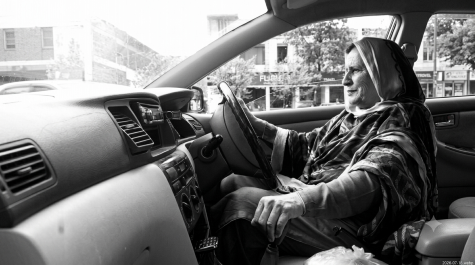
“In 1992, she began,” the driver said. “A world of men. She wore a heavy burqa. She carried a loaded weapon in the glovebox.”
“A gun?”
“For safety. But the burqa scared the passengers. They stayed away. So she dropped the veil. She wore the hijab. Later, she uncovered her head. The city grew to know her face.”
“Where did she come from?”
“Peshawar. A hard family. Pashtun. They married her off at thirteen.”
“A child,” I said.
“A child,” he agreed. “Then Karachi. 1972. Her husband worked in the Navy. But the war of 1971 had broken things. Her husband survived the camps. He returned. He taught her to drive. Then he died in 1981.”
“She had children?”
“Six. Four girls. Two boys. She washed floors. She worked the looms in the cloth mills. But the money was thin. In the late eighties, the streets of Karachi turned violent. Blood on the pavement. She took the children and fled north to Rawalpindi.”
“And she drove.”
“She drove. First school vans. Then the airport. She drove the high mountain roads. Swat. Chitral. The high passes of Waziristan. Even the tribal elders respected her. In 1995, she married again. She had another daughter. But she kept the wheel.”
The driver stopped at a dark crossing. The houses here were old, built of yellow brick.
“Then her health failed her,” the driver said. His voice dropped. “The brain. 2015. A hemorrhage. High blood pressure. Diabetes. Her legs grew weak. She sold the taxi to buy her medicine. It was a dark year.”
“The end?” I asked.
“No,” he said. “The people remembered. They made a page on the computer. By May 2016, they bought her a new van. She went back to the schools. She kept driving.”
He pulled the cab to the curb. The ride was over. I handed him the fare and thanked him for such an inspiring story.
“She remained in the seat,” I said.
“She did,” he said.
I stepped out into the rain. The yellow cab merged into the grey traffic, moving east, steady and slow.
______________
 Dr. Zaffar Junejo has a Ph.D in History from the University of Malaya. His areas of interest are post-colonial history, social history and peasants’ history. He may be reached at junejozi@gmail.com