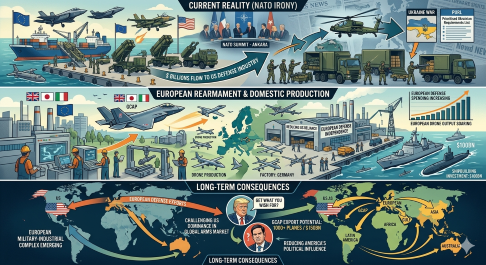
While shelling out billions to America, Europeans are also building the factories and shipyards that will build the weapons that will in the long-term replace American imports.
By Tom Arms | London
Marco Rubio says the next month’s NATO summit will be one of the most consequential in history. He is right—but not for the reasons he imagines.
President Trump has spent years demanding that Europe take responsibility for its own defense. The Europeans have finally agreed. The problem is that they have also concluded that they cannot rely entirely on Washington.
That realization is likely to dominate the summit. The immediate result will be more defense spending. The long-term result may be the emergence of a European military-industrial complex capable of challenging America’s dominance of the global arms market.
If so, future historians may conclude that Donald Trump did more than persuade Europe to rearm. He persuaded it to compete.
It will not be a happy group when the 32 NATO leaders gather in Ankara on 7-8 July. The 30 European members are still angry about Donald Trump’s designs on Greenland; statements about “European civilizational decline” and his failure to consult allies before starting a war with Iran. Trump is angry that Denmark won’t handover Greenland; NATO restrictions on US airbases during the Iran War and the Alliance’s failure to join the Israeli American war on Iran.
But at the top of the agenda will be the Ukraine War and European rearmament. The Trump Administration has successfully shifted the cost of arming Ukraine from American to European shoulders with the PURL (Prioritized Ukrainian Requirements List) program. Trump plus the Ukraine War and the growing Russian threat has prompted Europe that it needs more weapons now. It takes time to build the factories and shipyards to make them, so they are by buying more from America.
The Russian threat is bonanza for the US defense industry. Between 2021 and 2015 European arms imports increased 217 percent over the previous five-year period. The estimated amount is $220 billion. European NATO is rushing to fill its defense gaps with off-the-shelf F-35s, Patriot Missile Systems, HIMARS, Apache helicopters and munitions.
But while shelling out billions to America, Europeans are also building the factories and shipyards that will build the weapons that will in the long-term replace American imports.
The big European emphasis is on drones. The Ukraine war has revealed that the future of war is unmanned vehicles in the air and on the ground. Germany—which is leading the way in increased European defense expenditure—has recently signed a deal with Ukraine for a drone manufacturing factory. France’s Renault car company is also entering the drone business and claims it will soon be producing 600 drones a month. Defense analysts believe that Europe is on track to produce millions of drones a year.
Shipyards take years to build. Current production is abysmal. The Royal Navy, for instance, has on order only seven frigates and three submarines by the end of this year. But as a total the European allies are investing $100 billion in the defense shipbuilding business. This sum is reckoned to be enough to construct 287 vessels.
Aircraft production is focused on the GCAP (Global Combat Aircraft Program)—a joint effort between Britain, Japan and Italy, Europe’s second largest military power (Britain) with Asia’s second largest economy (Japan) and Italy’s advanced aerospace industry.
Production on the GCAP prototype is expected to start this year with the first demonstration aircraft flying by 2027-28. Full is scheduled to begin in 2030 and the aircraft is expected to produce more than 300 fighter aircraft for its partner countries. The GCAP is designed to replace America’s F-35. Roberto Cingolani, CEO of Italy’s Leonardo Aerospace, Roberto Cingolani, stressed that one of the main benefits of the GCAP would be independence from American defense industry and political controls.
Possibly even more important, the GCAP has huge export potential. The Gulf countries and Australia have expressed a keen interest in either buying the plane or partnering in its production. This could easily lead to export sales of 1,000 planes. This would be worth an estimated $150 billion.
That is just the purchase price. Aircraft are estimated to earn up to four times their initial sale price in upgrades and maintenance. The F-35, which the GCAP is designed to replace, is estimated to earn $1.5 trillion in its lifetime.
The United States is responsible for 43 percent of the world’s arms sales—four times more than its nearest competitor. According to the State Department, last year contracted military export sales reached a record $331 billion or one percent of America’s GDP. An estimated $115 billion is estimated to have been bought by NATO allies. Europe is the biggest market for America’s weapons manufacturers by a massive margin.
By alienating his NATO allies with insults and threats and encouraging them to increase defense spending and rearm, Donald Trump is cutting his own vital defense industry out of their most profitable market. He is also creating a European defense industry that within ten years will be competing with the US in third markets.
Trump is also reducing America’s worldwide political influence. With arms sales comes upgrades and maintenance which stretch decades into the future. The upgrades include training exercises, exchanges of personnel, intelligence sharing and political influence which spills over into other export sales.
Marco Rubio may well be right. This summit could prove one of the most consequential in NATO’s history. But the lasting consequence may not be a stronger American-led alliance. It may be the birth of a European defense industry capable of standing on its own—and competing with the United States for customers around the world. Donald Trump wanted Europe to do more for its own defense. He may discover that getting what you wish for can be an expensive mistake.
Read: Observations of an Expat: Special Relationship
_____________
 Tom Arms is foreign editor of Liberal Democrat Voice. He also contributes to “The New World” and lectures on world affairs. Tom is also the author of “The Falklands Crisis,” two editions of “The Encyclopedia of the Cold War” and “America Made in Britain.”