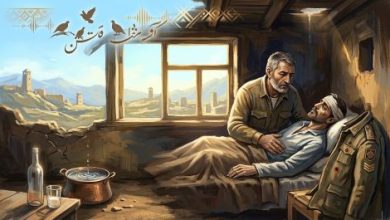
Review of Muhammad Ali Pathan’s Urdu book “Saanp Ka Aghwa” translated by Abid Unar
Gul Mohammad Umrani
This is the latest book from ambidextrous writer Muhammad Ali Pathan, 43rd in the perpetual sequence of craftsmanship, and is about the genre of Drama, in the form of a Teleplay, translated from Sindhi to Urdu. The translator is popular poetic wizard Abid Unar. He is an outstanding talented and excellent Free Verse practitioner and a conscientious, insightful mind behind the eerily not so ambiguous, passionate, suspenseful, cryptic, mysterious, meandering and subtle, sharply pithy, aphoristic, challenging and anticlimactic poems in the current intellectual and aesthetically introspective milieu, on the line and in print.
As commonly known, the multidimensional, philosophic and Mystical creator of Sindhi teleplay Muhammad Ali Pathan is writing in all kinds of literary genres. These are of exoteric charmingly unique variegated topics under the skillful hues and the combinations, which essentially comprise of the divergent inquisitive inimitable strands and elements of spontaneous narratives, and this new work is timely and fulfils these trends consistently presented by him through his distinctive style and diction besides being a gift from the illustrious writer in Urdu prose, courtesy Abid Unar this time on. Great Work indeed. Much more is there any way to show the difference between genuine human endeavors to bring the best vintage literary talents and to comprehend what is the exclusive high quality of artistic aesthetic creativity.
Abid Unar is an accomplished translator in his own right, as he had also rendered some short stories from Urdu to Sindhi, particularly those of Manto and Krishen Chander, which were purely intimidating and amazing pieces of intimate expertise and deep feelings and knowledge about the art of translation of the Classics.
This work involves the ability to effectively adapt and convert words from the archetypal Sindhi to fluent colloquial phraseology in Urdu translation so much effortlessly. Abid is fascinating to read here, as he has delved into the essential Sindhi text and has captured the essence, meaning, idiomatic flavour, metaphorical nuances, with the cutting edge cultural professional exactitude. He is consciously conversational in tone and temper, almost honestly narrated in minute imagery of everlasting innuendos throughout the whole translation. His heterogeneous selected use of Urdu in place of the original Sindhi is reflective of his voracious substitution of vocabulary indicated in his linguistic ethnic diversity. He is indubitably conscious of his humility when he is not convinced that he is endowed with such critical acumen to achieve the job with desirable results as this is his first such work on the insistence of the original Sindhi indefatigable writer Mohammad Ali Pathan.
There is enough evidence to justify that both the writer and translator deserve kudos for the teleplay, which is still very much uniquely exotic profound social depiction of the rural life in its exquisite essence. The question of the realistic eccentricities and complex situations, with dramatic impact of perspicacious imperative of Suspense. The play is yet to be seen or telecast but the entire gamut of the atmospheric socio- cultural continuity will be imbibed if you want to learn about the life of the poor snake charmers and the shenanigans of the police, the petty feudal and the vicissitudes of the ruthlessness of hostile reverses of the bad fortune. Human vicious avarice, greed and cruel exploitative dark narrative is the epitome of the Wisdom one comes across as the eternal ethical lesson against the poor downtrodden hapless people, not unlike other stories of the writer. For him sky is the limit nowadays. He is a self-actualized person who does not know where to find a hibernation from the work, as many books are on the way.
Read: Book Review: Pakistan Lost
___________________
 Gul Mohammad Umrani is a retired bureaucrat. He held key positions during his career. He also served as Secretary, Sindh Culture Department. He has authored his autobiography published in three volumes.