The mountains of Sindh have served as a canvas where people inscribed their beliefs, rituals and journeys, transforming the rugged terrain into a dynamic record of human experience
Zulfiqar Ali Kalhoro
Exploring the mountains of Sindh reveals a landscape where both past and present are inscribed in stone, transforming the terrain into a living archive of human history and experience. On these rugged terrains we see unfolding Sindh’s cultural heritage, particularly rock art. For centuries, people inscribed their beliefs, rituals, journeys, and worldview onto the rocks. Rock art is distributed across many of Sindh’s mountain ranges.
Since 1998, I have been travelling to these mountains to document rock art, aiming to share personal discoveries that highlight Sindh’s rich cultural heritage and engage readers in its significance. The most notable valleys, referred to as Nais, where I discovered rock art sites, include Seeta, Mazarani, Keharji, Gerelo, Radh, Buri, Khurbi, Makhi, Sallari, Gaj, Nari/Nali, Kukrani, Angai, Thado, Mol, Baran, and many others.

Each of these rock art sites offers a window into Sindh’s diverse cultural history, with artwork ranging from prehistoric hunting scenes to modern engravings of choppers and aircraft, inspiring admiration for the region’s vibrant artistic traditions.
During my more than two decades of fieldwork in Khirthar, I discovered and documented thousands of petroglyphs and numerous rock paintings. The themes found in Sindh’s rock art are diverse, including hunting and warfare scenes. Most magnificent are engravings of bull domestication, a subject not seen in any other rock art region in Pakistan.
The rock art of Sindh features a diverse range of animals, including bulls, bison, camels, horses, goats, deer, cats, leopards, and wolves. Additionally, birds and plants are depicted in the rock art of Sindh. Human figures and geometric patterns are also common themes. Particularly fascinating are the depictions of Buddhist stupas, Zoroastrian fire altars, temples, symbols, and various shrines.

Religious symbols and structures have always been one of my favourite subjects in Sindh’s rock art. To date, I have discovered over two thousand images of Buddhist stupas in Sindh. Apart from these stupas and Zoroastrian fire altars, a variety of shrine petroglyphs can be found, which belong to different periods. Some of these shrines may date back to the time of the Indus Valley Civilisation.
Engravings of shrines can be found in several valleys in Sindh. In Dadu’s Gaj valley, I discovered a depiction of a Buddhist shrine at the Loi Dan rock art site. This shrine is a square structure with an entrance on the east. Its roof is adorned with four decorated finials, each featuring three designs resembling tree branches. Inside the shrine, three individual figures are depicted. Two of the figures stand close to the northern and southern walls, respectively. The figure near the northern wall is holding a whip, while the third figure is shown standing beneath a niche. It may suggest that the shrine is dedicated to three deities.

The legend of these three deities is also depicted on coins from the era of Huviskha, a Kushan ruler. Gold coins discovered from Gandhara depict the three deities: Skanda-Kumaro, Bizago, and Mahaseno. The figure of Mahaseno is shown standing under a canopy or niche flanked by Skanda-Kumaro. The engravings at the Loi Dan in Gaj valley site likely represent the legend of these three deities from the Kushan period, when the Kushans ruled over upper Sindh from 78 to 175 AD.
To date, I have discovered over two thousand images of Buddhist stupas in Sindh. Some of these shrines may date back to the time of the Indus Valley Civilization

Representations of several shrine petroglyphs can be found in the rock art of the Angai valley in Dadu district. These engravings are truly magnificent and are unique, as similar depictions are not found elsewhere in the Khirthar Range. In addition to the shrine motifs, I also discovered various ethnographic petroglyphs in the Angai valley. The main motifs include handprints, footprints, shoe prints, and a variety of weapons. Interestingly, the rock art in the Angai Valley also depicts choppers, aircraft, fighter jets, vehicles, and a variety of guns. Based on these recent and earlier discoveries, I have decided to write two books: one on contemporary rock art, titled Understanding Rock Art with Ethnography, and the other on shrines, titled Signs and Shrines in Sindh’s Rock Art.
In addition to shrine petroglyphs, one of the most recurrent themes in both modern and ancient rock art from Sindh is the depiction of handprints. Handprints and hand stencils are linked to the earliest forms of cave art. This motif in rock art has captured the attention of artists throughout history, as the practice of engraving handprints has continued from prehistoric times to the historic period across the globe.
In Sindh, handprints are not only found in rock art but also in memorial stones in Tharparkar, making Sindh’s art uniquely characterized by the presence of handprints across prehistoric, historic, and contemporary contexts, unlike other regions.

Handprint engravings and paintings have long captured the attention of researchers, prompting a range of interpretations, from ritualistic symbolism and territorial markers to mobility. However, some of the most illuminating insights arise not from theoretical frameworks but from the lived experiences of communities that continue to practice this today.
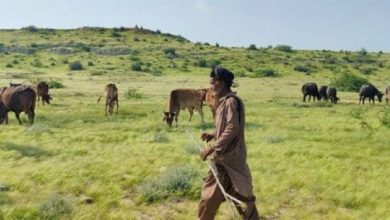
During my ethnographic interviews with shepherds in Sindh, I learned that the practice of leaving one’s mark on stone is far from a relic of the past. Many shepherds continue to engrave their hands onto rock surfaces, and the stories they share illuminate a rich cultural logic behind these markings. Before a shepherd begins carving, he seeks recognition, a desire to see himself inscribed in the landscape. The first impulse is often to engrave a handprint or footprint, direct and intimate imprints of the self. With handprint carvings, the shepherds also write their names.
Afterwards, the shepherd may carve an object that defines him, such as his weapon—traditionally an axe, though in recent decades even the outline of a gun appears. The next step often involves engraving a footprint or the outline of a sandal.

Together, these three motifs-handprint, footprint, and weapon- form a personal signature of the shepherd. They embody identity, memory, and belonging, linking the shepherd not only to his immediate environment but also to a centuries-old continuum of pastoral tradition.
As a shepherd becomes more proficient at producing these initial engravings, he progressively expands his repertoire to include additional motifs—such as depictions of his water bottle, mirror, comb, animals, birds, and whatever he observes around him, from truck to bus; nothing goes unnoticed by his gaze. Ethnographic data offer critical insights into the social and cultural functions of these symbols within contemporary pastoral communities, revealing how material culture, daily practices, and identity are encoded visually. From a theoretical standpoint, such evidence aligns with semiotic and anthropological perspectives that view signs not merely as representations but as active agents in constructing meaning, memory, and social belonging.

Although ancient rock art motifs cannot always be interpreted with certainty today, insights from present-day rock art producers (shepherds) help bridge this gap. Their practices show how older symbolic traditions continue while new forms of imagery also emerge, reflecting the semiotic idea of cultural continuity and change. By combining ethnographic observations with semiotic theory, researchers gain a broader and more grounded understanding of rock art in Sindh. This approach allows us to study contemporary rock art traditions in relation to both lived experience and broader theoretical perspectives.
Read: Mystery Cup-Marks on Babro Hill in Maher Valley of Malir, Sindh
_________________________
Zulfiqar Ali Kalhoro is an anthropologist and author of several books. He tweets at: @Kalhorozulfiqar
First published by The Friday Times Lahore on December 1, 2025