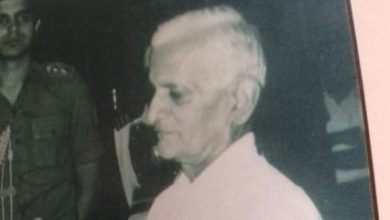
Hafeez Sheikh (1931–1971) rose from severe economic hardship to become one of the most distinctive realist voices in South Asian regional literature.
Gambat remembers the late writer with Book Fair from 16-19 January 2026
By Ramesh Raja
Hafeez Sheikh was a pioneering Sindhi short story writer and journalist whose work transformed personal struggle into enduring social critique. Born on 10 December 1931 in Gambat town, Khairpur Mirs district of Sindh, he rose from severe economic hardship to become one of the most distinctive realist voices in South Asian regional literature. Hafeez Shaikh introduced my city Gambat into the circles of literature and journalism and Dr. Raheem Bux Bhatti through GIMS Hospital worldwide.
 Forced to leave school at an early age due to poverty, Hafeez Sheikh worked as a shoe shiner and shop assistant before resuming his education through extraordinary perseverance. He completed his higher studies in Karachi and later earned an MA in Journalism from Lahore, a journey that profoundly shaped his literary and political consciousness. His career in journalism included work with Nawai-e-Sindh, association with the Associated Press of Pakistan (APP), service as Personal Assistant to Muhammad Ayub Khuhro, and later administrative responsibilities as Divisional In-Charge in Family Planning.
In 1951, while residing at Mitharam Hostel, Hafeez Sheikh played a formative role in establishing the Sindhi Adabi Sangat, a leading literary movement advocating progressive, human-centered writing. His fiction, deeply influenced by his journalistic training, exposed social injustice, institutional violence, class inequality, and the emotional costs of authoritarian systems.
His most celebrated short stories—“Ammaan, I Will Not Go to School,” “Two Shadows,” “Congratulations,” “The Writer,” and “Twatto”—are landmarks of Sindhi social realism. “Ammaan, I Will Not Go to School,” now taught at universities, remains a powerful indictment of fear-based education, portraying how authority, when fused with violence, destroys the very spirit it claims to discipline.
Hafeez Sheikh’s work came under the close and incisive scrutiny of critics such as the respected Rasool Bux Palijo. In 1970, while writing the dedication for the second edition of his short story collection “Saagar Ji Lehran Te” (On the Waves of the Sea), Hafeez Sheikh wrote:
 “I dedicate this to Sindh’s renowned critic Rasool Bux Palijo, who did not even have the fare to travel from Thatta to Karachi, yet after reading my short story ‘Mubarkoon’ (Congratulations), he borrowed five rupees from a friend and came all the way to Karachi. He sought me out and when we finally met face to face, he said:
“Bullshit….What the hell are you doing….you have ruined the face of such a fine short story. It was a living, breathing piece of writing—why did you sink the boat like this?’
I replied, ‘Why are you so angry? Sit down, let us talk. It is possible that you are right, and it is also possible that I am right.’
We held our sitting at the Iranian Hotel over six-paisa cups of tea. After two hours, when we had completed three rounds of tea, I said to him, ‘You are right. When Mubarkoon will published again, I will change its ending.’”
Later, when Mubarkoon was published in Urdu, its ending had indeed been changed, and it appeared under the new title “Gaariyan Garakandiyan Rahyoon” (“Vehicles Kept Crashing / Rolling On”). This mode of criticism was itself a test. There was a contest between my ego and the writer’s love for his craft—and in the end, my ego bowed its head before suggestions of Palijo.
Hafeez Sheikh rejected romantic escapism in literature. He wrote with stark honesty, drawing directly from lived experience. His narratives are grounded in everyday life, rural landscapes, emotional silences, and moral contradictions, giving voice to those pushed to the margins. Critics often describe his stories as autobiographical—not because they recount events, but because they carry the emotional truth of a life lived in resistance.
Hafeez Sheikh died prematurely on 9 November 1971 and was buried in Hyderabad Cantonment. His physical grave may have faded, but his intellectual legacy endures.
Revival Through Memory: The Hafeez Sheikh Book Fair
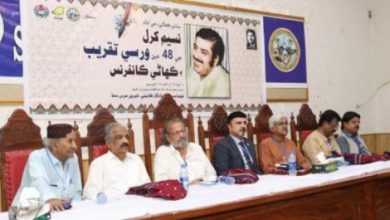
In recent years, Hafeez Sheikh’s legacy has been meaningfully revived in his hometown through the Hafeez Sheikh Book Fair, organized by Sindh Fikri Forum Gambat. Now an established cultural tradition, the book fair reconnects contemporary readers with progressive literary values and critical thought.
The initiative is led by committed cultural organizers Awais Mangi, Salih Narejo, Darban Ujan, Rafiq Sindhyar, Umar Ali, Adnan Soomro, Soorih Sindhi, Mohsin Khuhro, Adnan Latif, Kaleem Ullah, Mehdi Hassan, Kashif Ujjan, and their colleagues, who have transformed Gambat into a vibrant site of intellectual exchange.
The fair also enjoys consistent support from Gambat’s literary community, including Sah Shaikh, Altaf Bhatti, Nazeer Sirohi, Ramesh Raja, Raz Ali Gul Bhutto, Ghohar Shaikh, Basharat Narejo, Bhawan Sindhi, Dr Yaar Markhand, Manzoor Ujjan, Lutuf Sahito, Ali Gul Khuhro, Sana Jakhar, among others—reflecting a collective commitment to sustaining literary culture in Sindh and its surrounding regions.
Why Hafeez Sheikh Matters Today
Hafeez Sheikh’s writing remains urgently relevant in a world grappling with inequality, authoritarianism, and cultural amnesia. His work reminds us that literature is not decoration—it is conscience. Through words rooted in truth and compassion, he challenged power, questioned norms, and insisted on human dignity.
Today, Hafeez Sheikh is remembered not only through his stories but through living cultural practices that continue to inspire dialogue, reading, and resistance. In remembering him, Sindh reclaims a voice that never ceased to speak.
Read: Diplomacy vs. Biodiversity: The Houbara Bustard’s Dilemma
______________
 The author of this article, Engr. Ramesh Raja, is a Civil Engineer, visionary planner, PMP certified and literary enthusiast with a passion for art and recreation. He can be reached at engineer.raja@gmail.com