Deserts Sing, Hope Breathes Through Dunes
Deserts Sang to Bring Life to Disaster-Stricken Thar

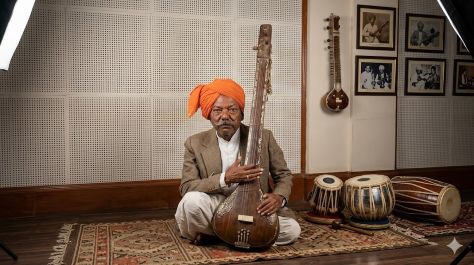
Mohan Bhagat is remembered not only as a singer but as a symbol of Sindh’s spiritual and cultural harmony.
In the silent deserts of Thar, where music once rose from the hearts of wandering singers, his voice still seems to echo; gentle, devotional and timeless.
Tribute to a Legend Singer Mohan Bhagat
By: Ramesh Raja
Every year on March 10, music lovers in Sindh remember the legendary folk and devotional singer Mohan Bhagat, whose voice once echoed across the silent deserts of Thar. Even decades after his passing in 1995, his singing continues to live in the memories of listeners who grew up with his soulful renditions of Sufi and Bhakti poetry.
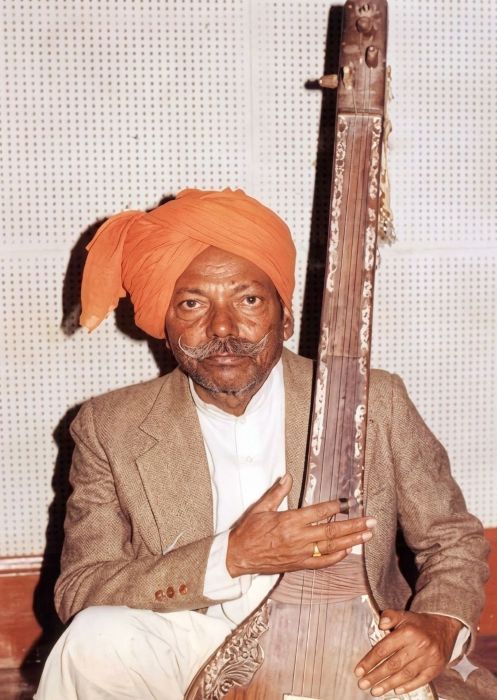 Mohan Bhagat was one of those rare artists whose voice carried both sweetness and depth. He was often described as the “sweet voice of Thar”; a humble man whose fame spread quietly across Sindh. In the vast stillness of the Thar Desert, his voice rose like a resonant call, filling the silence with devotion and melody.
He was born around 1929–1930 in Islamkot, in the district of Tharparkar. Like many children of the desert, his early life was simple. As a boy, he would take goats to graze in the open lands of Thar. During those lonely hours in the wilderness, he would sing devotional verses and kafis to pass the time. Perhaps it was in that quiet landscape that his voice found its natural rhythm.
Music was part of his family tradition. His father Bhagat Umedram and his uncle Moti Bhagat were both respected singers in the region. From them, Mohan Bhagat received his early training in music. People who heard him sing as a child often spoke of the unusual charm and strength in his voice.
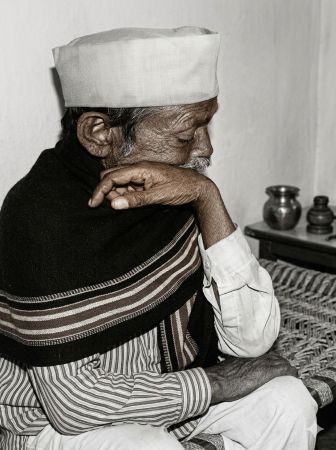 Later, he refined his singing style under the guidance of the renowned Thari singer Amro Bhagat and the famous musician Ustad Murad Fakir, who was widely respected for his mastery of kafi singing. Murad Fakir’s circle also included the celebrated folk singer Mai Bhagi, making it a rich musical tradition from which Mohan Bhagat learned and evolved.
Mohan Bhagat’s repertoire reflected the spiritual diversity of the Subcontinent. He sang the poetry of great saints and mystics such as Shah Abdul Latif Bhittai, Bhagat Kabir, Mira Bai, Tulsidas, Bulleh Shah, and Sultan Bahu. Through his voice, the teachings of these poets reached ordinary people in villages and towns.
His performances were simple yet powerful. Usually accompanied by three or four companions including his brother Sarupo Bhagat and later his son Shankar Bhagat — he sang with traditional instruments such as the tanburo, jhanjh, dholak, talli, and harmonium. Despite using only a few instruments, his performances created a deeply moving atmosphere that often left audiences spellbound.
The tunes he used carried influences from Marwari, Dhatki, and Gujarati folk traditions, reflecting the cultural connections of the desert region. His tanburo itself was special; made from the root of an ancient ak tree; an unusual example of traditional craftsmanship in Sindh.
Mohan Bhagat also recorded many songs for Radio Pakistan, and later his music was released on audio cassettes. Through these recordings, his voice reached listeners far beyond the desert villages of Thar.
For many people, those cassettes were their first introduction to his music. My father, Late Kaloo Mal, was deeply fond of music and kept a rich collection of such recordings. It was through those cassettes that I first listened to Mohan Bhagat singing the poetry of Kabir and Shah Latif. Even today, those songs remain unforgettable.
Music has a mysterious power. A truly strong and soulful voice can capture the human heart within moments. When such a voice rises in the silence of the desert, the dunes themselves seem to awaken. The quiet winds, the endless sands, and the vast sky suddenly feel alive with colour and emotion. Mohan Bhagat possessed that rare magic. His singing could turn the loneliness of the desert into a celebration of spirit.
Beyond radio and recordings, he also performed on Pakistan Television and at countless cultural gatherings across Sindh. Through his art, he helped carry ancient folk and devotional traditions into a more refined musical expression. His voice brought the poetry of Shah Latif and Kabir to new generations while preserving the simplicity and purity of the desert’s musical heritage.
After his passing on March 10, 1995, his musical tradition continued through his son Shankar Bhagat and his nephew Atam Bhagat, who still perform in the same style.
Today, Mohan Bhagat is remembered not only as a singer but as a symbol of Sindh’s spiritual and cultural harmony. In the silent deserts of Thar, where music once rose from the hearts of wandering singers, his voice still seems to echo; gentle, devotional and timeless.
Read: Fragrance That Still Walks Gambat Streets
____________________
 The author of this article, Engr. Ramesh Raja, is a Civil Engineer, visionary planner, PMP certified and literary enthusiast with a passion for art and recreation. He can be reached at engineer.raja@gmail.com