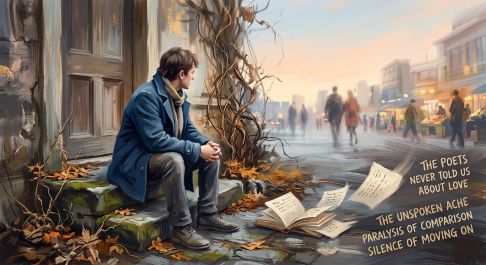
Beyond the fiery passion and dramatic heartbreak immortalized by poets lies the quiet agony of being left behind. It is the uncelebrated grief of watching someone you love bloom into a future that no longer has room for you.
Shaheer Pulikkal | India
Love, as immortalized by poets like Shakespeare, Neruda, and Rumi, is often painted as a force of transcendence—fiery passion, eternal devotion, or a fleeting ecstasy that elevates the soul. Yet, there exists a quieter, more agonizing kind of love that rarely graces the pages of sonnets: the love that lingers when someone you cherish moves on, leaving you stuck in the quicksand of your own life. This is the love that festers in silence, a slow bleed of longing and loss that poets seldom capture, perhaps because it lacks the grandeur of triumph or the drama of heartbreak. It is the love of being left behind, tethered to a life that feels hollow while the person you love strides into their future.
The Unspoken Ache
This love is not the sharp stab of betrayal or the cathartic wail of a breakup. It is the dull, persistent ache of watching someone you love—whether a partner, friend, or family member—slip into a new chapter of their life while you remain anchored in place. Perhaps they’ve found new dreams, a new city, or a new version of themselves, while you grapple with the same routines, the same unfulfilled desires, and the same unchanging horizon. The poets don’t tell you about the nights spent scrolling through their social media, seeing their laughter in new places, with new faces, while your world feels like it is shrinking. This love is heavy, a weight that presses down not with intensity but with relentless consistency.
You love them still, fiercely, but it’s a love that cannot be spoken. To confess it would be to admit your stagnation, to reveal that while they’ve soared, you’re still circling the same doubts and fears. The poets might call this devotion, but it feels more like a haunting—a ghost of what was, whispering through the monotony of your days.
The Paralysis of Comparison
What makes this love so paralyzing is the comparison it breeds. Their life, vibrant and evolving, becomes a mirror reflecting your own inertia. You see them chasing careers in distant cities, building families, or embracing adventures, while you’re caught in the inertia of a job you tolerate, a town you never left, or dreams you never dared to pursue. Every update from them—a new job, a trip abroad, a milestone celebrated—feels like a quiet indictment of your own stalled existence. The love you feel for them twists into a kind of self-reproach, a reminder of the paths you didn’t take.
This is not jealousy, though it might brush against it. It’s a deeper, more existential sorrow—a recognition that the person you love is living a life you can no longer touch, and in their absence, you’re forced to confront the ways you’ve failed to live your own. The poets don’t write about this because it lacks the romance of longing or the clarity of loss. It’s messy, unglamorous, and deeply personal.
The Silence of Moving On
The world expects you to move on, to match their pace, to “find yourself” as they have. But this love keeps you tethered to the past, not because you want to reclaim it, but because it’s the last place you felt alive. You replay conversations, moments, promises—none of which they likely remember with the same intensity. You wonder if they ever think of you, if they know how much their absence has carved out of your days. The poets might weave tales of unrequited love, but they rarely speak of the love that persists when the other person doesn’t even know you’re still holding on.
Society offers no rituals for this kind of grief. There are no breakup songs for the slow drift of divergence, no self-help books for loving someone who hasn’t died or betrayed you but simply outgrown you. You’re expected to smile, to cheer their successes, to keep your longing locked away. And so, you do. You like their posts, send congratulatory messages, and pretend your heart isn’t breaking under the weight of their progress.
Finding Meaning in the Stuckness
Yet, within this unspoken love lies a strange kind of resilience. To love someone who has moved on, to carry that love while feeling stuck, is an act of quiet courage. It’s a refusal to let go of what they meant, even as the world urges you to move forward. This love, though painful, can be a catalyst—not for chasing them, but for rediscovering yourself. The poets may not write about it, but this love forces you to confront your own life, to ask why you feel stuck, and to begin, however slowly, to carve out a path of your own.
It starts with small acts: a new hobby, a journal entry, a step toward a dream you’ve long buried. The love doesn’t fade, but it can transform—from a weight that holds you back to a quiet fire that pushes you forward. You may never catch up to them, and perhaps you don’t need to. This love, uncelebrated by poets, teaches you that your life, too, is worth living, even if it moves at a different pace.
A Love Worth Living For
The poets may never tell you about this love, but it is no less real, no less profound. It is the love that lingers in the spaces between who you were and who you might become. It is the love that hurts because it matters, because it reminds you that you are capable of feeling deeply, even when the world feels still. And in that stillness, there is a story—one of resilience, of quiet longing, and of the slow, stubborn work of building a life that honors the love you carry, even as the one you love walks away.
___________
 Shaheer Pulikkal is a young Indian short‑story writer and novelist from Kerala. A Malayalam writer, he has published works multiple times.