Rome in Two Days: History, Friendship, and Sindhi Hospitality in the Eternal City
A short travel narrative from 6–7 March 2026
By Abdullah Usman Morai | Sweden
From Stockholm’s Snow to Rome’s Gentle Breeze
Travel often begins with contrasts. On the morning of 6th March 2026, I left behind the icy, snow-covered landscape of Stockholm and flew south toward Italy. When the plane descended into Rome, the difference was immediately noticeable. The biting Nordic winter had been replaced by Rome’s relatively mild and pleasant weather.
 As frequently happens during my travels, my friend Jan Mangrio was also joining the journey, flying from Cardiff in the United Kingdom. His flight was scheduled to arrive about an hour and a half after mine. Having some time to spare, I settled at an airport cafeteria.
Airports are fascinating places to observe human movement. Sitting with a cup of tea, occasionally browsing social media, I watched travelers arriving and departing. People moved with different rhythms, some rushing toward their gates, others patiently waiting. Among them were also travelers accompanied by dogs, calmly walking beside their owners, adding a touch of warmth to the otherwise hurried atmosphere of an international airport.
Memories of Rome and an Old Friend
Whenever I think of Rome, my mind naturally returns to my friend Prem Sagar, who introduced me to the Eternal City during my first visit several years ago. Since he was not in Rome this time, he kindly connected me with a gentleman living there, Mr. Alaptageen, a warm and kind-hearted young man originally from Mansehra in Pakistan.
After completing his studies in Rome, Alaptageen started working with the Food and Agriculture Organization (FAO). He invited us to join him for iftar, as the visit coincided with the holy month of Ramadan. Although he suggested that we come directly to his place, we decided to check in first at our accommodation.
A Comfortable Stay in Prati
Our bed-and-breakfast was located in Prati, one of Rome’s elegant residential districts. Developed in the late nineteenth century after Italy’s unification, Prati is known for its wide streets, orderly urban planning, and beautiful residential buildings. The neighborhood lies just a short distance from Vatican City and is popular among visitors seeking a quieter stay while still being close to Rome’s historic attractions.
After Jan arrived, we made our way to our B&B named Vatication, located near the Vatican. The journey involved a direct bus followed by a short ten-minute walk.
The self-check-in process was smooth and efficient. The place was neat, beautifully decorated, and welcoming, exactly what a traveler hopes for after a long journey.
Without wasting much time, we stepped out again to explore the nearby area.
 Entering the World’s Smallest State
Within minutes, we found ourselves approaching Vatican City, the smallest independent state in the world and the spiritual center of the Roman Catholic Church.
The area around St. Peter’s Square was lively with visitors. Pilgrims and tourists from across the globe were strolling through the vast square, admiring the grand architecture and taking photographs.
Although the square was busy, it was not overwhelmingly crowded. Still, I must admit that during my earlier visit to the Sanctuary of Fátima in Portugal, I personally felt a deeper spiritual atmosphere than I experienced here.
Nevertheless, standing in Vatican City, surrounded by centuries of religious history, remains a remarkable experience.
After spending some time walking around and taking photographs, we followed the signs toward the nearby metro station.
Rome’s Beating Transport Hub
From Ottaviano Metro Station, we took the metro toward Roma Termini.
Termini is the largest railway station in Rome and one of the busiest transport hubs in Europe. Trains, metros, buses, and airport connections all converge here, making it the heart of the city’s transportation network.
Because it was the weekend, the station was bustling with people. Many young travelers seemed to be heading out for nightlife and social gatherings. In such crowded places, however, one must remain alert. Rome’s Termini is also known as an area where pickpockets operate.
From Termini, we changed trains and continued toward the Basilica San Paolo Metro Station.
 A Small Detour and a Warm Welcome
From there, we boarded a bus toward Alaptageen’s residence. Unfortunately, we got off at the wrong stop, which meant an additional twenty-minute walk.
Thankfully, modern technology came to the rescue. By sharing our live location, Alaptageen was able to locate us easily and even walked toward us to guide the way.
It was our first meeting in person, yet he welcomed us with the warmth of an old friend.
A Desi Iftar in Rome
At his apartment, we were greeted with genuine hospitality and a delicious desi iftar.
As we say in Sindhi:
“Sabh thak lahee wya” means all the tiredness simply melted away.
Mr.Alaptageen had previously studied at IBA Sukkur, one of Sindh’s leading educational institutions, before moving to Rome for higher studies.
We were soon joined by Abbas Shah Rizvi from Khairpur Mirs, who was pursuing his PhD in Rome.
Later, another young man entered the living room. At first glance, I assumed he might be Italian, but he introduced himself as Shafay Shaikh from Larkano, who had recently arrived in Rome for his studies.
At that moment, the apartment transformed into what felt like a Sindhi otaq, a traditional gathering place filled with conversation, laughter, and shared stories.
Exploring Rome by Night
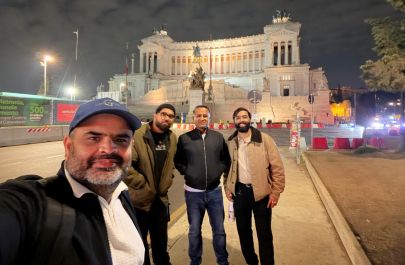
Because our time in Rome was limited, we decided to visit some of the city’s most famous landmarks that same evening. Alaptageen and Shafay kindly offered to accompany us, making the exploration much easier.
The Altar of the Fatherland
Our first stop was the impressive Altare della Patria, also known as the Altar of the Fatherland.
Constructed to honor Victor Emmanuel II, the monument symbolizes the unification of Italy and contains the Tomb of the Unknown Soldier.
At night, illuminated by soft lights, the white marble monument looked magnificent.
 Ancient Rome: The Roman Forum and Palatine Hill
Nearby lie the ruins of the Roman Forum and Palatine Hill.
The Roman Forum was once the political and commercial center of the Roman Empire, where senators debated, and citizens gathered.
Palatine Hill, overlooking the Forum, is believed to be the birthplace of Rome and once housed the luxurious palaces of Roman emperors.
Even from a distance, the ruins carried a powerful sense of history.
The Colosseum Under the Night Sky
From there, we walked toward the iconic Colosseum.
I had seen the Colosseum during the daytime before, but seeing it illuminated at night was an entirely different experience. The ancient amphitheater, built nearly two thousand years ago, once hosted gladiator contests and public spectacles for thousands of spectators.
Even at that late hour, the area remained lively with tourists, including many visitors from South Asia.
One interesting detail nearby caught my attention was a public drinking-water system that offered still or sparkling water at the push of a button. Travelers could fill a bottle, a cup, or even half a liter. It was a simple yet impressive example of how cities can encourage public water usage instead of bottled water.
The Ever-Busy Trevi Fountain
Our next destination was the world-famous Trevi Fountain.
Although the buses were relatively comfortable, the square around the fountain was extremely crowded. Visitors of all ages were enjoying the atmosphere.
Naturally, everyone was taking photographs. In today’s digital age, it sometimes feels as if people spend more time capturing a place than truly experiencing it.
Still, the fountain’s beauty, its dramatic sculptures, and flowing water remain unforgettable.
After about half an hour there, we purchased a few souvenirs and continued our walk through Rome’s historic center.
Pantheon and the Temple of Hadrian
We briefly passed the ruins of the Temple of Hadrian and then reached the majestic Pantheon.
Originally built as a temple to all Roman gods, the Pantheon is one of the best-preserved buildings from ancient Rome. Its enormous dome, with a circular opening at the center, remains one of the greatest architectural achievements of the ancient world.
 Returning to Prati
It was getting late, and although our hosts wished to treat us to Rome’s famous gelato ice cream, we decided to return to the hotel.
They helped us find the correct bus, and after exchanging warm farewells, we returned to the Prati neighborhood.
Back at the B&B, I enjoyed a simple but comforting luxury, a cup of tea prepared in the room with the kettle and tea supplies I had requested earlier.
Breakfast and Small Memories
The next morning’s breakfast was simple yet satisfying.
One charming detail of the B&B’s decoration caught my attention: small toy Vespa scooters and miniature cars displayed on the shelves. Seeing them reminded me of what we used to call “Dedri cars” in Sindhi, frog-like small cars similar to one once owned by DSP Qazi Abdul Haq of Moro.
Meeting Inspiring Sindhi Entrepreneurs
Before leaving Rome, we planned to meet two remarkable young Sindhi girls, Anoshi Chabarya and her business partner, who had opened a restaurant in the city.
Both originally come from the districts of Kandhkot and Jacobabad in northern Sindh. These districts are culturally rich but often lack opportunities for young women to pursue international careers.
Their achievement, therefore, becomes even more inspiring.
We took the metro from Ottaviano Metro Station to San Giovanni Metro Station, changing trains at Termini.
From there, we chose to walk and enjoy the surrounding neighborhood.
Hungry Scholars: A Sindhi Corner in Rome
Eventually, we arrived at their restaurant, Hungry Scholars, a unique and meaningful name reflecting curiosity, learning, education, and global experiences.
Anoshi had come early just to meet us before the restaurant opened. Her warm welcome made the place feel less like a restaurant and more like a Sindhi home.
Where there are Sindhis, tea is inevitable.
We were served desi chai and biscuits, though we politely declined additional food since we had already eaten breakfast.
During our conversation, we learned about their journey, studying at IBA Sukkur, moving to Rome for higher education, and eventually launching their own restaurant business.
Starting a business abroad is never easy. Their determination and courage are inspiring for many young people, especially girls from Sindh.
Their story sends a powerful message:
Spread your wings, and you will discover the world is larger than you imagined.
Anyone visiting Rome should consider stopping by Hungry Scholars, not only for food but also for the warmth of Sindhi hospitality thousands of kilometers away from home.
Onward to the Next Journey
After planning our route carefully, we headed toward the Roma Tiburtina railway station, from where our FlixBus to Naples would depart.
The bus ride to the station took about forty-five minutes due to rush-hour traffic, but we arrived comfortably on time. After confirming the departure platform at the FlixBus office, we sat down and relaxed.
Soon, the bus arrived.
As it departed from Rome toward Naples, our short yet memorable chapter in the Eternal City came to an end, filled with history, friendships, and a surprising touch of Sindhi hospitality in the heart of Italy.
A City of History, Encounters, and Memories
As the bus slowly rolled out of Rome toward Naples, I looked back at the city that had witnessed more than two thousand years of human history. Rome is often called the Eternal City, and after spending even a short time there, one begins to understand why. Every street corner seems to carry a story, every monument whispers memories of empires, faith, art, and human ambition.
Yet for me, this visit to Rome was not only about ancient ruins, grand monuments, or famous fountains. It was also about people, the warmth of friends, the generosity of strangers who quickly became companions, and the surprising feeling of finding a small Sindhi world thousands of kilometers away from home.
From sharing iftar in an apartment that felt like a Sindhi otaq to meeting young entrepreneurs who carried their dreams from Sindh to Italy, the journey reminded me that travel is not merely about geography. It is about human connections.
Cities impress us with their architecture, but people leave the deeper impressions.
As the lights of Rome slowly faded behind us and the road stretched toward the south, I realized that journeys are never measured only in kilometers. They are measured in moments: a warm cup of tea after a long walk, a familiar language spoken in a distant land, and the quiet realization that the world, despite its vastness, can sometimes feel surprisingly small and wonderfully connected.
And with that thought, our Roman chapter closed, not as an ending, but as another beautiful memory added to the endless journey of travel.
Read: Long Moroccan Turban Speaks Desert Winds
__________________
Abdullah Soomro, penname Abdullah Usman Morai, hailing from Moro town of Sindh, province of Pakistan, is based in Stockholm Sweden. Currently he is working as Groundwater Engineer in Stockholm Sweden. He did BE (Agriculture) from Sindh Agriculture University Tando Jam and MSc water systems technology from KTH Stockholm Sweden as well as MSc Management from Stockholm University. Beside this he also did masters in journalism and economics from Shah Abdul Latif University Khairpur Mirs, Sindh. He is author of a travelogue book named ‘Musafatoon’. His second book is in process. He writes articles from time to time. A frequent traveler, he also does podcast on YouTube with channel name: VASJE Podcast.