For we have already found
A more enduring address than any house can offer.
We are together—
Forever—
Within the pages of a book.
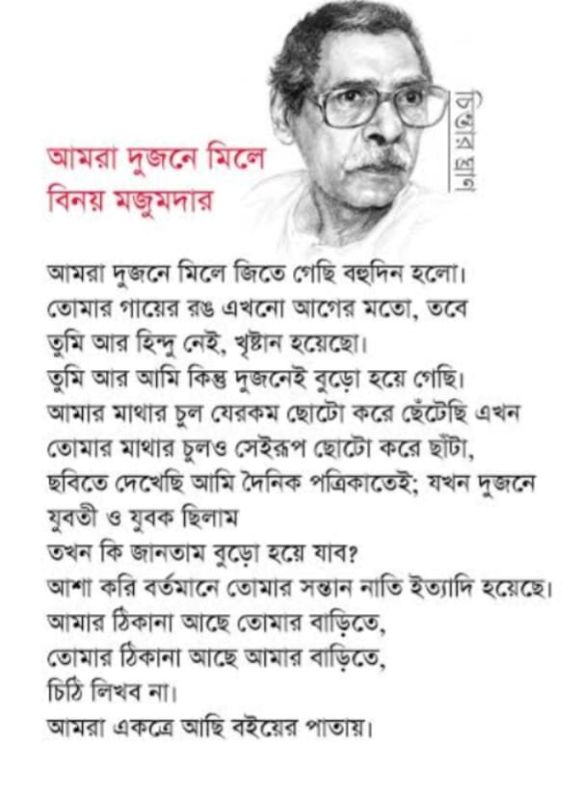
Binoy Majumder
 Binoy Majumdar was one of the major post-Tagore poets, who, despite his higher education in engineering, spent his life in a one-sided love with a woman. He was not only a poet but also a brilliant engineer, a social reformer, and a dervish-like individual with communist ideals, whose life is an astonishing story oscillating between brilliance and deep mental agony.
Binoy spent the last several years of his life away from the noise of Calcutta in a dilapidated house in Thakurnagar, where his only friends were butterflies, fish, and trees. He called himself India’s first “Chandal poet,” dismantling human arrogance to present a formula for equality with nature. He rejected offers to become a university professor, choosing instead to be a poet. He was hospitalized for psychiatric treatment multiple times, where he received electric shocks. Laughing at himself, he would say: “I am the Inspector General of all the mental asylums in West Bengal.”
Binoy Majumdar introduced the concept of “Green Romanticism” to Bengali poetry. This theory emphasizes a deep unity between humans and nature. Researchers refer to his works as Écriture Écologie, or ecological writing. While traditional romantic poets were limited to flowers and nightingales, Binoy used unconventional symbols such as fish, mosquitoes, insects, blood, and flesh.
Translated by Debasree Chakraborti
The Two of Us
The two of us have won—
We won a long, long time ago.
Your complexion remains just as it was in those days,
Though you are no longer a Hindu;
You have embraced Christianity.
And yet, you and I have both grown old.
The hair I once cut short
Has now been mirrored upon your head—
Trimmed close, just as mine.
I saw your photograph in the daily newspaper,
And for a moment, time seemed to fold in upon itself.
When we were young—
When you were a young woman and I a young man—
Did we ever imagine that one day
Youth would quietly leave us behind,
And old age would come to sit beside us?
I hope that, by now,
You have children, grandchildren,
And a house filled with the ordinary music of generations.
My address still exists at your home;
Yours still remains at mine.
There is no need to write letters anymore.
For we have already found
A more enduring address than any house can offer.
We are together—
Forever—
Within the pages of a book.
___________
 Debasree Chakraborti is a renowned novel writer of Bengali language. Based in Kolkata, West Bengal, India, she has done Master’s in Modern History from the Kolkata University, and authored some thirty books, mostly the novels, with historical perspective and themes. Her novel is ‘Maharaja Dahir’ that covers the history of Sindh from 662, the year of first attack on Sindh by the Arab armies till date, was published in 2024 and translated by Nasir Aijaz into Sindhi language. Recently, her new Bengali novel ‘The Last People of Mohenjo Daro’ has also been published.