He looked at the statue again, but this time through the eyes of a sculptor, not a haunted lover. He saw an incredible piece of art, an embodiment.
By Abdel Latif Moubarak | Egypt
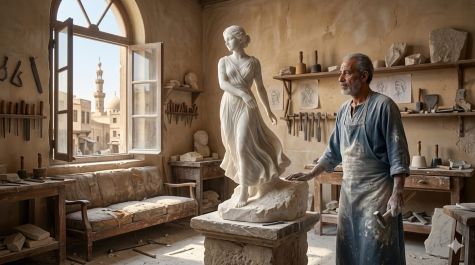
Assem’s workshop was tucked away in a forgotten corner of the city, where the roar of traffic couldn’t reach—only the rhythmic ring of chisels striking the heart of silence. Assem wasn’t an ordinary sculptor; it was said he had the power to make stone breathe. But since Sarah’s passing a year ago, he hadn’t touched a single block of marble. His tools were layered in dust, much like his heart.
Sarah was the light through which he saw every angle and shadow. Her sudden departure in an accident left a void that all the marble in the world couldn’t fill. On a particularly cold night, Assem finally decided to face his grief. He pulled the shroud off the largest block of white Carrara marble he owned, staring at it as if it were a prison holding his beloved’s soul captive.
Assem didn’t start with sketches or blueprints. He closed his eyes and conjured the texture of her face, the curve of her shoulder when she laughed, and the way her hair fell like a waterfall of black silk. With the first blow of the hammer against the chisel, a white shard flew off like a petrified tear.
The strike was powerful, fueled by suppressed rage and bitter helplessness. He began to shape the head, chipping away the excess to reveal the features time had etched into his memory. The stone was cold, but his hands were burning. “I will get you out of here, Sarah,” he whispered into the marble’s deaf ear.
A week passed, and the shapeless block transformed into a ghostly human silhouette. Assem slept for only a few hours on a tattered sofa in the workshop, waking up to bitter coffee before returning to his duel with the stone. He began defining the eyes; that was the hardest stage. Sarah had a specific spark—a blend of intelligence and tenderness.
Every time he carved into the marble, he felt as if he were carving into his own flesh. White dust coated his clothes, his hair, and his eyelashes until he looked like a living statue moving among the dead stone.
In the third week, the miracle began to happen. The collarbone appeared, along with the infinite delicacy in the folds of the dress he chose for her. He didn’t want her static; he wanted her in a moment of motion, as if she were turning to say goodbye.
He used the finest rasps, passing them over the marble “skin” until it felt as smooth as silk. He whispered words to the statue he never said while she was alive—belated apologies, promises to stay, and stories of the lonely days he spent. He began to feel that the statue was listening.
Assem reached a level of obsession that made him refuse to leave the workshop. Sarah was emerging from the rock with terrifying clarity. In the dim candlelight, he imagined her marble chest rising and falling with faint breaths.
He began talking to her as if she truly existed. “Are you cold, Sarah?” he would ask, covering the statue with his coat on winter nights. Neighbors began to whisper about the mad sculptor who held conversations with stone.
In a moment of sheer exhaustion, Assem’s hand slipped. The chisel left a small scratch across the statue’s cheek. Assem let out a cry that tore through the night’s silence, falling to his knees and weeping as if the scratch were on the real Sarah’s face.
He spent two whole days meticulously repairing that scratch, filing it with extreme gentleness until it vanished, but it left a wound in his heart that wouldn’t heal. He realized then that stone, no matter how beautiful, always falls short of human perfection.
Two months had passed. The statue was now complete. Sarah stood in the center of the room, possessing a beauty beyond description. The marble no longer looked like stone; it seemed translucent, radiating an internal light. Assem had drained all his energy; he had lost weight, his eyes were sunken, but he looked at his work with a pride tinged with terror.
The statue was so beautiful that Assem was afraid to touch it. He feared that touching it would reveal the coldness of the stone and wake him from his beautiful dream.
On the night he decided to unveil the statue to himself for the last time, Assem sat before the marble Sarah. He asked her, “Why don’t you speak? I’ve given you everything I own… my soul, my time, and my memory.”
Silence prevailed—the kind of silence only broken by the wind outside. He reached out and touched her marble hand. It was as cold as ice. At that moment, reality collided with his fantasy. This wasn’t Sarah. This was merely marble remains, a monument to his sorrow, not a restoration of his beloved.
Assem wept for a long time—not out of regret for the work, but out of the realization of the end. He understood that art does not resurrect the dead; it only immortalizes their memory. He gathered his tools and cleaned the workshop of the dust that had accumulated for months.
He looked at the statue again, but this time through the eyes of a sculptor, not a haunted lover. He saw an incredible piece of art, an embodiment.
Read: Treasuries of Sorrow – Short Story
__________________
 The author was born in Suez and writes poetry using classical Arabic and Egyptian vernacular. He received a Bachelor of Law from Ain Shams University. He was one of the most important poets of the 1980s and his poems were published in several literary magazines in Egypt and the Arab world, including the Arab magazine, Kuwait magazine, News Literature, Republic newspaper, Al-Ahram, the new publishing culture (magazine).[1] Received the Excellence and Creativity Shield from the Arab Media Union in 2014 and Won the shield of excellence and creativity from the East Academy 2021.He won the Sergio Camellini International Award in Italy in 2025. He won first place in the “Divinamente Donna” competition in Italy 2026.