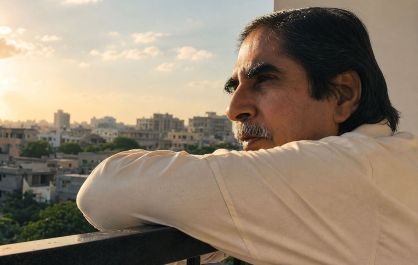
The poem by Shaikh Ayaz, operates on several simultaneous planes. It has romantic, mystical, existential, and psychological undertones at the one same time without resolving into any single one. Its strength lies in this deliberate instability. The meaning is not delivered, it is rather experienced as shifting perception.
By: Raphic Burdo
Shaikh Ayaz is one of most celebrated poets of Pakistan. More importantly, Shaikh Ayaz is one of the most significant modern Sindhi poets, widely regarded as a bridge between classical Sindhi poetic sensibility (Sufi, folk, symbolic) and modern existential expression. His work often carries the emotional vocabulary of love poetry while simultaneously opening into political awareness, metaphysical questioning, and psychological depth. He writes in a tradition shaped by Shah Abdul Latif Bhittai, yet his idiom is modern—urban at moments, fractured at others, intensely personal throughout.
Originally Shaikh Ayaz wrote in Sindhi. He has been translated in Urdu, Punjabi, Siraiki and English. Ayaz has been the poet of the rebels, lovers, revolutionaries and iconoclasts. His poetry immensely evolved during his active writing period between 1960s to late 1990s. His resistance poetry has been as much popular among the youth as his romantic poetry. In later years of his life Shaikh Ayaz grew more otherworldly.
The poem by Shaikh Ayaz which follows, operates on several simultaneous planes. It has romantic, mystical, existential, and psychological undertones at the one same time without resolving into any single one. Its strength lies in this deliberate instability. The meaning is not delivered, it is rather experienced as shifting perception.
I would to invite the esteemed reader to sing the following ghazal of Ayaz.
اي دل نه کاءُ ڌوڪو، اچ پيءُ هي پروڪو
ساغر وچان ڏسي ٿو، هيءَ ڪائنات ڪو ڪو
گهر گهر، گهٽيءَ گهٽيءَ ۾، تون گهنڊ ٿو وڄائين
اي،ميفروش! تنهنجو هر هنڌ آهي هوڪو
اڄ رات شبنمي آ، ڇو جام ۾ ڪمي آ
هن وقت ڪا به ناهي، مون تي ميار لوڪو
هي ناز جون نهارون، تو اڳ ۾ به آزمايون
شايد جٽاءُ ڪن اڄ، اي عشق کاءُ ڌوڪو
هي تندُ تيز طوفان، مان پار ڪيئن پهچان
سوچو ته ناخدائو، آهي به آسرو ڪو
تيسين اياز هن کي، پورو پسي نه سگهندين
جيسين کلي نه جاني! ڪو جيءَ ۾ جهروڪو
[Ai dil na khau dhokho, ach pī hĩ paroko,.Sāghar vichāñ dise tho, hī kāināt ko ko.
Ghar ghar, ghati ghati meñ, tūñ ghaṇḍ tho wajjain,
Ae mai farosh! tuhnjo har handh āhe hoko.
Aj rāt shabnamī ā, chho jām meñ kamī ā,
Hin waqt kā ba nāhe, muhn te mayār loko.
Hī nāz joon nihāroñ, to agh meñ ba āzmāyoñ
Shāyad jaṭāu kan aj, ai ishq khāu dhokho.
Hī tund tez tūfān, māñ pār keyañ pahchāñ
Socho ta nākhudāo, āhe ba āsro ko.
Tīsīñ Ayāz hin khe, pūro pasī na saghndīñ
Jīsīñ khulī na jānī! ko jī mieñ jharoko.]
Let me render it into English for the benefit of connoisseurs of poetry so that they are able to take deep dive into the poetic thought as well while enjoying the musicality and cadence of Shaikh Ayaz’s genius.
O heart! be not deceived,
come, drink the old wine;
Only few get the glimmers of the universe,
From the goblet.
House to house, from lane to lane,
you keep striking the bell;
O wine-bearer, your proclamation
echoes everywhere.
Tonight the air is dewy,
Let the cup be full to the brim;
At such an hour, O people!
I am accountable no one.
These glances steeped in coquetry,
you have already tested;
May sustain longer, O love!
suffer again a deception.
This fierce raging storm,
how shall I reach across?
Wonder, O Sailors!
is there any way out?
Ayaz, you shall never behold
the whole of mystery
until, my dear, somewhere within the soul,
a hidden receptive window opens.
Now that you have read/sung or hymned Sindhi version and recited the English transliteration of Shaikh Ayaz’s given poem, let me make an attempt at the systematic critical appreciation of the poem.
Form and Architecture: The poem is built as a lyric sequence of autonomous stanzas, rather than a linear narrative. Each stanza functions like a self-contained meditation. Stanza 1 expresses epistemic doubt and intoxication of perception. In Stanza 2 omnipresence of desire and call of the tavern is reflected. The Stanza 3 depicts emotional restraint and speaks of social judgment. Stanza 4 progresses the proceeds into skepticism in love and trials. The Stanza 5 is takes us logically into the domain of existential obstruction by using imager of storm. Finally, the Stanza 6 leads us to ultimate internal and spiritual revelation, much like self-awareness or self-discovery.
This structure is not accidental. It reflects a non-teleological experience of consciousness: meaning does not “develop” in a straight line; it accumulates in waves. The form itself enacts the poem’s philosophy: reality is not sequential, it is episodic.
Symbolism: The poem uses a classical Indo-Persian symbolic system but recharges it with modern ambiguity. Wine, Tavern, Wine-seller are traditional Sufi symbols of divine intoxication. Here these become psychologically layered. Intoxication stands for altered consciousness? The tavern represents omnipresence of places of self-discovery, not fixed spaces specified by other people. Here the wine-seller shows the omnipresent call of experience itself. Unlike purely devotional poetry, here the symbolism is unstable, meaning thereby, that it can be spiritual, romantic, or existential at once.
Dewy night (shabnami raat) is a key atmospheric symbol in the poem. It represents softness of perception, emotional vulnerability, sensory quietness before revelation or collapse. It is not at all decorative nature imagery. IT is a state of being.
The symbols of Storm, Boat, Crossing to other side introduce rupture. They present life as an uncertain navigation, knowledge as incomplete guidance, and the self as exposed traveler. The boatman or sailor (Nākhudā)) motif subtly evokes classical metaphors of guidance, yet here even guidance appears uncertain.
In the poem, Inner window (jharoko) is the metaphysical pivot, showing that truth is internal aperture. The perception requires opening, not acquisition; knowledge is transformation of capacity. It is the poem’s final epistemological statement.
Diction: Shaikh Ayaz’s diction is surprisingly simple. He uses everyday verbs (see, drink, cross, open) and common nouns (night, cup, storm, heart). However, you will notice these words carry compressed symbolic density. This creates a dual effect. First, immediate emotional accessibility, and secondly, deep interpretive ambiguity. The language is deliberately non-ornamental yet highly resonant which a hallmark of modern classical poets is.
Sonic Texture: I have made effort so that even in translation, you can identify the musical architecture of the original poem of Ayaz. Repetition of address (“O heart,”. “O Love”, “O wine-seller,” “O Sailor”), internal echoing of sound clusters, and rhythmic alternation between soft and hard phonetics. The original Sindhi poem carries a sung quality, close to oral lyrical tradition. The poem is meant not only to be read but to be internally heard. Its music is not strict meter; it is emotional cadence, the expansion and contraction of thought.
Emotional Depth: In this poem of Shaikh Ayaz dominant emotional field is oscillatory instability: trust vs doubt, surrender vs resistance, desire vs. fear, and revelation vs. obscurity. This is not confusion. It is a structured psychological condition of modern subjectivity. In the poem, the speaker is not unified; he is experiencing the fragmentation of certainty itself. Thus the poem becomes a map of consciousness under pressure.
Philosophical Message: Poetry, like art and literature, many say, must be enjoyed and appreciates on “as is basis”. This school of thought has long been the proponent of art for art. But there is no shortage of literary critics who strongly champion “art for life”. I would side with latter now and seek to take you to the central philosophical proposition of this poem of legendry Shaikh Ayaz of Sindh.
We gather from the poem that reality is partially visible. It is never fully graspable. The key implications are that perception is conditional on our inner state, truth is not an external discovery but an internal opening. Moreover, that love and knowledge are both experiments in uncertainty. This poem of Ayaz rejects closure. Even its final line does not resolve, rather it opens.
Romanticism Reconfigured: This is not romantic poetry in the conventional sense. Love here is unstable, dangerous, illuminating, and, above all, inseparable from existential risk. The beloved is not a person alone, but a force of perception destabilization. Here, romantic experience becomes a method of knowledge, not merely emotion.
The reader will surely realize that this poem of Shaikh Ayaz moves through the classic Sufi-symbolic landscape of Sindhi and Persian poetry. Wine, cup, tavern are not merely sensual images; they signify spiritual awakening, ecstasy, and unveiled truth. The wine-seller (may-farosh) resembles the mystical guide whose call resounds through existence itself. The final image of the inner window (Jharoko) (“جهروڪو”) is quintessentially mystical: reality cannot be fully seen outwardly until an aperture opens within consciousness. The translation of Ayaz’s poem aims not for literal equivalence alone, but for the cadence, inward luminosity, and metaphysical suggestiveness.
Shaikh Ayaz is ultimately not describing love or nature. He is describing states of consciousness in motion, where the self is continuously negotiating between illusion and revelation, desire and fear, world and inwardness. In that sense, the poem is not about what is seen. It is about what kind of being is required in order to see. If overall critical evaluation, the poem succeeds because it operates on multiple registers simultaneously. It uses classical symbolism without classical certainty. It has romantic intensity without romantic resolution. In addition to that, the poem employs mystical language without doctrinal closure. It also carries tinge of modern psychology without fragmentation into prose.
All in all, the achievement of poem lies in maintaining controlled ambiguity. Each image is stable enough to feel meaningful, unstable enough to remain open. In short, this poem stands within the modern Sindhi lyrical canon as an example of how traditional symbolic vocabulary can be transformed into a contemporary philosophy of consciousness. Its enduring strength is that it does not explain reality. It instead recreates the condition of encountering reality before explanation becomes possible. In that that sense, Shaikh Ayaz is not merely a poet of love or mysticism. He is a poet of perceptual thresholds, moments where the self is not yet defined by interpretation, but is still open to becoming.
Read: Shah Latif and Authentic Living
____________________
Raphic Burdo is student of literature and psychology. He reads for pleasure and writes to share his take on things with the world.