Stories of Karachi’s Taxi Drivers from 1993 to 2000
Zaffar Junejo
[Author’s Note: I joined a non-government organization in mid-1993. In those days, we were frequent travelers to other Asian countries, and during that period I maintained a diary. I once showed the notes to Muhammad Ibrahim Joyo — the legendary scholar, translator, and intellectual giant of the Sindhi world — who suggested categorizing the entries by theme and getting them published. He recalled that long ago, perhaps in 1955, the Sindhi journal Mehran had launched a similar idea titled ‘Hik Deenh Ji Ghaleh’ (The Story of a Day), even offering a prize for it. He himself had submitted the first story, he told me with a smile, just to set a standard for other writers. Later, Maulana Ghulam Muhammad Girami, a scholar of high standing and journalist; Shamsher ul Haidri, a distinguished Sindhi poet, journalist, and playwright; and Siraj ul Haq Memon, an iconic novelist, linguist, and journalist, all contributed their observations of a single day. These writings were published until 1968.
I agreed with Joyo Sahib that I would group the write-ups by subject and get them published, but I failed to do so. Recently, I sat down to organize my notes. I found various entries about the taxi drivers of Karachi city. Some were very brief and incomplete; others were short but held a finished truth. I have chosen five stories from each year, all of them gathered from the drivers of those cars. In total, there will be thirty-five stories covering the period from 1993 to 2000.
On the surface, these pieces appear to be simple narratives. However, beneath the prose, they depict the complex socio-political and cultural landscape of Karachi during those turbulent days. They are the echoes of a city in motion.]
The Land of Others
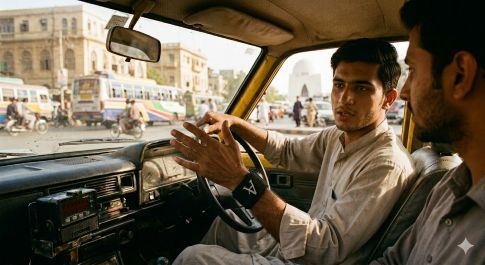
The sun was hot over Saddar. The air smelled of diesel and dust. I hailed a yellow taxi. It was old, but the engine started with a clean knock.
“Gulshan-e-Iqbal,” I said.
The driver nodded. He did not speak. He took MA Jinnah Road, the one they used to call old Bandar Road. The traffic was heavy. Buses roared, painted in bright, violent colors. We crawled through the heat. Inside the cab, it was quiet.
We passed the white dome of Jinnah’s Mausoleum. It stood tall against the pale sky. The silence in the car felt long, like the road.
“What is your name?” I asked.
“Rahim,” he said. Then he looked in the rearview mirror. “Abdul Rahim.”
“You were born here. In Karachi.”
“Yes,” he said. He shifted gears. “I was. But my grandfather and my elder brother were from Delhi.”
“What did they tell you about it? About India?”
The traffic broke. He accelerated. His shoulders relaxed.
“Let it be, Sahib,” Rahim said. “It was all a drama.”
“How?”
“Perhaps not a drama,” he said, turning the wheel. “But a confusion. Last week, I spoke to my taya. My elder uncle. I asked him about home, Delhi. On Eid, or the tenth of Muharram, everyone gathers. The uncles, the aunts, the old acquaintances. They praise Delhi. They talk about the dargahs, the melas, the sweets, the old days. They cry for it. But in the streets, they abuse India. They are ready to fight India.”
He stopped talking. He watched a motorcycle cut in front of the bumper.
“What did he say?” I asked.
“There was a long pause,” Rahim said. “Then my uncle told me, ‘We were cheated. We lived on rumors. On assumptions and propaganda.'”
“What does that mean?”
Rahim glanced at me through the mirror. “Are you Sindhi, Sir?”
“Yes,” I said. “I am.”
“Forgive me,” he said. “I only say what my grandfather told us. He said they came to Pakistan, and within one week, they knew. They realized they had landed on the land of others. The Sindhis were already here. My grandfather said it was a hard reality to accept. So they found an escape. They abuse India in the streets to feel common, and they praise it at home because they miss it.”
His voice was smooth. It had the rhythm of the city. He drove with one hand and gestured with the other. On his left wrist, there was a strip, with a design of the letter A.
We passed the Federal Urdu University. The old buildings went by. I wanted to lighten the air.
“The letter A,” I said, pointing casually at the strip. “Is that for a beloved?”
He pulled his arm back. He looked at his wrist the way a man checks his watch to see how much of the day is left. He did not answer.
We crossed the Sadequain Gallery. As we were crossing, the traffic jammed. The engines idled hot, and the noise of the street grew loud around us. Horns blared. Drivers shouted. My stop was near.
“Stop at Kala Board,” I said. “Near the Sindh Technical Board.”
He brought the taxi to the curb through the press of vehicles. The brakes squeaked. The trip had taken less than one hour, but the sun was lower now.
I looked at the meter and paid him his fare. He took notes.
I opened the door and stood in the noise and dust of the roadside.
“Saeen,” Rahim said. He leaned toward the passenger window. “This letter A. It is the first letter of Altaf Bhai’s name.”
He did not wait for me to speak. He smiled, a quick, sharp motion of the lips, and thanked me. Then he drove back into the thick of the traffic, and the gray exhaust hid the car.
***
The Righteous Man
The sun was low over the Press Club. The heat of Karachi hung thick in the air, heavy with dust and the smell of sea salt. I flagged down a yellow taxi. The car was not old, but it had the dull look of a machine that never rested.
“NIPA,” I said.
He did not look back. “Sit.”
“How much?”
“Pay me what you pay the others,” he said. His voice was flat.
“I have never taken a cab from here,” I said. “Tell me your charge.”
“Four hundred and fifty rupees.”
“Three hundred and fifty,” I said.
He shifted into first gear. “Get in.”
The traffic was loud on the main road. The engine hummed evenly under the floorboards. I watched the back of his neck. He looked to be in his late twenties, his hair clipped short, and his shoulders straight against the vinyl seat.
“How is business?” I asked.
“Allah ka shukur,” he said. He raised his left hand from the wheel, touched the lobe of his ear, and pointed one finger toward the sky. Then he went silent.
We drove for a long time without words. The city passed by in a blur of concrete and bright billboards. The silence in the cab felt heavy, like the heat outside. Then, without being asked, he spoke. His tone was monotonous, the tone of a man repeating a truth he had decided upon.
“The world has changed,” he said.
I did not answer. I let him talk.
“Last night,” he said, watching the road ahead. “About ten o’clock. I was parked near Khada Market. I was drinking a cup of tea. The tea was still hot in the cup. Someone knocked on the glass of the driver’s side.”
He turned a corner. The tires squeaked softly.
“I held the cup in my hand,” he went on. “There was a man and a woman. They leaned close to the door. The man was young, maybe thirty. He asked if I could take them for a drive. To Clifton Beach, then Shireen Jinnah Colony, and back to the market. I told them yes.”
He paused, adjusting his grip on the wheel. On his left wrist, a black cloth strip was fastened tight.
“We started,” he said. “We had just passed the Malaysian Consulate. In the mirror, I saw them. They were giggling. Pushing each other. I looked away. I thought, they are young. It is their right to be happy.”
The traffic slowed, then broke. He accelerated.
“Then we reached the beach,” he said. “We crossed the row of dark huts. I looked in the mirror again. I could not see the girl. She was gone from the seat.”
He did not look at me. His eyes stayed on the asphalt.
“I was worried, but I kept quiet,” he said. “Then I heard the sounds from the back. What I suspected was true. I did not like it. I reversed the taxi right there. I took a sharp left turn.”
“What did they do?” I asked.
“They shouted,” he said. “They cried that they wanted to go to Shireen Jinnah Colony. I lied to them. I told them I had an emergency. Something urgent. But I did not take them back to Khada Market. I stopped right there by the sand. I told them to get out.”
The brakes whined slightly as we approached an intersection.
“They wanted to pay me,” the driver said. His left hand gestured in the air, smooth and deliberate. “I refused. Should I take money for that kind of work? For facilitating that?”
He looked at me through the rearview mirror now. His eyes expected something. Praise, perhaps. Or agreement that he was a righteous man. It was a good story. It was the kind of story men tell to feel clean in a city that is not.
“I don’t know,” I said.
He nodded once, satisfied with his own virtue, and turned the car toward NIPA.
***
The Geometry of a Zealot
The sun was brutal over the compound. I came out of the American NGO inside the Church Compound, near where the mobile market stands now. This was before the years of General Musharraf, before everyone talked of good Taliban and bad Taliban. The air smelled of hot dust and old brick.
I walked toward Tower Market. A few yellow taxis stood in the shadow of the church building. The shadow was thin.
I picked one. “Sohrab Goth,” I said.
The driver looked at me. “Five hundred rupees.”
“Good,” I said. “Let us go.”
I got into the back seat. The vinyl was hot. I wanted to make him at ease.
“What is your name?” I asked.
“Gul Khan,” he said.
He shifted into gear, and we did not speak for a long time. The city outside was loud, but inside the cab, it was just the heat and the rattle of the old chassis. He took a few haphazard turns, cutting through the press of the traffic, until he hit Ispahani Road. The road was wide and grey.
Gul Khan looked at me in the rearview mirror. His eyes were bright.
“Sahib,” he said. “Can I ask you one thing?”
“Ask,” I said.
“Nawaz Sharif did a good thing with the atomic test,” he said. He nodded once, hard. “A very good thing. Now India will think twice. Now they know what a Muslim is.”
He did not say Pakistan. He said Muslim.
“Do not underestimate India,” I said. “It is a democracy. It is a huge country. Geographically, it is vast.”
He smiled. It was the smile of a man who thought he knew a secret.
“I am an illiterate man, Sahib,” he said. “But I have ideas. I know how to face India.”
“Tell me your ideas,” I said.
He gripped the steering wheel tight with his right hand. He raised his left hand and held up four fingers. He spoke clearly.
“The vastness of India is no issue,” Gul Khan said. “If Pakistan and Afghanistan merge, we become one country. One big land. Then we implement Shariat. Shariat is much better than democracy.”
He watched the road, his four fingers still in the air.
“Then we tell the Hindus and the Christians to migrate to India. If they do not want to live under Shariat, they must leave. Then we give a deadline to the people of India. We tell them to become Muslim.”
“And if they do not?” I asked.
“Then we attack,” he said. “All Muslims together.” He paused to clarify that by Muslims, he meant the Afghans and Pakistanis of before. Then he concluded, “We take India.” I looked out the window. The concrete buildings went by, dry and yellow under the sun. I thought how naive he was. I wondered how many passengers had sat in this seat and listened to his fanaticism. The poison was quiet, but it was there, moving through the streets in the back of small cars.
We crossed the Gulzar-e-Hijri police station. The tires roared on the asphalt.
Gul Khan took a long U-turn under the overhead bridge. He pulled the taxi to the curb in front of Al-Asif Square. The square looked heavy and grey in the afternoon light.
I paid him his five hundred rupees. He thanked me and took the notes.
I got out and stood on the crowded roadside. I watched the yellow taxi pull back into the traffic, disappearing into the dust. I stood there for a while, thinking that how fast society was moving toward nowhere.
_______________
 Dr. Zaffar Junejo has a Ph.D in History from the University of Malaya. His areas of interest are post-colonial history, social history and peasants’ history. He may be reached at junejozi@gmail.com