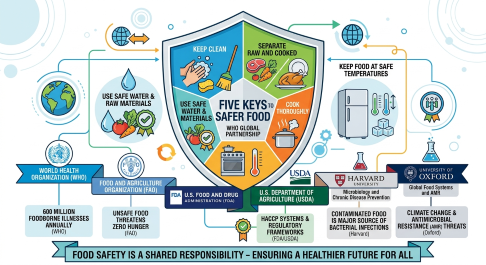
Keep clean, separate raw and cooked foods, cook thoroughly, keep food at safe temperatures, and use safe water and raw materials.
Hammad Ahmed and Ayesha Sohail
Food safety has become one of the most critical global public health challenges of the 21st century. According to the World Health Organization (WHO), unsafe food causes approximately 600 million cases of foodborne illnesses every year, leading to nearly 420,000 deaths worldwide. World Food Safety Day, observed on 7 June, highlights the urgent need for collective action to ensure safe, nutritious, and uncontaminated food for all.
The World Health Organization (WHO) emphasizes the “Five Keys to Safer Food”: keep clean, separate raw and cooked foods, cook thoroughly, keep food at safe temperatures, and use safe water and raw materials. WHO stresses that food safety is not only a health issue but also a development issue affecting economies, trade, and food security.
The FAO highlights that food safety is essential for achieving Zero Hunger (SDG-2). It states that unsafe food threatens food security by reducing availability and consumer trust. FAO promotes improved agricultural practices, safe handling of raw materials, and stronger food supply chain monitoring systems.
The U.S. Food and Drug Administration (FDA) and U.S. Department of Agriculture (USDA) focus on strict regulatory frameworks to ensure food safety from production to consumption. FDA emphasizes Hazard Analysis and Critical Control Points (HACCP) systems, while USDA regulates meat, poultry, and processed food safety standards. Their guidelines strongly support prevention of contamination rather than reaction after outbreaks.
Leading academic institutions also contribute significantly to food safety research:
- Harvard University highlights the link between food safety, microbiology, and chronic disease prevention. Harvard research shows that contaminated food is a major source of bacterial infections like Salmonella and E. coli.
- University of Oxford focuses on global food systems, climate change impacts on food safety, and antimicrobial resistance (AMR), which is a growing global threat linked to food production systems.
Across international organizations, a clear consensus exists:
- Food safety is a shared responsibility between governments, producers, and consumers.
- Prevention is more effective than treatment of foodborne diseases.
- Strong surveillance systems and laboratory testing are essential.
- Education and awareness play a key role in reducing risks.
Other important organizations like the Codex Alimentarius Commission (WHO/FAO), European Food Safety Authority (EFSA), and Centers for Disease Control and Prevention (CDC) also reinforce the importance of standardized global food safety regulations.
Food safety is not optional—it is a fundamental human right. As global food systems become more complex, the risk of contamination increases. However, with the combined efforts of international organizations like WHO, FAO, FDA, USDA, and leading universities such as Harvard and Oxford, a safer global food system is achievable.
Public awareness, scientific research, and strict regulatory enforcement together can ensure a healthier future.
Read: Burden to Solutions – Safe Food Everywhere
_____________________
Hammad Ahmed and Ayesha Sohail are students of BS Food Science & Technology at Hamdard University Karachi. Their academic interests include food safety, quality assurance, food processing, and public health awareness.