An Essay on the Literary Journey of Soumya Salek, a renowned poet of Bangladesh
By Nurul Hoque
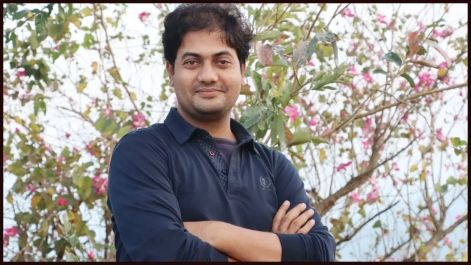
On a late February morning in 1987, when the winter air of Bengal yields to the soft whispers of Falgun, Soumya Salek entered the world in the quiet village of Kadla within the Kochua UpoZela of Chandpur district, at the home of his maternal kin. Chandpur is a land defined by the majestic confluence of rivers, where the Padma and the Meghna meet in a vast and restless embrace, and though his ancestral roots belong to the nearby village of Tetaiya, it was this soil drenched in alluvial memories and riverine mists that quietly nurtured his early imagination. Born to Md. Nurul Islam and Roushan Ara Begum, who gifted him a lineage rooted in grace, faith, and quiet dignity, he learned from his domestic surroundings the cadence of Bengali speech—the soft rustle of paddy leaves, the rhythmic beating of rain against corrugated roofs, and the melancholic songs of boatmen drifting across silt-laden waters—sensory impressions that would later become the foundational palette of his literary universe.
As he grew, his intellectual journey led him to Comilla Victoria College, an institution renowned for its academic legacy, where he pursued a Master’s degree in Accounting. At first glance, the rigorous world of accounting, built upon ledgers, balance sheets, and precise numerical reconciliation, might seem far removed from the uncharted realms of poetry; yet for Soumya Salek, this dual discipline forged a distinct harmony. The balance sheet taught him symmetry, restraint, and structure, while the poetic muse offered him a canvas to explore the unquantifiable dimensions of human emotion, mortality, and existential angst, creating a synthesis of analytical precision and lyrical vulnerability that would eventually define his artistic voice.
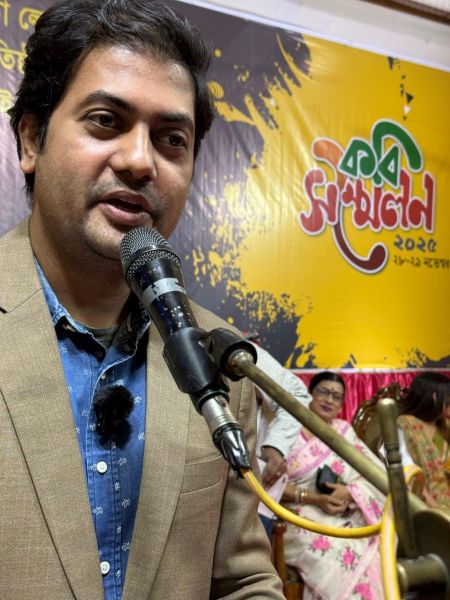 Soumya Salek’s formal entrance into the literary sphere occurred in 2008 at the Amar Ekushey Book Fair in Dhaka when his poetry was featured in the curated anthology Selected Poems of 2007, marking the beginning of a relentless artistic journey during which his verses, short stories, essays, and dramatic works appeared across more than a hundred literary journals, little magazines, and regional anthologies across Bangladesh and India. Rather than offering mere decorative verse, Salek approached literature as a philosophical quest and a search for truth amid the fractured realities of modern existence, an inquiry vividly embodied in his published poetic volumes. His debut collection Atmakhuner Sketch (Sketch of Self-Extermination), published in 2016 by Prakriti Prakashan, examines self-reckoning and internal conflict through the metaphor of a sketch as an ongoing draft of identity and a vulnerable exploration of grief and psychological fragmentation. This was followed in 2018 by Usha O Gamini (Usha and Gamini), published by Deshoj Prakashan, a pivotal collection that juxtaposes celestial light with earthly journeying, whose manuscript received the prestigious Deshoj National Manuscript Award in 2017 for its seamless blending of classical motifs with modern poetic sensibilities. In 2020, Somoy Prakashan released Pata Jhorar Orchestra (Symphony of Falling Leaves), where autumn becomes an allegory for decay, memory, and spiritual transition as falling leaves perform a symphony reminding the reader that every ending carries its own music. Expanding his gaze toward urban solitude, Park Bencher Kobita (Poems from a Park Bench), published by Kobi Prakashan in 2022, turns the park bench into an observation post to reflect on forgotten lives, brief encounters, and the quiet dignity of city dwellers. His 2023 volume Shirohpeera O Onyanyo Songbed (Migraine and Other Sensations), also from Kobi Prakashan, transforms physical pain and psychological tension into art, using migraine as a symbol for the modern intellectual’s internal throbbing caused by social unrest, alienation, and hyper-awareness, while his 2026 collection Otijaponer Khoykhoti (The Erosion of Existence), published by Jolodhi, offers a mature meditation on longevity, endurance, weariness, and the emotional cost of surviving through changing eras.
Beyond verse, Soumya Salek has built an equally formidable reputation as an insightful essayist and cultural critic. His 2019 essay collection Shobdo Chitra Mot O Motobad (Word, Image, Ideology and Isms), published by Somoy Prakashan, investigates how language shapes thought, how literary images carry cultural memory, and how artistic creation interacts with ideology, while his 2025 work Biangsho Ekbingsho (The Twentieth and Twenty-First), published by Bunan Prakashan, offers a critical study of literary shifts between centuries, analyzing how digital culture, rapid urbanization, and shifting values have transformed contemporary Bengali literature. His dramatic collection Swopnobondhi O Onyanyo Natok (Dream-Bound and Other Plays), published by Chhinnapatra in 2025, explores theatrical storytelling by using dialogue and staging to address human ambition and moral compromise, whereas his travelogue Momer Putul Momir Deshe (Wax Dolls in the Land of Mummies), published by Prosidho Publishers in 2022, chronicles his journey through Egypt, weaving together historical reflection, architectural awe, and meditations on human mortality along the Nile.
As an editor, Salek has dedicated himself to preserving regional history and literary heritage through works like Japone Udjapone Ilish (Living and Celebrating the Hilsa, 2018), Protnonatok Mahasthan (Mahasthan: An Archaeological Drama, published by Bangladesh Shilpakala Academy in 2020), and Golposonggroho: Adwaita Mallabarman (2021), alongside his editing of influential little magazines such as Chasharu, Shalbon, and Jolpushpo, which served as vibrant platforms for emerging voices and non-conformist literary thought.
Soumya Salek’s substantial contributions to Bengali literature have earned him significant honors, including the Deshoj National Manuscript Award in 2017 for Usha O Gamini, the Chandpur Deputy Commissioner’s Manuscript Award in 2018, and the Hilsa Festival Honor in 2014 in recognition of his engagement with regional folk tradition. Professionally, he serves at the Bangladesh Shilpakala Academy in Dhaka, directly contributing to institutional efforts aimed at preserving, documenting, and promoting the nation’s fine arts and cultural heritage. From the quiet, river-bound village of Kadla to the prominent cultural institutions of Dhaka, Soumya Salek’s journey reflects a lifelong dedication to the written word, standing at the intersection of traditional Bengali lyricism and modern urban consciousness as a vital voice who audits both the soul and the world with quiet grace, lyric sensitivity, and intellectual depth.
An Analytical Study of Soumya Salek’s Poetic Landscape
In contemporary Bengali poetry, Soumya Salek occupies a distinctive space where existential anxiety, spatial displacement, and emotional introspection converge. His poetic consciousness continuously navigates between the concrete geography of urban spaces and the intangible topographies of human desire, solitude, and mortality. By examining key excerpts from his translated poems, “The Erosion of Existence “The Dancing Girls,” “Losing Myself,” “Birthmark,” and “I Know Nothing”—one can chart the delicate architectural framework of his verse, characterized by quiet lyricism, vivid imagery, and philosophical depth.
Salek presents a striking juxtaposition between physical environment and internal despair. Written in the reflective setting of Gulshan Lodge, Kolkata, the poet contemplates the weariness that accompanies prolonged survival and geographic separation. He opens with an atmospheric observation:
”In late autumn, sudden rain leaves Kolkata trembling; its streets, damp with dust and ink-black grime, / are washed clean by this rare downpour.”
Here, the rain acts as both a literal cleanser of urban grime and a symbolic mechanism of emotional catharsis. The phrase “ink-black grime” subtly invokes the physical material of writing itself, suggesting that the poet’s urban surroundings are saturated with recorded memories and history. However, this external cleansing stands in stark contrast to the poet’s internal unrest, which remains unwashed:
”And the erosion of existence/ Be carried away in the songs of wandering minstrels, / Where shall I gather that peace?”
The core concept of over-living or existence (Otijapon) implies an existential fatigue—a state wherein living exceeds its natural, joyful capacity and becomes a heavy endurance. By longing for his inner burden to be carried away by “wandering minstrels” (bauls or folk singers), Poet Salek anchors his modern alienation in traditional Bengal motif, seeking redemption through art and song.
The poem “The Dancing Girls” shifts the perspective toward the seductive power of sensory presence and aesthetic performance. Through structured, rhythmic observations, Salek maps the movement of artistic performance onto human emotion:
”When they gave their attention to their waists, the breath of Arabian horses spread in every direction!”
This line employs a striking, dynamic metaphor. The comparison to the “breath of Arabian horses” evokes raw vitality, momentum, and untamed energy, capturing how body language in art can command space and alter the atmospheric pulse of the audience. The progression of the poem culminates in a philosophical turn away from bodily aesthetic toward emotional truth:
”And when they gave their attention to their hearts itself / the young men, torn loose by the wild rush of the tempestuous wind, / took flight and vanished!”
Salek illustrates that while physical beauty generates admiration, the revelation of the heart—the core of genuine emotional vulnerability—is overwhelming. The imagery of young men being swept away like leaves in a tempest suggests that deep emotional honesty possesses a force far more destabilizing than surface allure.
In “Losing Myself,” the poet turns inward to critique the hyper-functional, mechanical demands of contemporary existence. He begins with a paradoxical declaration:
”It is good to leave some things behind; / to bring everything along makes one seem selfish.”
Salek directly challenges the modern impulse to accumulate and possess. He personifies this critique through an imagined observer who comments on human compulsion:
”He who thinks everything in this world is necessary, / this mechanical man, ah, poor soul, / crushed beneath the burden of life, / he deserves our pity!”
The term “mechanical man” encapsulates the cold efficiency demanded by modernity. Salek posits that the refusal to let go transforms human beings into burdened machines. True awakening, he argues, requires vulnerability and spiritual subtraction:
”Sometimes a wound deep within can become a tender awakening… So sometimes I lose myself, / sometimes I leave everything behind.”
By viewing a deep wound as a “tender awakening,” Salek highlights the transformative potential of suffering. He surrenders his writing tools, desires, and unfulfilled ambitions—leaving “songs upon the wind”—to regain a pure, unencumbered connection with existence.
Maternal Insight and Sacred Memory
”Birthmark” shifts from urban solitude to the intimate realm of familial memory and maternal empathy. The poem opens with a meditation on the physical and psychological toll of aging:
”So much fades away, buried within the folds of age— / wrinkles drawn / in the script of time…”
Here, time is depicted as an author scribbling wrinkles upon the human frame, while life’s struggles leave unread marks of suffering within the soul. Salek notes that in the ordinary friction of domestic existence, standard human relationships often fail to perceive these hidden wounds. It is only the maternal gaze that possesses true perceptual clarity:
”Only Mother knows / Where the sorrows lie concealed, / Where pain has made its dwelling; / and Mother knows / Where the wound is hidden in the heart, / which one of them / is its birthmark.”
The distinction between a casual wound and a “birthmark” is central to the poem’s emotional resonance. While a wound is inflicted by external life battles, the birthmark symbolizes an intrinsic, primal mark of identity. Salek suggests that maternal love is unique in its ability to differentiate between transient pain and essential human suffering, offering a sacred space of understanding that requires no spoken explanation.
In “I Know Nothing,” Poet Salek addresses the limits of self-knowledge and the agonizing nature of unexplained longing. The speaker responds to an accuser who demands total transparency and logical explanations for emotional turmoil:
”You want to uncover everything. / You want to know everything. / And, failing to understand it all, / you accuse me again and again… / and swear in anger: / ‘Deceiver, you know it all!'”
This stanza reflects the tension between rational demands for clarity and the fundamentally irrational nature of human passion. The world demands rationalizing every tear, desire, and gesture of supplication. In response, the poet rejects the title of a conscious master of his emotions, concluding with a line of profound confession:
”The burning ache of endless desire /
In truth, I know nothing of it at all!”
By declaring total ignorance regarding the origins of his own desire, Salek embraces mystery over intellectual certainty. The poetic voice realizes that human longing is an ancient, uncontainable force—one that cannot be fully cataloged, audited, or explained through words alone.
A Voice of Quiet Resistance and Depth
Across these selected works, Soumya Salek demonstrates a mastery of tone that balances intellectual precision with lyrical softness. Whether contemplating urban exile in Kolkata, analyzing the sensory power of performance, critiquing the mechanical nature of modern life, honoring maternal intuition, or confessing the limits of self-knowledge, his poetry remains steadfastly devoted to exploring the human condition.
Through carefully constructed metaphors and memorable poetic phrasing, Salek reminds us that true poetry does not offer simple answers to life’s mysteries; rather, it provides a quiet space where the quiet burdens of existence can be acknowledged, pondered, and held with grace.
Poems of Poet Soumya Salek
The Erosion of Existence
In late autumn, sudden rain leaves Kolkata trembling; its streets, damp with dust and ink-black grime,
Are washed clean by this rare downpour.
For the peace I wander in search of,
For the dream that leaves me shattered in its delusion,
For the cheerful delirium in which these timeworn letters
Might fold away their weary feet,
And the erosion of existence
Be carried away in the songs of wandering minstrels,
Where shall I gather that peace?
Where shall I sit and settle the account of life?
So I return, outwardly and within.
I wake through the night; day by day, the debt grows.
The intoxication fades away!
Yet, in the returning wind,
I see an immense erosion,
An endless falling of clouds; Kolkata lies submerged, waiting by the roadside.
How much longer must this life be spent away?
I can no longer hold my patience.
In exile, my soul opened itself completely, yet this heart remained scattered, unresolved.
(Gulshan Lodge, Kolkata – 7 December 2023)
THE DANCING GIRLS
When the dancing girls gave their attention to their eyes,
the letters of love slipped from their yearning chest!
When they gave their attention to their fingers,
a storm of applause resounded through every vein!
When they gave their attention to their waists,
the breath of Arabian horses spread in every direction!
When they gave their attention to their feet,
the revellers forgot the past and future and danced in a drunken trance!
And when they gave their attention to their hearts.
the young men, torn loose by the wild rush of the tempestuous wind, took flight and vanished!
LOSING MYSELF
It is good to leave some things behind;
to bring everything along makes one seem selfish.
It feels as though someone is following behind, saying:
“He who thinks everything in this world is necessary,
this mechanical man, ah, poor soul,
crushed beneath the burden of life,
he deserves our pity!”
It is good to lose some things;
unless we lose them, we can never know
which ones we truly need
and which are merely burdens upon the mind.
Sometimes a wound deep within can become a tender awakening;
the head trembles, tears fall, and blood flows in the chest.
So sometimes I lose myself,
sometimes I leave everything behind.
And so I leave songs upon the wind,
words and poems, the restlessness of desire.
I leave behind my notebook and pen,
I leave behind the losses and ruins of all that I have lived through;
the voice of a failed bumblebee,
the heart’s own narration.
BIRTHMARK
So much fades away, buried within the folds of age—
wrinkles drawn
in the script of time,
Through the clashes and blows of life;
So much remains unretrieved within us,
Sin and suffering, damage and distress;
Coming close, no one bends to read them through the heart’s deep feeling—
In this squandered battle of domestic life,
Only Mother knows
Where the sorrows lie concealed,
Where pain has made its dwelling;
and Mother knows
Where the wound is hidden in the heart,
which one of them
is its birthmark.
I KNOW NOTHING
Look, find out,
towards whom I have stretched my hands,
towards whose tender face,
whose parted breast,
whose tresses falling in clustered curls.
Look, find out,
to whom I have raised my hands in supplication,
in search of what, in hope of which happiness,
in pursuit of what,
with eyes reddened by streams of tears.
Come, rescue me.
From what fierce intoxication
does this dishevelled self arise?
From what ailing desire
have I smeared my forehead with dust?
You want to uncover everything.
You want to know everything.
And, failing to understand it all,
you accuse me again and again,
speak again and again of the mystery I have withheld,
and swear in anger:
“Deceiver, you know it all!”
“Who knows what the heart longs for?”
the soul laments at every moment, alas!
The burning ache of endless desire—
In truth, I know nothing of it at all!
____________

Nurul Hoque is a poet, time-conscious rhymer, novelist, and editor. He is skilled at composing poetry, rhymes, stories, and songs. He has been working as a writer for almost three decades.