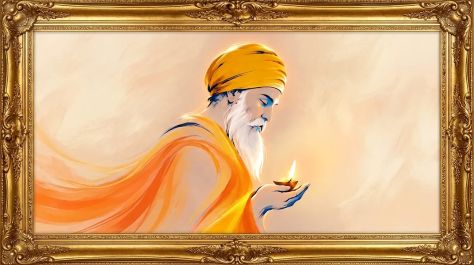
Guru Nanak, the mystic saint poet of Punjab, challenged caste divisions, untouchability, religious prejudice, empty rituals and social injustice.
Kalavanti Raja
Today, the historic town of Nankana Sahib in Pakistan becomes a center of spiritual devotion as Sikh pilgrims from across the world gather to celebrate the 557th birth anniversary, or Parkash Purab, of Guru Nanak Dev Ji. The sacred occasion brings renewed life to the birthplace of a mystic poet whose message travelled far beyond the boundaries of Punjab, religion and geography. For Sikhs, it is a day of profound reverence. For the people of this region, it is also a celebration of a shared spiritual heritage, a reminder that the language of love and humanity belongs to everyone.
Guru Nanak was born on 15 April 1469 at Rai Bhoi Ki Talwandi, now known as Nankana Sahib. His father, Mehta Kalu, was associated with revenue administration, and his mother was Mata Tripta. His elder sister, Bebe Nanaki, recognized his spiritual depth from an early age and became one of his first supporters. He married Mata Sulakhni around 1487 and had two sons, Sri Chand and Lakhmi Das. Yet his spiritual vision did not lead him away from ordinary life. He believed that a person could live among family and society while remaining devoted to truth, honest work and service.
The world into which Nanak was born was intellectually and spiritually diverse. Ancient India had developed several philosophical traditions, including the six orthodox schools of Nyaya, Vaisheshika, Samkhya, Yoga, Mimamsa and Vedanta. Alongside them flourished non-Vedic traditions such as Charvaka, Jainism, Buddhism and Ajivika. Later, Bhakti and Sant movements gave powerful expression to devotion, equality and the search for spiritual truth. Sufism, rooted in Islam, also developed a rich tradition of love and inward reflection. Guru Nanak emerged from this wider intellectual landscape, yet founded a distinct spiritual path that became Sikhism.
His message was simple but revolutionary: there is one universal Creator, and all human beings are equal before that Divine reality. The opening declaration of Sikh scripture expresses this vision:
اِک اونکار، ست نام، کرتا پُرکھ، نِربھؤ، نِروَیر۔
(There is One Universal Creator. Truth is His Name. He is the Creator, without fear and without hatred.)
Nanak challenged caste divisions, untouchability, religious prejudice, empty rituals and social injustice. He taught that devotion must be reflected in conduct, not merely in outward appearance. His celebrated words, traditionally associated with his spiritual experience at Sultanpur Lodhi, were: “There is no Hindu, there is no Muslim.” Their deeper message was that humanity must not be imprisoned by labels when the Divine belongs to all.
His lifelong companion Bhai Mardana, a Muslim musician and rabab player, travelled with him and gave musical expression to his hymns. Their friendship remains one of the most beautiful symbols of interfaith harmony in South Asian history. Nanak’s travels, traditionally remembered as four Udasis, took him across the Indian subcontinent and beyond, including places associated with Haridwar, Varanasi, Assam, southern India, Sri Lanka, Kashmir, Tibet, Mecca, Medina, Baghdad, Afghanistan and Sindh. The precise routes and dates remain debated, but these journeys represent his determination to engage with people of different faiths and traditions.
His teachings are often expressed through three principles: Naam Japna, remembrance of the Divine; Kirat Karni, earning through honest labour; and Vand Chakna, sharing one’s earnings with others. He placed great importance on Seva, selfless service, Sangat, collective spiritual fellowship, and Langar, the community kitchen where people sit together without distinction of caste, status or religion.
His poetry carries these teachings with extraordinary simplicity and depth. One of his most celebrated lines declares:
سچّہو اُورے سبھ کو، اُپر سچّ آچار۔
(Truth is higher than everything, but higher still is truthful living.)
Another teaches that spiritual victory begins within:
مَن جیتے جگ جیت۔
(Conquer your mind, and you conquer the world.)
His respect for nature and the interconnectedness of life is beautifully expressed in these words:
پون گرو، پانی پتا، ماتا دھرت مہت۔
(Air is the Guru, water is the father, and the great earth is the mother.)
He also gave dignity to honest work and generosity:
گھال کھائے، کِچھ ہتھوں دے، نانک راہ پچھانَہِ سَے۔
(Those who earn through honest labor and share with others, says Nanak, have understood the true path.)
And he reminded humanity that all life depends upon one universal source:
سبھنا جِیا کا اِک داتا، سو مَیں وِسَر نہ جائی۔
(There is only One Giver for all living beings. May I never forget Him)
Guru Nanak’s compositions are preserved in the Guru Granth Sahib, the eternal spiritual authority of Sikhism. Traditionally, 974 hymns and compositions are attributed to him, although totals vary according to how different poetic forms are counted. His celebrated works include Japji Sahib, Asa Di Var, Sidh Gosht, Dakhni Onkar, Barah Maha, Patti and Babar Bani. His verses appear in 19 of the scripture’s 31 principal ragas. They combine philosophical insight, lyrical beauty, social criticism and the language of ordinary people. The Guru Granth Sahib, compiled initially by Guru Arjan in 1604, contains the compositions of Sikh Gurus as well as those of several Bhagat and Sufi poets, including Kabir, Ravidas, Namdev and Sheikh Farid. It comprises 1,430 angs and brings together a remarkable diversity of spiritual voices.
The script Gurmukhi was standardized and promoted by Guru Angad, the second Sikh Guru, while the Punjabi language itself has a much older and wider literary history. Punjabi is written in Gurmukhi in India and Shahmukhi in Pakistan. After Guru Nanak, the Sikh tradition continued through nine human Gurus. Guru Arjan compiled the Adi Granth; Guru Hargobind developed the principle of Miri and Piri; Guru Tegh Bahadur gave his life in defence of religious freedom; and Guru Gobind Singh established the Khalsa in 1699. Before his death in Nanded in 1708, Guru Gobind Singh declared the Guru Granth Sahib the eternal Guru, bringing the succession of human Gurus to an end.
Nanak belongs to a remarkable constellation of mystic poets whose words continue to illuminate Punjab and Sindh. Baba Farid preceded him, while Kabir was his near contemporary. Later came Shah Hussain, Sultan Bahu, Bulleh Shah and Waris Shah. Across the Indus, Shah Abdul Latif Bhittai, Sachal Sarmast and Sami gave poetic expression to love, truth, spiritual unity and the dignity of human existence. Their doctrines were not identical, but their poetry often meets in its compassion for humanity and its resistance to narrow divisions. In Shah Latif’s stories of Sassui, Marui, Moomal and Sohni, as in Nanak’s hymns, the human journey becomes a search for truth, courage and the beloved.
The history of Sikhism also carries a profound political dimension. Following the execution of Guru Arjan under Emperor Jahangir in 1606 and Guru Tegh Bahadur under Aurangzeb in 1675, Sikh resistance grew. Banda Singh Bahadur established Sikh political authority at Sirhind in 1710. During the eighteenth century, the Sikh Misls emerged amid repeated invasions by Ahmad Shah Durrani. Maharaja Ranjit Singh united much of Punjab, captured Lahore in 1799 and established the Sikh Empire in 1801. His administration brought together people of different faiths. Following the Anglo-Sikh wars, the British annexed Punjab in 1849.
The Partition of 1947 divided Punjab between India and Pakistan, bringing immense suffering, migration and communal violence. Most Sikhs moved to Indian Punjab, while many of their most sacred historical sites remained in Pakistan. Nankana Sahib, Kartarpur, Panja Sahib at Hassan Abdal, Dera Sahib in Lahore, Sacha Sauda and Eminabad are enduring landmarks of Sikh heritage. Across the border in India, Harmandir Sahib, Anandpur Sahib, Patna Sahib and Hazur Sahib remain major centres of pilgrimage. The Kartarpur Corridor, inaugurated in 2019, offered a historic opportunity for Indian Sikh pilgrims to visit Gurdwara Darbar Sahib without a conventional visa, although access has faced interruptions amid political tensions.
Sikh communities today are found across the world, with a global population broadly estimated at 25 to 30 million. India remains home to the overwhelming majority, while substantial communities live in Canada, the United Kingdom, the United States, Australia, Malaysia and other countries. Pakistan’s 2023 census recorded 15,998 Sikhs. These figures reflect a faith whose roots are deeply embedded in the Punjab region but whose message has become global.
This year’s Parkash Purab celebrations in Nankana Sahib, taking place from 22 to 24 November, have brought pilgrims from Pakistan and abroad to the birthplace of Guru Nanak. Thousands have travelled to pay homage at Gurdwara Janam Asthan, with Indian pilgrims among those arriving for the occasion. The celebrations are a reminder that sacred places can become bridges between communities and that cultural heritage need not be divided by political borders.
Guru Nanak’s birthday is therefore more than a religious anniversary. It is an invitation to rediscover the moral courage of speaking truth, the dignity of labor, the generosity of sharing, the humility of service and the wisdom of seeing humanity as one family. His poetry does not ask us to build walls around faith; it asks us to open our hearts to life.
From the soil of Nankana Sahib, his message continues to travel across rivers, deserts, mountains and generations. In an age still troubled by hatred, inequality and conflict, the voice of Guru Nanak remains as clear and necessary as ever: truth must become our conduct, love our language, service our faith and humanity our common identity.
Read: Diwali: A Cultural Festival beyond Religion
_____________
 Kalavanti Raja is a social and political activist from Gambat, Khairpur Mirs, with 30 years of work on women’s rights, minorities, and social justice. She has served in Sindhiyani Tahreek and participated in national and international forums across Asia, Europe, and America.. She can be reached at kalavanti.raja@gmail.com