Universalism is not necessarily dead as an aspiration. What is dying—perhaps dead—is the assumption that universal agreement can provide the machinery through which international problems are solved.
By Tom Arms |London
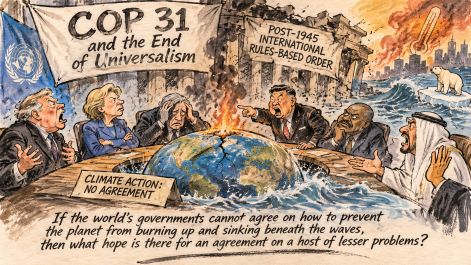
COP 31 may come to be regarded not simply as the breakdown of climate diplomacy, but as glaring evidence of the wider breakdown of the post-1945 international rules-based order.
If the world’s governments cannot agree on how to prevent the planet from burning up and sinking beneath the waves, then what hope is there for an agreement on a host of lesser problems?
However, universalism is not necessarily dead as an aspiration. What is dying—perhaps dead—is the assumption that universal agreement can provide the machinery through which international problems are solved.
COP 31 was not a complete failure. UN press releases are keen to point out that agreement was reached on many of the 165 agenda items. Governments just failed to agree on the biggest—fossil fuels. The countries whose economies are most dependent on the production of oil and gas—led by Russia and Saudi Arabia—refused to allow any mention of fossil fuels. They prioritized immediate domestic and political considerations over collective survival.
In doing so, they took a leaf from Donald Trump’s “America First” playbook. The US was not represented – even at observer level—in Anatalya, Turkey.
It is not just climate change where international cooperation has failed. The World Trade Organization (WTO) has been hamstrung since 2019 because the US refused to make the necessary appointments to the international regulatory agency. As a result, the Appellate Body lost the quorum necessary to hear appeals.
The international human rights system is also under pressure. The UN was founded on the proposition that certain rights belong to all humans. But the enforcement of those rights has become increasingly selective. If human rights are universal in principle but conditional in practice, what does universalism actually mean.
Then there is AI. Artificial Intelligence is developing across national borders. Its implications for employment, surveillance, warfare, privacy, democratic institutions and economic inequality are global. Yet there is no comprehensive international regulatory framework in sight.
How about peacekeeping and collective security. Led by America’s failure to pay its dues me\ns that the UN is desperately short of cash. This means that the international community is increasingly unable to finance to finance the institution established to maintain world peace and security.
There may, however, be a silver lining. Alongside the fracturing of universalism there is the beginning of what might be termed “An Open Coalition of the Rules Based Order.
It is comprised of the pro-Ukraine “Coalition of the Willing” and Canadian Prime Minister Mark Carney’s “Middle Powers.” They are the EU, Norway, UK, Japan, Australia, New Zealand. Canada, Taiwan and South Korea. The two groups are separate but overlapping and share a number of common interests.
Between them they represent a third of the world’s GDP; 30 percent of manufacturing output; 25 percent of energy consumption; 45 percent of financial services; 45 percent of information and communications technology services; 90 percent of advanced semi-conductor manufacturing and 27 percent of the world’s defence spending.
These countries have the potential to form the nucleus of an open coalition of nations committed to upholding and renewing the principles of the post-1945 international order. Rather than being a fixed alliance, or an exclusive grouping, they should provide a framework for practical cooperation. Its membership should remain open to other countries willing to subscribe to basic principles.
Pragmatism must be their watchword. They should agree on such issues as limiting fossil fuel production; making trade between member states as free as possible; establish common standards for AI; defend the international rule of law; develop a consistent human rights policy and, if possible, be willing to provide military resources for international stability
The institutions created after the Second World War were founded on the proposition that nations, however different their political systems, economic interests and national ambitions, shared certain fundamental interests. Peace, prosperity, security and the preservation of the planet were not matters which could be achieved by individual countries acting alone.
That proposition remains as valid today as it was in 1945. What has changed is the willingness of governments to act upon it.
COP31 has provided a particularly depressing illustration of the consequences. The danger is that we are entering an era in which international cooperation becomes the exception rather than the rule. The strong will increasingly impose their will on the weak, while the institutions designed to protect the interests of all will become increasingly irrelevant.
But the alternative need not be surrender.
A coalition of countries prepared to defend international law, promote sustainable development, maintain open trade and protect fundamental human rights could keep alive the principles on which universalism was founded.
It might begin with a relatively small group. It might proceed issue by issue. It might not even call itself a coalition. But it would provide an alternative to the increasingly dangerous proposition that might is right and that international cooperation is an optional extra.
The ultimate objective must be to persuade other countries to join, not to exclude them.
There is an old saying that a rising tide floats all ships. It was once a reasonable description of the benefits of an increasingly interconnected world. Today, as the seas rise and the international order begins to sink, we need to rediscover its meaning.
Read: Cop 31: Another injustice against Climate Justice
______________
 Tom Arms is Foreign Editor of Liberal Democratic Voice. He also lectures on World Affairs and is a regular contributor to “The New World.” Tom is also the author of two editions of “The Encyclopedia of the Cold War,” “World Elections on File,” “The Falklands Crisis” and “America Made in Britain.”