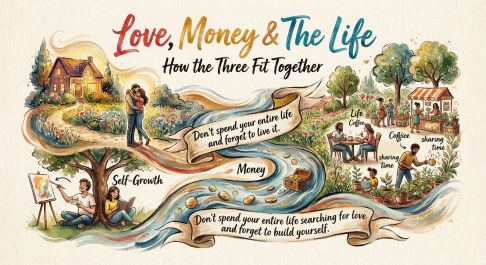
Don’t spend your entire life earning money and forget to live it. Don’t spend your entire life searching for love and forget to build yourself.
Afifa Khawaja Rashid Husain
People often talk about love and money as if they were rivals. One is called pure and the other practical, and we are told to choose between them. This framing is tidy, but it is wrong. Love, money and life are not three competing prizes. Life is the whole, and love and money are two of the main tools we use to build it. Understanding what each one can and cannot do is one of the most useful pieces of practical wisdom a person can have.
Start with life, not with love or money
The first logical step is to ask what we are actually trying to achieve. Almost everyone, when pressed, says some version of the same thing: a life that feels secure, meaningful and connected. Security, meaning and connection are the goals. Money and love are means to them.
This matters because confusing means with ends leads to predictable mistakes. A person who treats money as the goal keeps accumulating long after the point where more adds anything. A person who treats being loved as the goal can end up giving away their own judgment and dignity to keep it. In both cases a tool has been promoted to a purpose, and the person ends up serving it.
What money actually does?
Money is best understood as stored choice. It buys time, safety and options. It cannot buy the feeling of being known by another person, and it cannot guarantee happiness. But its absence has real, measurable costs.
When money is scarce, the mind is occupied by it. Every decision becomes a trade-off, small emergencies become crises, and there is little energy left for patience, creativity or kindness. This is why financial stress is one of the most common sources of conflict in families and marriages. Saying “money isn’t important” is easy for people who have enough of it.
The relationship between money and wellbeing is also uneven. Moving from struggling to stable improves life enormously. Moving from comfortable to rich improves it far less. The logical conclusion is that money deserves serious attention up to the point of security and flexibility, and diminishing attention after that.
What love actually does?
Love, in its broad sense (romantic, family, and friendship), supplies what money cannot: belonging, support and meaning. Long-running research on adult life has repeatedly found that the quality of a person’s close relationships is one of the strongest predictors of health and happiness in later years. People with warm, dependable bonds recover better from setbacks and tend to live longer and more contentedly.
But love also has limits. It does not pay rent, and good intentions do not replace planning. Love that is expected to carry every burden, financial, practical and emotional, often buckles under the weight. Affection is the foundation of a relationship, but it needs a structure of habits, honesty and shared responsibility built on top of it.
Where the two meet
Love and money interact in at least three ways.
Money strains love when it is hidden or unequal. Secrecy about spending, debt or income erodes trust faster than almost any other issue. The problem is rarely the amount of money. It is the feeling that one person is not being honest or that decisions are not shared.
Love can protect against financial hardship. Families and friends pool resources, share housing, watch each other’s children and lend a hand in bad years. A strong network is a kind of wealth that does not appear on a bank statement.
Choosing a partner is a financial decision whether we admit it or not. Values around saving, risk, generosity and work shape a shared life for decades. Compatibility in how two people think about money is therefore not unromantic. It is a sign of respect for the future you intend to build together.
Read: Comparison Between Love and Money in Life
The common mistakes
The errors people make tend to fall into a few patterns:
- Chasing money at the expense of relationships. Overwork can deliver a bigger income and an emptier life. Success that nobody is around to share is a poor trade.
- Chasing love while ignoring money. Romantic idealism that refuses to discuss practical matters often ends in resentment when bills arrive.
- Using money to replace love. Gifts, comfort and provision cannot stand in for attention and presence, especially with children and partners.
- Using love as a bargaining chip. When affection becomes conditional on money or status, neither is healthy.
- Postponing life. Many people say they will live fully once they are financially secure or once they find the right person. But time is the one resource that cannot be earned back.
A sensible way to hold all three
The logic points toward balance, though not in the vague sense of “a bit of everything.” Balance here means giving each element the role it is suited for.
- Secure the base. Aim for enough money to remove constant fear: an emergency cushion, manageable debt, and a way of earning that is sustainable. This is what buys freedom to think about other things.
- Invest in people deliberately. Relationships compound like savings but only when tended regularly. Time, honesty and small acts of reliability are the deposits.
- Talk about money early and plainly. In families and partnerships, open conversations about income, spending and goals prevent most financial conflict before it starts.
- Define “enough.” Decide in advance what level of money and status would be sufficient for the life you want, and notice when you pass it. Without a definition, the target keeps moving.
- Protect time. Both money and love are ultimately spent in hours. How you allocate your days is the clearest statement of what you value.
Conclusion
Money gives life stability and choices. Love gives life warmth and meaning. Neither is sufficient alone, and neither is the enemy of the other. The person who understands money as a tool, love as a foundation and life as the purpose can make sensible decisions: work hard but not at any price, care deeply but not carelessly, and spend time on what will matter when the accounts are closed.
Don’t spend your entire life earning money and forget to live it. Don’t spend your entire life searching for love and forget to build yourself.
Yani paisa bhi kamao, mohabbat bhi karo, lekin apni zindagi aur apni pehchan ko kabhi mat bhoolo.
Read: The Psychology of Evaluating Ourselves
_______________
Afifa Khawaja Rashid Husain is a Karachi-based researcher and MPhil (Psychology) Scholar.