

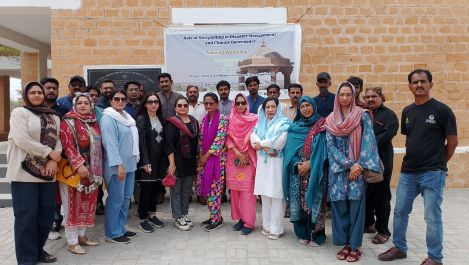
Role of media in disaster management: Climate governance highlighted at a workshop held in Thatta
Thatta, Sindh
Green Media Initiatives (GMI), under the Digital Democracy Initiative and with the support of Accountability Lab Pakistan, organized a training workshop titled “Role of Media in Disaster Management and Climate Governance” for journalists of Thatta Press Club Makli at the UNESCO World Heritage Site, Makli Necropolis.
Through the Digital Democracy Initiative, Accountability Lab Pakistan is providing technical and financial support to grassroots civil society organizations across the country to strengthen public participation in governance, promote transparency within public institutions, and improve the delivery of essential public services.
The workshop equipped journalists with practical knowledge and skills in modern journalism, digital media, environmental reporting, climate change, responsible reporting during disasters, fact-checking, mobile journalism, and the effective use of digital tools.
Speaking on the occasion, Fariha Fatima, Program Associate at Transparency International Pakistan, emphasized that inclusive community participation in decision-making and evidence-based reporting are fundamental to advancing climate justice, particularly in Sindh, where communities are disproportionately affected by the growing impacts of climate change.
She also highlighted the importance of transparency, climate governance, and the effective use of the Right to Information (RTI) law in strengthening accountability.
Senior journalist Muhammad Taban Zafar stressed that a professional journalist must always prioritize verification, impartiality, and thorough research.
He further stated that journalists must adopt a responsible approach when reporting on climate change and natural disasters, as the media plays a crucial role not only in informing the public but also in raising awareness, influencing policymaking, and strengthening community preparedness.
Shabina Faraz, Chief Executive Officer of Green Media Initiatives, emphasized the urgent need for accurate and timely information on climate change, coastal vulnerabilities, sea intrusion, flooding, and other natural hazards. She encouraged journalists to amplify the voices of affected communities and incorporate both challenges and practical solutions into their reporting.
Saadia Ubaid Khan, Communication Officer at Green Media Initiatives, Fozia Jameel, Head of Programs and Information Technology, and Shiraz Waryo, President of Thatta Press Club Makli, conducted practical sessions on digital journalism, mobile journalism, responsible use of social media, video production, video editing, fact-checking, effective caption writing, live reporting, and timely dissemination of information through digital platforms.
The workshop also featured a briefing by Sarfaraz Jatoi, In-charge of Makli Necropolis, who introduced participants to the historical significance of the Makli Necropolis, its rich cultural heritage, and its status as a UNESCO World Heritage Site. (Press Release)
Read: Climate Crimes, Ecocide, and Pakistan’s Legal Maze
_________________


