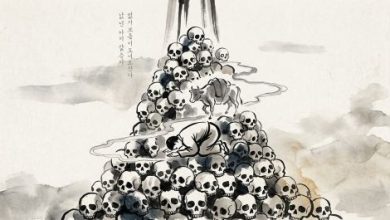
Since gaining awareness, Didda’s life had been so full of difficulties that no dreadful situation now had any power over her mind. Moreover, her tantric ascetic guru had taught her how to establish control over circumstances
Maharani Didda: Witch Queen of Kashmir
By Debasree Chakraborti
Several days passed after the wedding. Since that day, Didda had not met Kṣemagupta even once. Through the maidservants, Valāgā tried many times to inquire about him, but every time she learned that the Maharaja was spending his time in the Pramod Mahal. Yet this marriage had been long awaited by the Maharaja himself. Now that Didda was in his household, why was he ignoring that long-anticipated moment of union and spending his days in the pleasure pavilion instead?
 Naravāhana too became deeply anxious about Didda’s future. Thinking of Kashmir’s destiny, he had wished for Didda’s arrival in Kṣemagupta’s life. Today he felt guilty himself, for knowingly and deliberately he had ruined Didda’s life. Since her arrival at her in-laws’ house, Didda had been almost confined within the household; no one even possessed the mental inclination to befriend the new bride. To them, Didda and Valāgā were two utterly unwanted individuals, as if they were completely different from the people of this place.
Outside the palace, however, Didda had managed to carve out a beautiful place in the hearts of the people of Kashmir. The gifts bestowed by Didda were delivered by Naravāhana, through his representatives, to every household in Srinagar. Many queens had come to Kashmir before, but never had anyone distributed gifts to the subjects in this manner. Generally, queens did not even regard the subjects as people; in contrast, the conduct of the new queen Didda awakened new dreams in the eyes of the populace.
But while Didda’s life was becoming directionless amid various conspiracies within the royal family, at that very moment Bhalāgā and Naravāhana together, while searching for the reason behind the Maharaja’s strange transformation, came to know of a terrifying truth. Within the royal palace there existed a faction opposed to Prime Minister Phālgun, with whom Naravāhana maintained extremely secret contacts. From them Naravāhana learned that, on the orders of Prime Minister Phālgun, a very potent narcotic was being mixed into the Maharaja’s food and liquor. When such a drug is administered to a person, that person’s power of thought and memory gradually begins to disappear. He also loses all control over his own desires and aversions.
Naravāhana clearly understood that Prime Minister Phālgun had adopted a vile path to slowly erase Didda from the Maharaja’s mind. Bhalāgā, an exceptionally intelligent woman, advised Naravāhana to get in touch with a vaidya (physician). Following Valāgā’s instructions, Naravāhana collected a small quantity of that special narcotic and went to a physician in the village of Chandanwāri. That physician examined the narcotic and informed them that if it is administered regularly to the human body, sexual desire increases to an extreme degree, but it does not last long; gradually, along with a person’s memory, it completely destroys reproductive capacity. From the physician, Naravāhana also learned that there is no medicine capable of neutralizing the effects of this drug. Naravāhana returned to the royal palace and conveyed this information in detail to Bhalāgā.
After hearing everything, Bhalāgā said, “Naravāhana, for the moment it is best to keep this information away from Princess Didda, because she has begun her married life with Kṣemagupta carrying a heart full of dreams. First, she must fully taste the form, essence, and fragrance of this life. Besides, in many cases time works like a life-restoring elixir; it has the power to accomplish many impossibilities.”
Naravāhana replied, “You are right. Leaving everything in the hands of time, for now we must somehow arrange to bring the Maharaja out of the pleasure pavilion.”
After reasoning with Bhalāgā, when Naravāhana reached Didda’s chambers, he found that Didda was not there—she was nowhere to be found. Deeply worried, Naravāhana said to Bhalāgā, “My heart tells me that disaster has struck. It is impossible for any new bride to endure such a great humiliation. And the greatest culprit is me; knowing everything, I have ruined the life of the young queen.”
Bhalāgā, in a tone of great surprise, said, “I don’t understand why you are breaking down so much. Nothing has happened. My Princess Didda is extremely intelligent; she would never take any wrong step.”
Naravāhana said, “Bhalāgā, the young queen is entirely new to this kingdom. She is unfamiliar with anything here. Then where has she gone? One possibility is that she has taken her own life; the other is that she has been abducted by Prime Minister Phālgun.”
Ignoring Naravāhana’s anxiety, Bhalāgā said with great confidence, “Naravāhana, where is the Maharaja’s pleasure pavilion?”
This question scattered Naravāhana’s thoughts in every direction. It seemed to him that he had been mistaken all along, and therefore until now he had He had been thinking of Didda as far too weak. But from whatever glimpses he had received of Didda’s character, she appeared to him to be an extremely strong personality. That was why, with Didda’s arrival, he had begun to dream anew about Kashmir.
On both sides rose high stone walls, within which nocturnal creatures dwelt; between the two walls ran a narrow path, with sentries posted at intervals along either side. At each place where a guard stood, a torch burned. Suddenly, along that path, the sound of jewelry and anklets began to echo; in the half-light, the glow of the surroundings seemed to brighten with the radiance of the visitor’s form. The guards knew very well who had arrived. Through his messenger, the Prime Minister had sent word that the new young queen would come to this pavilion today and that no obstacle should be placed in her way.
Didda had grown restless while waiting for Kṣemagupta, when she received word through a maidservant that the Maharaja was spending time in the pleasure pavilion. This message had been sent to Didda by Prime Minister Phālgun through that maidservant.
He wanted Didda to see her husband in such an abnormal setting and take a final farewell forever. But Didda had thought differently. From birth she had been deprived of all her rights. Father, mother, grandfather—even her own brothers had never acknowledged Didda; until entering this new life, she had not been able to establish her rights even as a wife. It seemed to Didda that in this way, by relinquishing her place at every stage of life, one day she would become completely destitute—so no more. From this stage onward, a vast change occurred on the stage of Didda’s life.
Since gaining awareness, Didda’s life had been so full of difficulties that no dreadful situation now had any power over her mind. Moreover, her tantric ascetic guru had taught her how to establish control over circumstances. Didda knew that no matter how severe the situation, she possessed the power to bring it under control. For this, she would have to forget everything around her and enter fully into the situation itself.
In the darkness, a bat flew in and brushed Didda’s cheek before darting away. Didda knew very well that by bringing her mind under control and concentrating her mental power. She knew that in this trial of putting her inner power to use, many obstacles would arise, and amid all this she would have to keep her mind under control. The guards bowed their heads and paid their respects as their young queen passed by. Didda paid no attention to anything around her; she could see only a single closed door.
Reaching the door, she struck it three times. She did not have to wait long— a naked woman opened the door and stood there. Before Didda’s presence, the woman’s very existence seemed to dissolve; as she stepped aside, Didda entered the chamber. Maharaja Kṣemagupta sat surrounded by women, a wine vessel in his hand. At the sight of Didda, the haze of intoxication around the Maharaja seemed to begin to lift; it felt as though a long-awaited moment, one he had lost, was now moving toward him.
Didda’s gaze did not rest on anything in that chamber—everything on that canvas was blurred except the Maharaja. Her eyes entered his eyes and seemed to begin to take control of his entire being. When Didda reached the pleasure couch and extended her hand toward him, the Maharaja moved toward her, grasped her hand, and rose to his feet. Because of excessive intoxication, he could not stand steadily; with her right hand, Didda held the Maharaja firmly by the waist and led him out of the pleasure chamber.
Didda was taking the Maharaja out through that dark, nocturnal alleyway, and the guards were astonished at the strange sight. Within moments, the news spread throughout the palace from the guards to the servants. On hearing this, Prime Minister Phālgun was deeply disheartened. Chandralekhā thought in amazement: how could a disabled woman like Didda accomplish what she herself had never dared to do?
The news also reached the ears of the Queen Mother. When her favorite maid came to inform her, she was extremely pleased. Every mother wishes to guide her child onto the right path; the Queen Mother had long wished to do so but had been unable. With Didda’s arrival, she now seemed to glimpse a ray of hope. This incident created, however slight, a small space for Didda in the Queen Mother’s heart. (Continues)
Click here for Part-1, Part-2, Part-3, Part-4, Part-5, Part-6, Part-7, Part-8, Part-9, Part-10, Part-11, Part-12, Part-13, Part-14,
________________
 Debasree Chakraborti is a renowned novel writer of Bengali language. Based in Kolkata, West Bengal, India, she has done Master’s in Modern History from the Kolkata University, and authored some thirty books, mostly the novels, with historical perspective and themes. Her novel is ‘Maharaja Dahir’ that covers the history of Sindh from 662, the year of first attack on Sindh by the Arab armies till date, was published last year and translated by Nasir Aijaz into Sindhi language.