Bhalaga always instructed Didda never to think of herself as weak because she was a woman. “Your only identity,” she would say, “is that of a brave warrior. Even Mother Bhavani, though a woman, slew demons. Never let yourself feel diminished by the character or power of your opponent.”
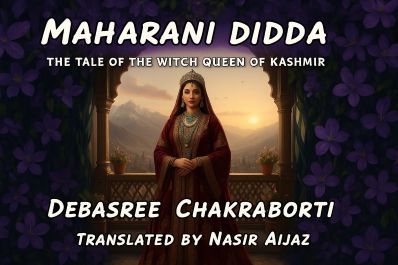
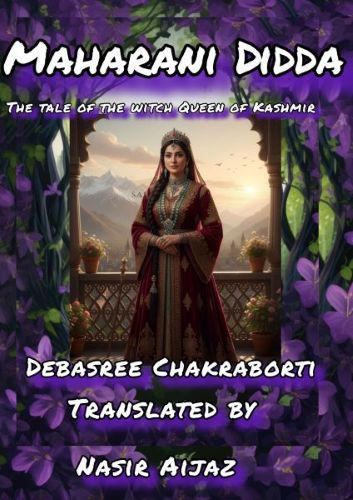
Maharani Didda: Witch Queen of Kashmir
By Debasree Chakraborti
Ten years had passed in the married life of Chandralekha and Maharaj Khemagupta. During this time, they were blessed with two healthy daughters.
 Queen Chandralekha had confined herself within the circle of duties of the household and her two daughters. The Maharaj, too, had once again bound his life within the pleasure palace, for his conjugal life with Chandralekha had turned extremely monotonous. After the birth of the two daughters, his aversion toward domestic life had only grown stronger. Maharaj Khemagupta was not a man meant to be bound to a single person or a repetitive pattern of life.
He craved new forms, new flavors, and new scents. Seeing the Maharaj return to his old habits, Narabahan became deeply worried. Above all, he was concerned about the future of Chandralekha and her two daughters. Prime Minister Phalguna, after all, was content with power and harbored no concern for the lives of his daughter and granddaughters. But Chandralekha—over these ten years, Narabahan had come to understand her well. For this woman, devoted wholly to her husband and children, there existed no other world. She had accepted Khemagupta as the object of worship of her life; if that beloved were to abandon her, it would be no less than death for her. Therefore, by any means necessary, Khemagupta had to be drawn out of the pleasure palace.
With these thoughts in mind, Narabahan considered arranging a hunting festival.
Maharaj Khemagupta would take rest in his palace at noon. At such a time, Narabahan arrived there and saw the Maharaj reclining on a comfortable chair, dressed in a white silk dhoti and an upper cloth. Beyond the open window, the view was green, with flocks of white herons landing there. Finding the Maharaj alone in such a serene and beautiful setting, Narabahan said, “Maharaj, it has been a long time since we went hunting. Let us go once.”
The Maharaj was still under the influence of the previous night’s intoxication. In a hoarse voice he said, “Hunting! Where do you want to go?” Narabahan understood that the Maharaj, too, wished to go—he was inclined toward the hunt. Narabahan had come fully prepared and said, “There is a dense forest on the bank of the Sutlej River. This time we shall hold the hunting festival in that forest. I have heard that the eyes of other rulers have not yet fallen upon it. They say the venison of that forest and the fish of the river are incomparable in taste.”
Even in his intoxicated state, the Maharaj seemed to discover a new flavor of life. He gave his consent at once.
Within two days of receiving the Maharaj’s approval, Narabahan set out toward the Sutlej with the Maharaj and their companions. After a long time outside the palace, the Maharaj seemed to turn into a free bird. They did not halt anywhere along the way; riding their horses without pause, they arrived at the riverbank just as the sun was setting. Gradually, darkness engulfed nature. Since it was not possible to set up camp in the dark, Narabahan took everyone to take shelter in a village beside the forest. In exchange for a large sum of money, the villagers provided refuge to the Maharaj and his companions. The Maharaj’s cooks collected wild fowl from the villagers, and preparations were made to cook pulao for the night.
Narabahan and the other companions, exhausted by the long journey, were overcome by sleep. Once the cooking was finished, they would wake briefly to eat and then return to sleep. But there was no sign of weariness in the Maharaj’s eyes. The inner world of his private chambers was like an intoxicated, imaginary realm, but the world outside was utterly real. Standing on the banks of the Sutlej, the Maharaj felt that this, perhaps, was true life; he felt this way whenever he went hunting. Far removed from royal pomp and splendor, he found it pleasant to spend time amid nature.
The Maharaj stepped out of his hut and stood outside. On one side, the pulao was being cooked, and many villagers were watching the process with great curiosity. The Maharaj walked forward. He was no longer dressed in royal attire; wearing a white silk dhoti and a silvery upper cloth, he moved ahead. After going some distance, he heard the sound of neighing mingled with the murmur of the river. Arrangements had been made to keep his horses by the bank of the Sutlej. The Maharaj took a black horse from the groom, mounted it and rode on. The horse’s groom stepped forward and said, “Maharaj, it has grown extremely tired from the long journey. Let it rest today.”
Ignoring the groom’s words, the Maharaj urged the horse on toward the forest. At first the horse was reluctant to move, but after several lashes of the whip, it neighed loudly and bolted forward. From the moment he entered this region, the deep forest had been drawing the Maharaj with irresistible force. Several branches of the Sutlej flowed through the forest; on the bank of one such branch, Didda, the princess of the Lohars, had set up her camp. During a battle with a leopard, the princess had been gravely wounded. Her entire body bore dreadful injuries, and treatment was underway.
Every day, the village herbalist was brought to her camp, where he applied various medicinal pastes to the princess’s wounds. In this manner, the injuries were gradually healing, and Princess Didda was now comparatively much better. However, within the surrounding forest, Didda’s companions had erected a cordon of nets around the camp, so that they might be protected from attacks by wild beasts.
Moreover, they had received news that King Khemagupta of Kashmir had come to this region to hunt. Bhalaga was well acquainted with Khemagupta’s character and the current state of his kingdom. Thus, to maintain a safe distance from such a debauched king and his companions, they had adopted this very measure as well. For Bhalaga had heard that Khemagupta and his men abducted women from various parts of the kingdom. Therefore, for their own safety, traps were laid all around their camp. Those traps were set that very night as well.
After Maharaj Khemagupta entered the forest, he did not have to go far. After covering only a short distance, he fell into one of Bhalaga’s traps. A large stretch of ground at one spot had been cut and loosened, with nets laid over it. As the Maharaj rode over that patch, horse and rider became entangled in the net and fell into a pit in the ground, where he was captured. On the trees around the site where the traps had been laid sat Didda’s guards. As soon as the Maharaj fell into the trap, one of the guards descended from the tree and went to inform Bhalaga. The news was then conveyed to Didda.
Bhalaga always instructed Didda never to think of herself as weak because she was a woman. “Your only identity,” she would say, “is that of a brave warrior. Even Mother Bhavani, though a woman, slew demons. Never let yourself feel diminished by the character or power of your opponent.”
“Whoever the enemy may be, you are Didda—unyielding, unchangeable. You must make your character as fierce and unbreakable as thunder.” Like an exceptional teacher, Bhalaga loved to test Didda at every stage, trying through these trials to gauge how complete her training had become. Having captured Khemagupta, he presented him before Didda.
That day Didda was dressed in yellow. Her long hair was braided and adorned with a garland of jasmine, and she sat on a chair examining her sword. She wore no ornaments. The light of a lamp in front of her reflected upon the blade and fell upon Didda’s face; it seemed as if a golden idol were seated there, the radiance of her beauty overflowing the room. Before Khemagupta’s arrival, a messenger had already brought the news to Didda. Inside her camp hung a light red curtain; before meeting any outsider, that curtain would be drawn down, and Didda remained behind it.
Maharaj Khemagupta still could not understand into whose hands he had fallen. When Valaga and the other attendants brought him into Didda’s camp, he saw what seemed like a golden glow spreading all around from behind the red curtain. The Maharaj felt as though he were seeing a beautiful dream, and he stood speechless. For at times, the boundary between reality and imagination blurred for him.
From behind the curtain, Didda said, “State your identity.”
After a moment’s silence, the Maharaj replied, “I am Khemagupta, ruler of Kashmir.”
Because of the Maharaj’s extremely simple attire, Bhalaga had not recognized him. He told Didda that she should conduct herself with the dignity befitting the presence of a king. Didda’s—remembering Bhalaga’s words, she drew aside the red curtain and stepped forward. The moment she appeared, the Maharaj’s eyes became fixed on Didda’s radiant beauty. Although Didda had a problem with her feet, it was not apparent at all, for through yogic training she had overcome her physical disability.
Didda ordered the guards to release the Maharaj. They had brought him bound with ropes, but at her command they set him free. There was a seating area at one side of the camp; she asked the Maharaj to take a seat there and herself sat facing him. Bhalaga had the maidservants serve the Maharaj fruit juice and sweets and arranged for his evening meal.
In a perfectly natural tone, Didda asked, “May I know the reason for the Maharaj’s arrival in the deep forest at this hour of the night?”
The Maharaj still seemed unable to shake off his daze. Then Bhalaga, raising his voice from the side, said sharply, “May we know the reason for the Maharaj’s arrival?”
At that, the Maharaj became somewhat composed and said, “I have come here to hunt.”
Didda replied, “I understand that you have come hunting, but why did you enter the boundaries of my camp so late at night?”
The Maharaj said, “I did not know that your camp was here.”
At once Bhalaga flung another question at the Maharaj: “The course of events is not very clear. You say you have come hunting, but where are your companions? It is impossible for a Maharaj to come hunting alone.”
Didda, too, looked at the Maharaj with two questioning eyes.
Eager to extricate himself from the situation as quickly as possible, and keenly feeling the strike of the god of desire, the Maharaj replied, “When I reached the banks of the Sutlej today, the sun was setting and darkness had fallen all around. At that moment it was not possible to set up camp by the river, so we took shelter in a village near the forest. My companions are there. But—” “In the darkness of the night, this forest drew me deeply toward itself, and so, forgetting time and circumstance, I set out along its paths.”
Didda said, “Your horse has been badly injured. Its care is now our responsibility. We shall restore it to full health and then send it to you.”
The Maharaj asked, “Then how shall I return?”
Didda smiled gently and replied, “Tonight you are our guest. First you must accept our hospitality; afterward, it is our duty to escort you safely back.”
The Maharaj felt as though he were truly dreaming—such beautiful events could happen only in dreams.
That night the Maharaj stayed under Princess Didda’s protection, dining on venison, pulao, and roasted wild fowl. At dawn the next day, Bhalaga, accompanied by a few others, escorted the Maharaj back to the village. Didda herself was not present at that time. The Maharaj had wished to see Didda once more before returning to the village, and his inability to do so left him deeply disappointed as he made his way back.
At the very entrance of the village, he saw his companions gathered in a crowd with the villagers. The moment they saw the Maharaj, they ran toward him. Within moments Narabahan arrived, embraced the Maharaj, and said, “Since last night we have lost all peace of mind. All night long we searched the entire surrounding region for you. Where were you, Maharaj? In your absence, all the joy of the hunt turned into deep sorrow.”
Before the Maharaj could reply, Bhalaga said, “There is nothing to worry about. The Maharaj accepted the hospitality of Princess Didda of the Lohara lineage. We have safely delivered your king back to you. The mount has been physically injured; after providing proper treatment, we shall send it as well.”
When Bhalaga and her companions, with folded hands, bowed to the Maharaj and sought leave to depart, the Maharaj said to Bhalaga, “From what I have experienced since last night, it is clear that you are the guardian of the princess. Therefore, I feel the urge to ask you a very personal question.” Bhalaga seemed to have anticipated this inwardly, as if he had been waiting for just such a moment. He said, “You may question me without hesitation. Please speak.”
With no trace of hesitation, the Maharaj asked, “Has Princess Didda’s betrothal been completed?”
Bhalaga appeared prepared for this question. He replied, “No, Maharaj, Princess Didda is not yet betrothed. She is so deeply engaged in her education and martial training that she has had no time to prepare for marriage. Yet her age is advancing, and this is indeed the most appropriate time for her to enter household life.” Expressing a note of concern, Bhalaga added, “But finding a truly worthy groom for her is an extremely difficult task.”
The Maharaj said calmly, “Bhalaga, take my message to King Singharaja of the Lohar dynasty. Tell him that I, Khemagupta, lord of Kashmir, seek his daughter, Princess Didda, as my wife.”
Witnessing this, Narabahan felt a ray of hope kindle within him. King Singharaja of the Lohars was a very powerful ruler who reigned over the northern regions of Kashmir. If a matrimonial alliance were established between Khemagupta and the Lohars, the people of Khemagupta’s kingdom would be freed from the web of conspiracies woven by Prime Minister Phalguna. Queen Chandralekha’s life, too, might be brought out from under her father’s control—perhaps this would prove beneficial for her as well.
Narabahan waited in anticipation for Bhalaga’s response, hoping this opportunity would be used wisely. Tears welled up in Bhalaga’s eyes; the last time this had happened was the day he had lifted Didda into his arms. After many years, waves surged within his heart like the rising sea. The girl he had raised with every drop of his own blood had now received a proposal of marriage. The doorway to Didda’s entry into married life seemed to open before him, and Bhalaga could see the radiance of a beautiful, luminous life advancing outward from that threshold. On the night of her birth, that aghori father, upon seeing Didda, had prophesied that this— …that one day the princess would become the ruler of Kashmir and would govern the land herself. And now, today, the lord of Kashmir, Khemagupta, was offering marriage to Didda.
Khemagupta was widely known as an exceedingly weak and ineffectual ruler. If Didda were to bind herself to him in marriage, she possessed every ability—through the force of her personality and valor—to become the true controller of Kashmir. Moreover, because of her two incompetent brothers, the responsibility of King Singharaja’s realm would ultimately fall upon her shoulders as well; in that sense, the entirety of Kashmir would lie within her charge. To reach the highest summit of life, some sacrifice is always necessary. Besides, influenced by Didda’s personality, a change in Khemagupta’s character was bound to occur.
Filled with hopeful thoughts, Bhalaga folded his hands and said, “Maharaj, there could be no better proposal than this. I bow my head and accept it. Be assured—King Singharaja and the Queen Mother will be immensely pleased with this proposal.”
Narabahan stepped forward and said, “No, Maharaj, this proposal cannot be sent to the Lohar king in such a manner. I shall take Kashmiri woolen garments, jewelry, Mother Kshir Bhavani’s scarf, walnuts, apples, and musk, and present the proposal to the Lohar king. Otherwise, it would be an insult to the princess.”
In a calm voice, the Maharaj replied, “No, Narabahan, I desire no dishonor for Princess Didda. You are a most discerning man and my well-wisher. Do whatever is most fitting for our good.”
Returning to the camp, Bhalaga informed Didda of the Maharaj’s proposal and also shared his own thoughts with her. After hearing everything, Didda said to Bhalaga, “Bhalaga, even knowing of Khemagupta’s weaknesses of character, I say this: no one has ever loved me except you. Khemagupta is the only man who has welcomed me into his life with the utmost respect—the first man in my life who has prayed for me from the depths of his heart. To reject this proposal would therefore be improper on my part. Moreover, Bhalaga, all my life you have shown me the dream of becoming the sovereign of a united Kashmir. I feel that this, too, is the will of God, and that perhaps this proposal has come for that very reason. ”From that day onward, a new feeling was born in Didda’s life, and she became deeply absorbed in thoughts for the welfare of all the people of Kashmir. Didda was a beggar for love; though a princess, she had been deprived all her life of that priceless jewel.
She had never received love from her father, mother, brothers, or relatives. Even the servants looked upon her with contempt and disdain. Only Bhalaga loved her, perhaps even more than his own life. Bhalaga shared every one of her emotions as his own; he knew who the greatest enemy of Didda’s life was. And so, in order to defeat that enemy, he transformed that very enemy into her greatest strength. By helping her conquer her physical disability, he made Didda indomitable. She strove at every moment to overcome her physical limitations and become supremely powerful and unstoppable.
That day she had asked Bhalaga, “Bhalaga, does Maharaj Khemagupta know about my physical disability?”
After remaining silent for a while, Bhalaga replied, “I have seen in the Maharaj’s eyes a terrible yearning to possess you. Let that yearning grow even stronger. Then I myself shall tell him. The moment to inform the Maharaj of this has not yet arrived.”
Hearing this, a pain took root in Princess Didda’s heart. On one side lay the uncertainty of a beautiful future life, and on the other arose another troubling thought: entering a new life by concealing the truth is nothing short of deception. She was deceiving the Maharaj. When she expressed this to Bhalaga, he said, “The Maharaj has fallen in love with you—not with your physical condition. And this limitation is not your identity. Your only identity is that you are a valiant warrior. To attain you as a wife is equal to a blessing from God; so banish these worries from your mind.”
Bhalaga’s influence over Didda was immense. And so she spent her days waiting for the right moment—the moment when Bhalaga would tell the Maharaj about her physical disability. (Continues)
Click here for Part-1, Part-2, Part-3, Part-4, Part-5, Part-6, Part-7, Part-8, Part-9, Part-10,
____________________
 Debasree Chakraborti is a renowned novel writer of Bengali language. Based in Kolkata, West Bengal, India, she has done Master’s in Modern History from the Kolkata University, and authored some thirty books, mostly the novels, with historical perspective and themes. Her novel is ‘Maharaja Dahir’ that covers the history of Sindh from 662, the year of first attack on Sindh by the Arab armies till date, was published last year and translated by Nasir Aijaz into Sindhi language.