“The boundary between justice and injustice no longer exists,” Bhalaga replied. “To protect oneself and one’s people, whichever path must be taken—that alone is truth and righteousness. Everything else is false.”
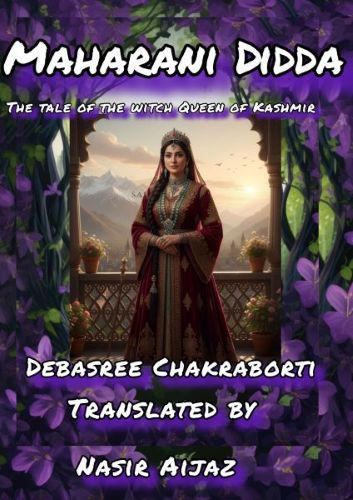
Maharani Didda: Witch Queen of Kashmir
By Debasree Chakraborti
 All around were snow-covered mountains, and in the middle lay paddy fields. Today the sky was overcast, but the wind was much stronger than on other days. The cold air rippled over the golden paddy, creating a soft, rustling melody.
Within a day or two the snowfall would begin, so the harvesting had already started. On one side of the field, farmers were cutting paddy when suddenly something seemed to enter the field from the direction of the forest, rushing rapidly through the middle of the field.
The farmers thought that perhaps some dangerous creature from the forest had entered the fields. Such things happened now and then; from its speed, they suspected it might be a cheetah. A few days earlier, a leopard had dragged away a boy from the village into the forest. The boy had taken his flock of sheep towards the hills. Later, parts of his body were found. As the farmers were preparing to return to the village, something else entered the field at great speed from the direction of the forest. Seeing this, the farmers dropped their harvested paddy and ran towards the village. Meanwhile, the sky grew dark with clouds, and along with the cold wave, a fine snowfall began. Gradually, nature started taking on a mysterious white, pristine form.
At such a moment, a voice came from within the field: “Princess, the snowfall has begun. This is not the time for childishness. Please come out quickly.”
Bhalaga stood up in the middle of the field, holding his staff, and looked up at the sky. Fine snowflakes covered his entire body. Then, gathering all his strength, he shouted: “Princess!”
For a while everything around fell silent, except for the whistling of the fierce wind.
 Bhalaga felt anxious. The way Didda was undergoing military training under him was not something an ordinary person could endure; there was a risk of injuring her body. What if something had happened? As these thoughts raced through his mind, suddenly it felt as if an earthquake had struck around him. Valaga saw the paddy plants around him lying flat on the ground in a circular pattern. He stood at the center of the circle, and some distance away stood Didda with a staff in her hand. Sixteen-year-old Didda was learning from Bhalaga the technique of fighting an enemy from concealment.
Bhalaga said, “Princess, a terrible storm is approaching. Come, we must take shelter in my hut.”
In one corner of Bhalaga’s hut there was a place for lighting a fire, and on the floor lay a soft bedding—made only for sitting near the warmth of the flames. Didda and Bhalaga sat there eating and drinking while outside the snowfall turned fierce. In such a situation, returning to the palace was impossible. So that night Princess Didda had to stay in Bhalaga’s humble dwelling. She had spent many such nights in this hut—despite being a princess, she was spending the night in the home of an ordinary guard. The king and queen, however, had no concern about this.
By now, Bhalaga had become a part of Didda’s daily life. He had nurtured her with his own arms, raising her with care. In that sense, Bhalaga was both a mother to her and a dear friend. He had taught Didda many mysterious and secret forms of training.
As Didda sipped from her food bowl, her eyes wandered to the other side of the room, where Bhalaga’s pet rooster, hen, and their newborn chicks were resting. The rooster’s shadow stretched long across the wall, and the hen lay in deep sleep on the soft bedding, her chicks nestled warmly beneath her wings. After observing them for a long time, Didda said to Bhalaga,
“The little ones are growing up so happily under their mother’s affection. The father too seems extremely dutiful.”
Bhalaga had raised Didda with his own hands; he knew her psychology better than anyone. Indifference and sarcasm had become her habitual nature. Yet, through all of this, he continued guiding her on the path toward becoming a complete warrior woman. So he changed the topic and said,
“Princess, listen carefully to what I’m about to tell you. This knowledge I received from my father.”
“From your father? Bhalaga, where did your father acquire such knowledge?”
“Princess, my father had joined the armies of many kingdoms outside the land of Kashyapa to earn a livelihood. Once he went to Rebantara, where many small kingdoms existed. While he was serving in the army of one such king, he formed a bond with the indigenous tribes of that region. The land was surrounded by rugged mountains and dense forests. My father was fond of traveling, so he took his horse deep into the jungle. Once inside, he sensed that someone was following him from tree to tree with incredible speed. At first he thought it was a monkey, but the trees on both sides of the path…”When spears suddenly shot down from the treetops and embedded themselves into the ground around him, forming a circle, he understood that it was the work of humans. He had been captured by a group skilled in a highly advanced form of warfare—one that allowed warriors to attack enemies while remaining hidden.
Listening intently, Didda said eagerly, “But Bhalaga, attacking an enemy from hiding is unjust.”
“The boundary between justice and injustice no longer exists,” Bhalaga replied. “To protect oneself and one’s people, whichever path must be taken—that alone is truth and righteousness. Everything else is false.”
“All right,” Didda asked, “then what did your father do?”
 “My father was extremely intelligent and friendly,” said Bhalaga. “He had to travel to many kingdoms to earn his livelihood. While trapped, he quickly used physical gestures to communicate a message of friendship. After that, he lived among them for some time, and even after being released, he continued visiting the tribal region. Over time, he mastered their secret battle techniques.”
Setting her bowl aside, Didda said, “Bhalaga, you have already taught me the techniques of fighting while hiding in the forest or in the fields. Now teach me the art of fighting from the treetops.”
“Princess, you will have to leap from one tree to another at incredible speed. Though extremely difficult, it will be nothing for you. Moreover, I will also teach you how to fight stealthily even on flat lands, where there are no forests or mountains. Among all the kings who have risen in the land of Kashyapa, you will surpass them with your war skills. Blur out everything around you—the environment, the situation—and focus only on me. You will see that one day you will become the controller of time itself.”
Didda held her weakened leg firmly and said, “Bhalaga, I must turn this into my greatest strength. Whatever weakness…” “With mental strength I must conquer it,” Didda said, “only then will I become unstoppable.”
To lighten the atmosphere, Bhalaga said, “Yes—and to do that, you must take your eyes off the rooster and hen’s family and look at the snowfall.”
Didda burst into laughter.
“Bhalaga, if the enemy attacks on a night of fierce snowfall, then teach me how to fight while wrapped in a blanket of snow. Come, let nature be our guide.”
Bhalaga too laughed and embraced Didda warmly.
In that moment, these two women—separated from society and the world—had only one identity: guru and disciple, mother and daughter, or two dear friends. No social definition could ever bind the depth of their bond. (Continues)
Click here for Part-1, Part-2, Part-3, Part-4, Part-5, Part-6, Part-7,
________________________
 Debasree Chakraborti is a renowned novel writer of Bengali language. Based in Kolkata, West Bengal, India, she has done Master’s in Modern History from the Kolkata University, and authored some thirty books, mostly the novels, with historical perspective and themes. Her novel is ‘Maharaja Dahir’ that covers the history of Sindh from 662, the year of first attack on Sindh by the Arab armies till date, was published last year and translated by Nasir Aijaz into Sindhi language.